1.5 - Chemical Formulae
Chemical symbols and formulae
- Every element has its own chemical symbol - a shorthand of one or two letters standing for one atom of that element.
- The first letter is always a capital and the second is lower case: Co is cobalt, but CO is carbon monoxide (one carbon atom joined to one oxygen atom).
- Most symbols come from the element's English name (e.g. H for hydrogen, C for carbon, Ca for calcium).
- Some come from older Latin names:
- Na (sodium), K (potassium), Fe (iron), Cu (copper), Pb (lead)
Diatomic elements
- Seven elements exist as molecules of two atoms joined together and are described as diatomic:
- Hydrogen (H2), nitrogen (N2), oxygen (O2), fluorine (F2), chlorine (Cl2), bromine (Br2), iodine (I2)
- Oxygen gas is always written O2, never O. It's still an element because it contains only one type of atom.
Reading a formula
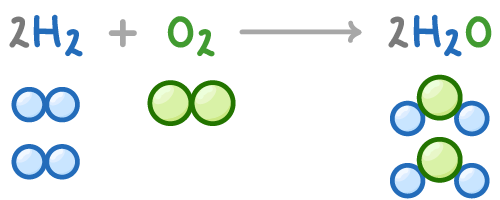
- A chemical formula shows which elements a substance contains, and how many atoms of each.
- Numbers are written as subscripts and apply only to the symbol immediately in front of them (a symbol with no subscript means one atom):
- H2O = two hydrogen atoms, one oxygen atom
- CO2 = one carbon atom, two oxygen atoms
- H2SO4 = two hydrogen atoms, one sulfur atom, four oxygen atoms (seven atoms in total)
- For a substance made of separate molecules, this is called the molecular formula.
Brackets in formulae
Brackets are used when a group of atoms is repeated. The subscript after the bracket multiplies everything inside it:
- Ca(OH)2 = one calcium, two oxygen, two hydrogen atoms
- Mg(NO3)2 = one magnesium, two nitrogen, six oxygen atoms
Formulas from diagrams
- In a molecular diagram, each circle represents an atom, identified by a key.
- You can write the formula by counting the atoms of each element:
- In a molecular substance, the formula describes one molecule.
- In a giant network, the formula gives the simplest whole-number ratio of the atoms or ions.
Writing the formula of a compound
- An ionic compound is made of positively charged ions and negatively charged ions, and has no overall charge.
- The ions combine in whatever ratio makes the positive and negative charges cancel exactly.
Common ion charges
| Charge | Ions |
|---|---|
| 1+ | sodium Na+, potassium K+, lithium Li+, silver Ag+, hydrogen H+, ammonium NH4+ |
| 2+ | magnesium Mg2+, calcium Ca2+, zinc Zn2+, copper(II) Cu2+, iron(II) Fe2+, lead(II) Pb2+ |
| 3+ | aluminium Al3+, iron(III) Fe3+ |
| 1− | chloride Cl-, bromide Br-, iodide I-, hydroxide OH-, nitrate NO3- |
| 2− | oxide O2-, sulfide S2-, carbonate CO32-, sulfate SO42- |
Hydroxide, nitrate, carbonate, sulfate and ammonium are group ions made of several atoms held together as a unit with an overall charge. Their formulae are never broken up.
Building a formula
- Write the ions with their charges.
- Work out the ratio of ions needed so the total positive and negative charges cancel out.
- Write the formula using subscripts for the numbers of ions (omitting the number 1).
Examples:
- Sodium chloride - One Na+ cancels one Cl-, giving NaCl.
- Magnesium chloride - Two Cl- ions cancel one Mg2+, giving MgCl2.
- Magnesium oxide - One Mg2+ cancels one O2-, giving MgO.
Where more than one group ion is needed, put it in brackets:
- Calcium nitrate - Ca2+ and NO3- gives Ca(NO3)2.
- Ammonium sulfate - NH4+ and SO42- gives (NH4)2SO4.
The charges never appear in the finished chemical formula.
TermDefinition
Chemical symbol
Diatomic molecule
Chemical formula
Group ion