2.11 - Formation of Ions
How an atom becomes an ion, and its charge
- An ion is a charged particle. It can be:
- A single atom that has gained or lost electrons (e.g. a chloride ion), or
- A group of atoms bonded together carrying an overall charge (e.g. a hydroxide ion).
- Atoms form ions to get a full outer shell of electrons - the stable arrangement a noble gas already has.
- An atom with an incomplete outer shell reaches this by losing or gaining electrons. It then has more protons than electrons (or more electrons than protons), so it carries a charge.
Metals lose, non-metals gain
- Metal atoms lose outer-shell electrons to form positive ions - called cations.
- Non-metal atoms gain electrons into their outer shell to form negative ions - called anions.
- The size of the charge is set by how many electrons move: lose three electrons and the charge is 3+; gain three and the charge is 3−.
Reading the charge off the periodic table
Every element in a group has the same number of outer electrons, so it loses or gains the same number to reach a full shell - making the charge predictable.
| Group | What happens | Charge | Example |
|---|---|---|---|
| 1 | Loses 1 electron | 1+ | Sodium forms Na+ |
| 2 | Loses 2 electrons | 2+ | Magnesium forms Mg2+ |
| 3 | Loses 3 electrons | 3+ | Aluminium forms Al3+ |
| 5 | Gains 3 electrons | 3− | Nitrogen forms N3- |
| 6 | Gains 2 electrons | 2− | Oxygen forms O2- |
| 7 | Gains 1 electron | 1− | Chlorine forms Cl- |
| 0 | Outer shell already full | None | Neon and argon do not form ions |
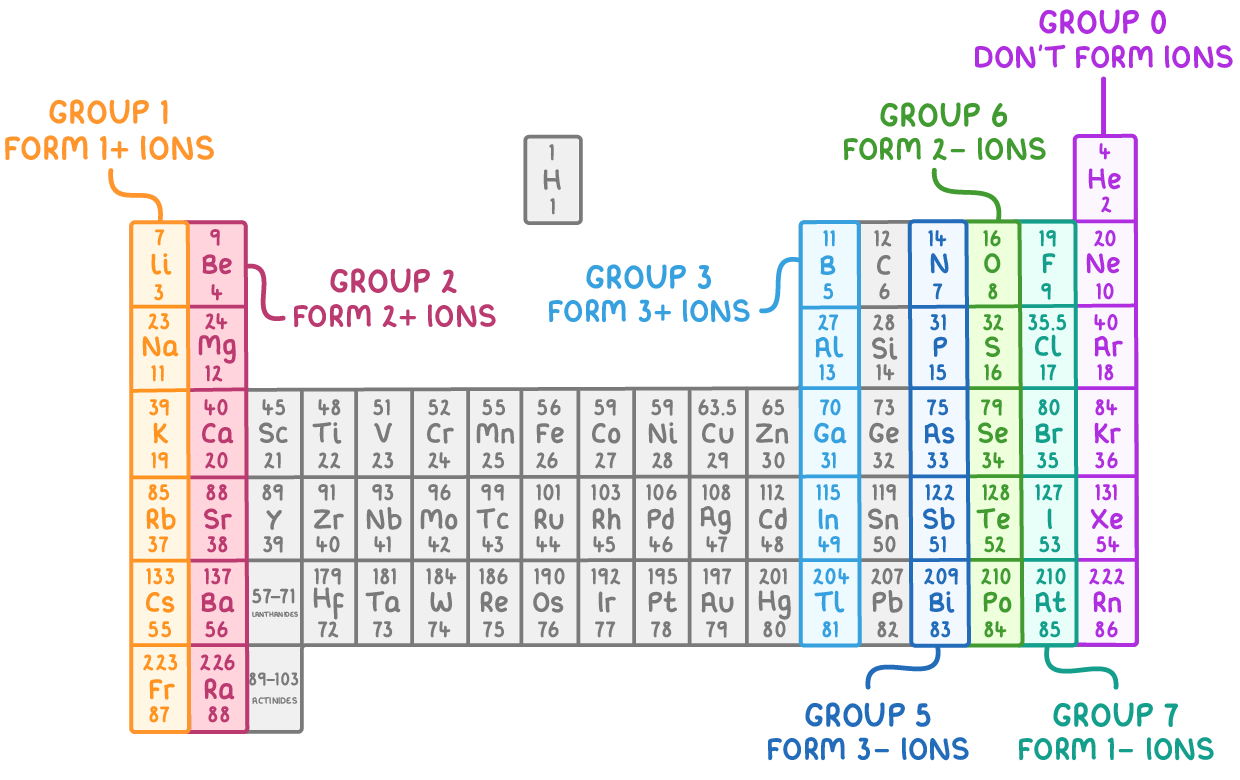
The electronic configuration of an ion
- To work out an ion's electronic configuration from its atom:
- Write out the atom's electron arrangement.
- Add or remove electrons from the outer shell to match the ion's charge.
- For elements in Groups 1, 2, 3, 5, 6 and 7, the ion ends up with the electron arrangement of the nearest noble gas. Transition metal ions such as Fe2+, below, do not follow this rule.
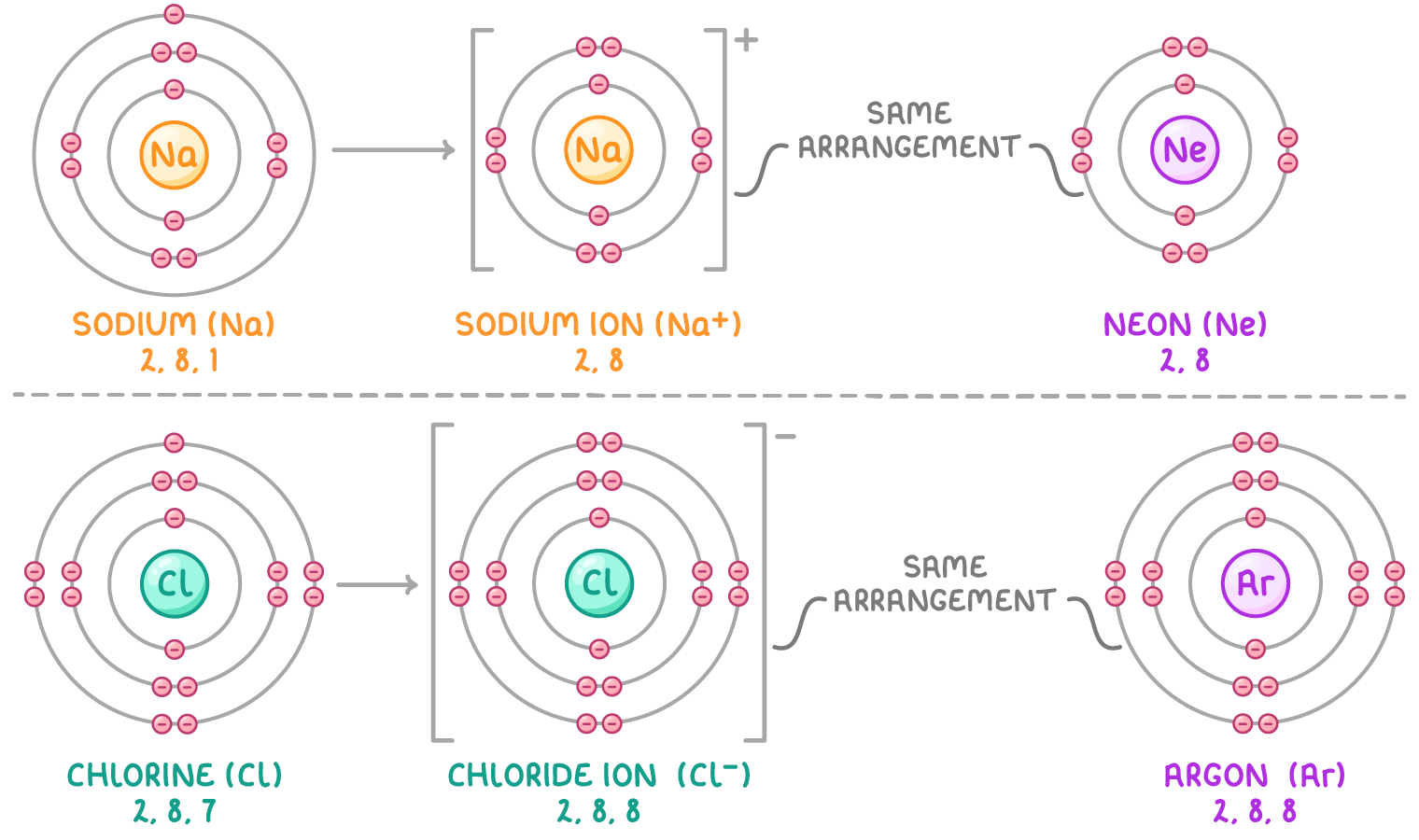
Worked examples of ion configurations
- Na (2,8,1) loses 1 electron → Na+ (2,8) - same as neon.
- Cl (2,8,7) gains 1 electron → Cl- (2,8,8) - same as argon.
- Mg (2,8,2) loses 2 electrons → Mg2+ (2,8).
- O (2,6) gains 2 electrons → O2- (2,8).
Using the numbers alone
- You can find the number of particles without drawing shells:
- Protons are unchanged from the atom, so they equal the atomic number.
- Electrons = atomic number adjusted by the charge - subtract the charge for a positive ion, add it for a negative ion.
- Fluorine has atomic number 9 (9 protons); F- has one more electron = 10 electrons.
- Iron has atomic number 26 (26 protons); Fe2+ has two fewer electrons = 24 electrons.
Worked example - Configuration of an ion
Finding an ion's electronic configuration follows three steps.
Step 1 - Write the atom's arrangement
Lithium's atom has the arrangement 2,1.
Step 2 - Find the change from the charge
Lithium is a Group 1 metal, so it loses its one outer electron, forming Li+.
Step 3 - Apply the change
Removing that electron leaves 2 - a full first shell, the same arrangement as helium.
Applying the same steps to fluorine (arrangement 2,7): as a Group 7 non-metal it gains one electron to complete its outer shell, forming F- with the arrangement 2,8 - the same as neon.
Each ion reaches whichever noble gas is nearest to it in the periodic table.
TermDefinition
IonA charged particle formed when an atom or a group of atoms loses or gains electrons.
CationA positively charged ion, which moves towards the cathode during electrolysis.
AnionA negatively charged ion, which moves towards the anode during electrolysis.
Key points to remember
How were these notes?