7.5 - Acid-Alkali Titration
The technique
Aim
To find the volume of dilute acid that exactly neutralises a measured volume of dilute alkali, using an indicator to judge the exact point of neutralisation.
Background
- An acid and an alkali react to make a salt and water, which is neutralisation.
- A titration measures the volume of one solution that reacts exactly with a measured volume of another.
- You can't see the moment the acid and alkali have exactly reacted, but an indicator changes colour at that point, the end point.
- So in this practical you pipette a fixed volume of alkali into a flask, and add acid from a burette until the indicator changes colour.
Method
- Fill the burette - Rinse it with deionised water and then with a little of the acid. Fill it above the zero mark using a small funnel, then remove the funnel so it can't drip in extra acid.
- Clear the jet - Run a little acid through, so the jet holds acid rather than an air bubble. Record the starting reading to the nearest 0.05 cm3, with your eye level with the bottom of the meniscus.
- Pipette the alkali - Rinse a volumetric pipette in the same way, using the alkali, then use a pipette filler to measure 25.0 cm3 of alkali into a conical flask.
- Add the indicator - Add two or three drops of methyl orange or phenolphthalein, and stand the flask on a white tile.
- Do a rough titration - Run acid in, swirling the flask, until the indicator changes colour. This rough titre shows where the end point is, and isn't used in the calculation.
- Do accurate titrations - With fresh alkali, run the acid in quickly to within about 2 cm3 of the rough titre, then drop by drop, swirling, until the colour just changes. The titre is the final reading minus the starting reading.
- Repeat until the titres are concordant - Keep going until two or more titres agree to within 0.10 cm3.
Safety
- Eye protection - Dilute acids and alkalis are irritants and can splash, so wash any off your skin at once.
- Pipettes and burettes - Fill a pipette with a pipette filler, never by mouth, and fill the burette below eye level. Both are thin glass that breaks easily.
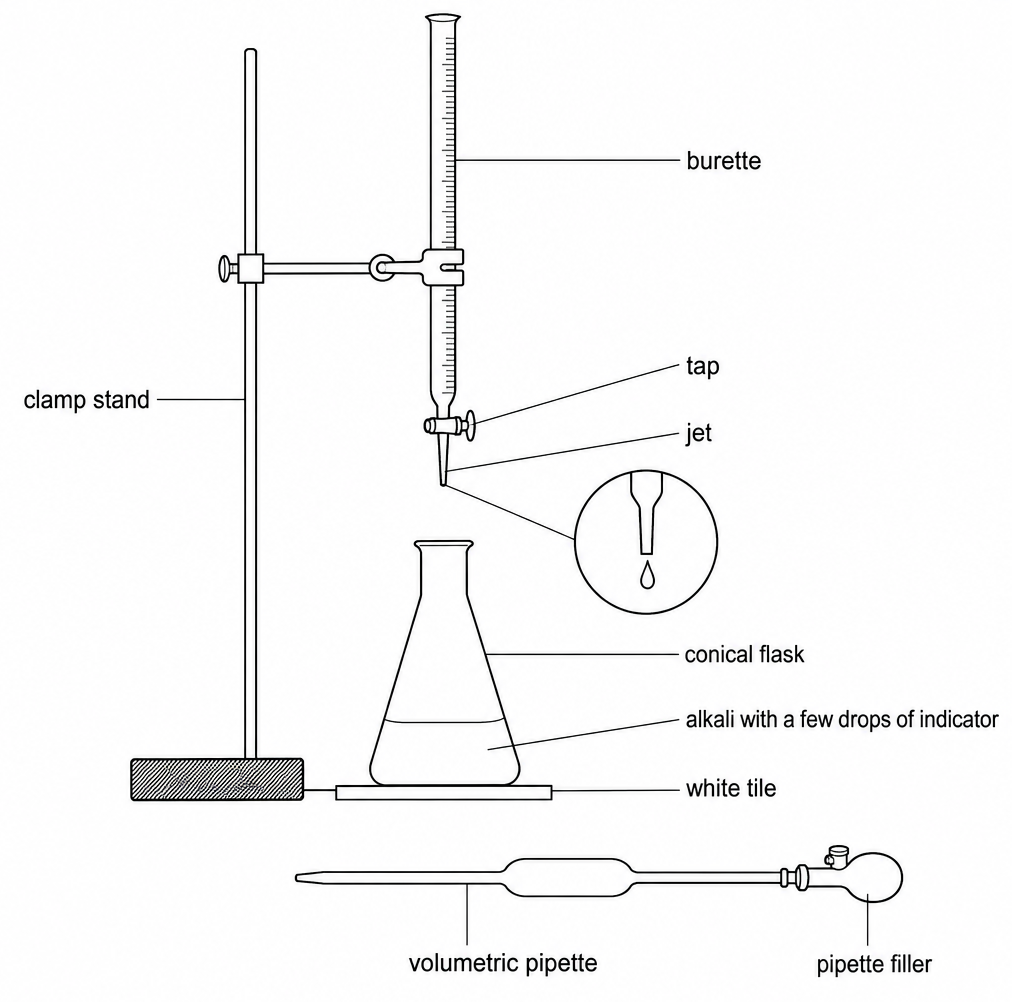
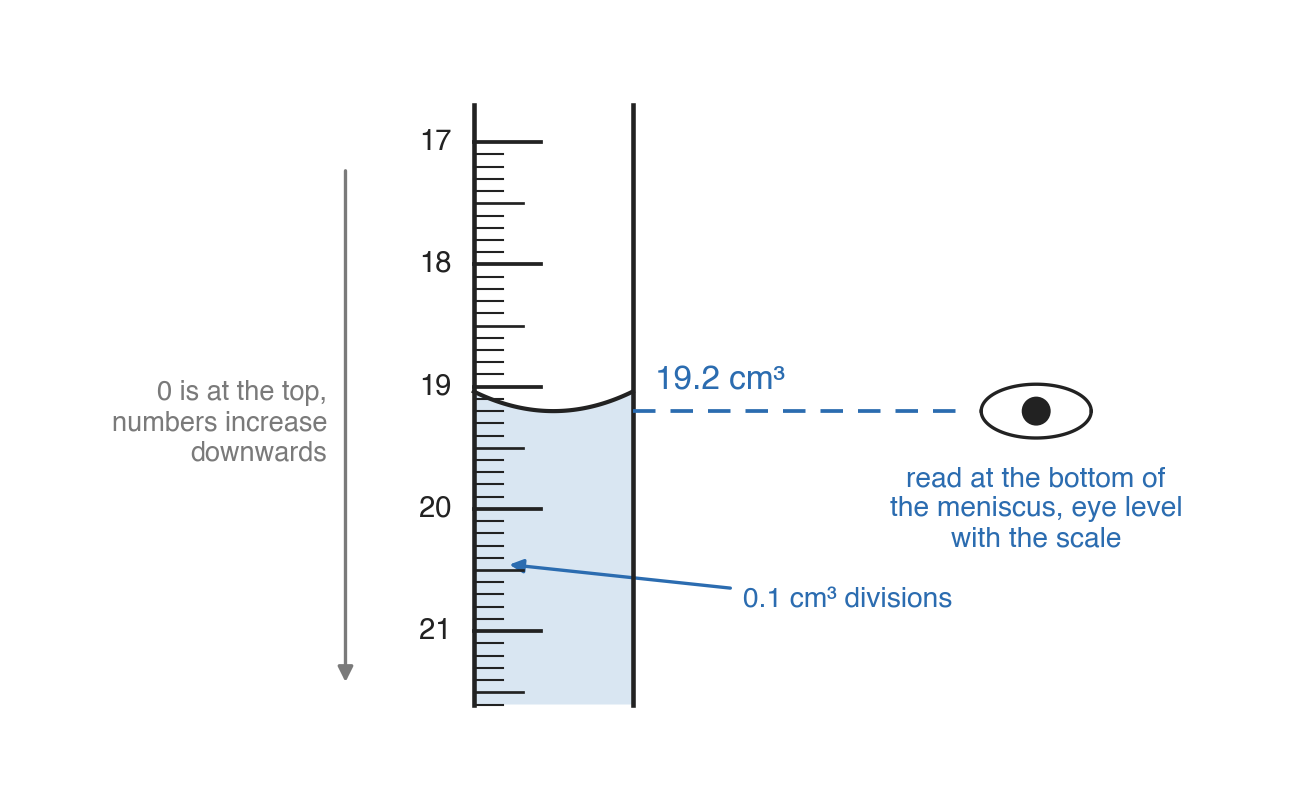
The burette is numbered downwards in 0.1 cm3 divisions, read here as 19.2 cm3.
Common exam questions
Question 1
Why is a pipette used to measure the alkali, and a burette used for the acid?
A pipette delivers one fixed, accurately known volume, so the amount of alkali is the same in every repeat. A burette delivers any volume, a drop at a time, which is what the titration is finding.
Question 2
Why is the burette rinsed with the acid, and the pipette with the alkali, rather than just with water?
Water left inside would dilute the solution. Diluted acid in the burette makes the titre too high, and diluted alkali in the pipette makes it too low. Rinsing with the solution itself leaves only that solution behind.
Question 3
Why is the acid added drop by drop as the end point is approached?
A single drop can change the colour at the end point. Adding acid any faster risks going past the end point, which makes the titre too high.
Question 4
Why is universal indicator not suitable for a titration?
It changes gradually through a range of colours, so there's no single volume at which the colour changes. A titration needs an indicator that changes sharply from one colour to another.
Question 5
What colour change would you see using methyl orange, and using phenolphthalein, as acid is added to an alkali?
Methyl orange changes from yellow in the alkali to red in the acid, and is orange at the end point. Phenolphthalein changes from pink in the alkali to colourless.