7.8 - Rate of Reaction by Gas Collection or Mass Loss
The experiment
Aim
To find out how the concentration of an acid, or the surface area of a solid, affects the rate of their reaction, by measuring how quickly a gas is produced.
Background
- Reactions happen when particles collide with enough energy. The more often they collide, the faster the reaction.
- The reaction is usually magnesium ribbon (giving hydrogen) or marble chips (giving carbon dioxide) in dilute hydrochloric acid.
- You can't see the rate directly, but you can measure how much gas is given off at set times.
- So in this practical you measure the volume of gas, or the mass lost as it escapes, at different concentrations or surface areas. The faster the gas is produced, the faster the rate of reaction.
Variables
- Independent variable - The concentration of the hydrochloric acid, or the size of the pieces of solid.
- Dependent variable - The volume of gas produced, or the loss in mass, at set times.
- Control variables - The volume of acid, the mass of solid, the temperature, and whichever of concentration and surface area isn't being changed.
Method
- Measure the acid - Pour 50 cm3 of dilute hydrochloric acid into a conical flask with a measuring cylinder.
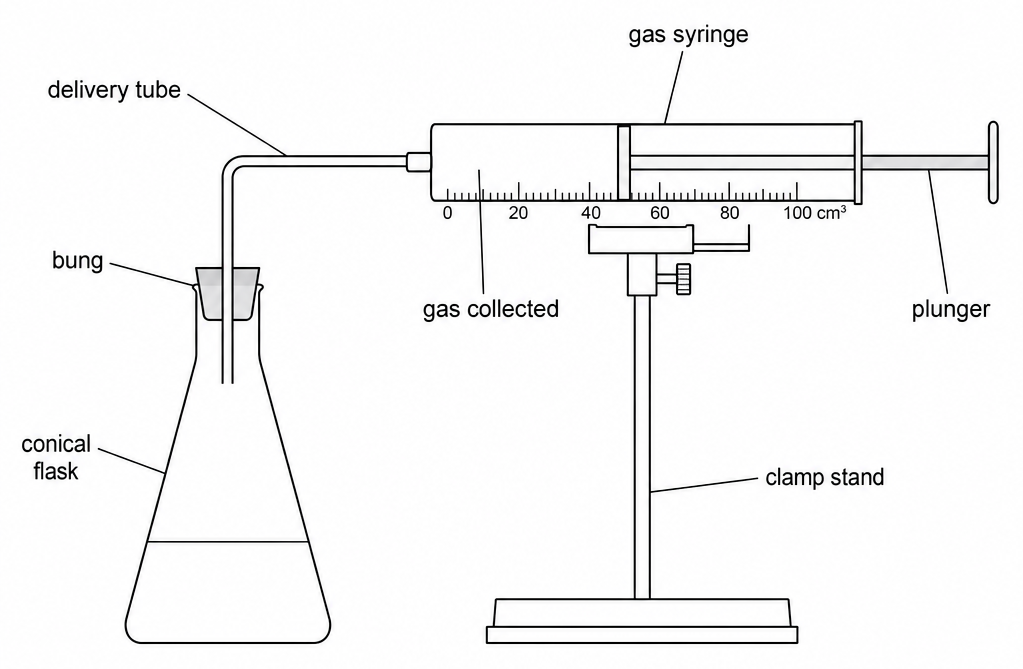
- Set up the gas collection - Connect a gas syringe to the flask with a bung and delivery tube, and check it reads zero. Or use a measuring cylinder full of water, upturned in a trough.
- Add the solid - Add a 3 cm strip of magnesium ribbon or a weighed mass of marble chips, push the bung in at once, and start the stopclock.
- Record the volume - Read it every 10 seconds until it stops changing.
- Change the concentration - Repeat with the acid diluted with water, keeping the total volume at 50 cm3.
- Or change the surface area - Repeat with the same mass of marble in smaller pieces, then as powder.
- Repeat each run - Do each run three times, so a mean can be found.
- Or measure the loss in mass - For marble chips, stand the flask of acid on a balance, add the chips, plug the neck loosely with cotton wool, and record the mass every 10 seconds.
Safety
- Eye protection - The acid is an irritant and can spit, and crushed marble chips can fly up.
- No naked flames - The hydrogen from magnesium is extremely flammable.
- Gas syringe - A fast reaction can push the plunger out, so use a large syringe and never point it at anyone.
Worked example - Rate from a gas volume graph
A student added a 3 cm strip of magnesium ribbon to 50 cm3 of excess dilute hydrochloric acid, fitted the bung, and read the volume of hydrogen every 10 seconds.
| Time in s | 0 | 10 | 20 | 30 | 40 | 50 | 60 | 70 |
|---|---|---|---|---|---|---|---|---|
| Volume of hydrogen in cm3 | 0 | 18 | 30 | 38 | 43 | 46 | 48 | 48 |
Find the mean rate for the whole reaction and the rate at 20 s, and explain the shape of the curve.
Step 1 - Plot the graph
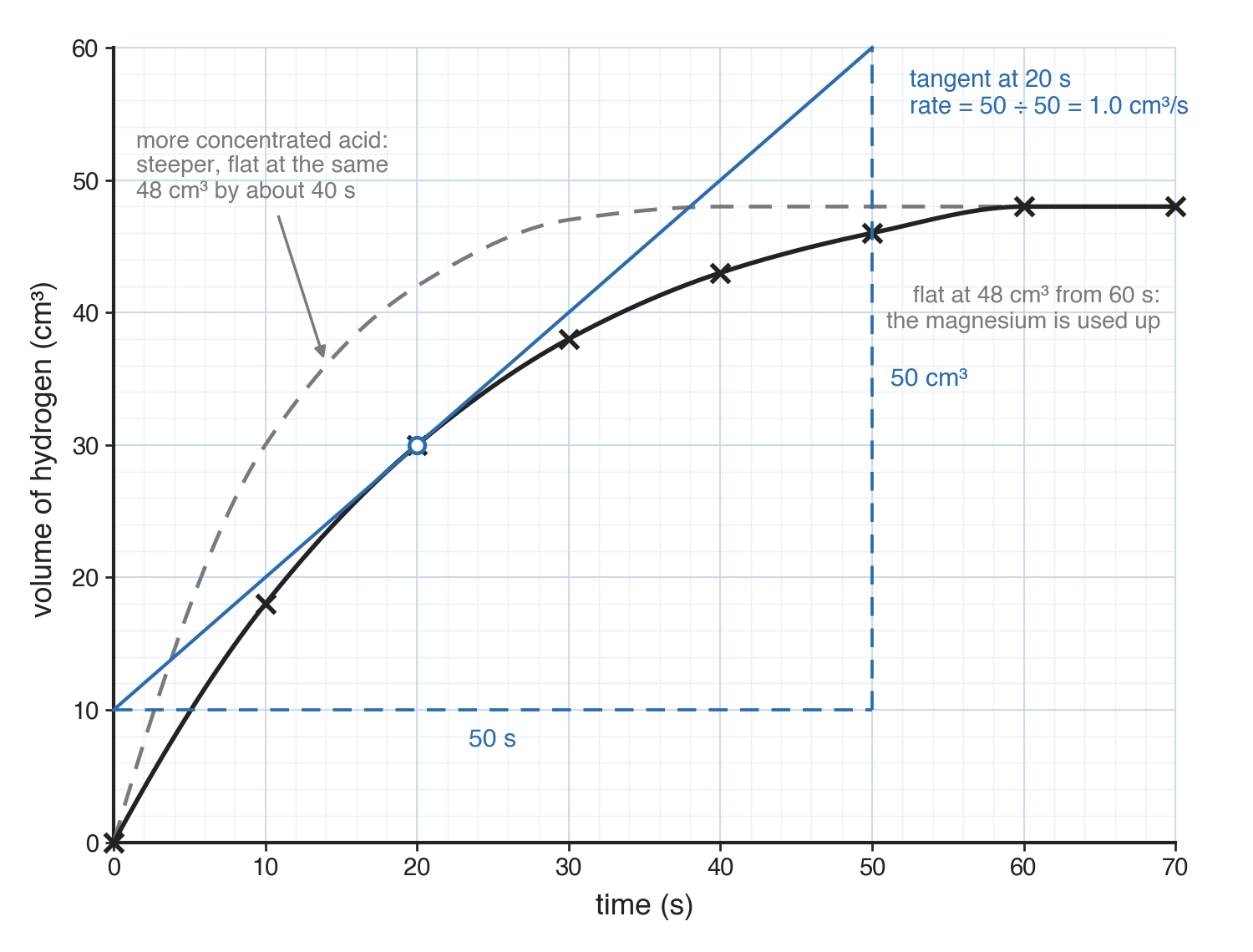
Plot the volume of hydrogen against time, and draw a smooth curve of best fit from the origin that runs flat along 48 cm3 from 60 s.
Step 2 - Find when the reaction finished
The volume stops changing at 60 s, so the reaction finished then.
Step 3 - Find the mean rate for the whole reaction
Divide the total volume of gas by the time the reaction took.
Mean rate = 48 ÷ 60 = 0.8 cm3/s
Step 4 - Find the rate at 20 s from a tangent (Higher tier)
Draw a straight line that touches the curve only at (20 s, 30 cm3). It passes through (0 s, 10 cm3) and (50 s, 60 cm3), so its gradient is the rate at 20 s.
A tangent is drawn by eye, so answers close to this are accepted.
Step 5 - Explain the shape of the curve
- The curve is steepest at the start, when the acid is most concentrated and collisions are most frequent.
- It flattens as the reactants are used up and collisions become less frequent.
- It goes flat at 60 s, because the magnesium has all been used up.
- More concentrated acid would give a steeper curve that goes flat sooner at the same 48 cm3, because the amount of magnesium is the same.
Common exam questions
Question 1
Why is a gas syringe better than a measuring cylinder upturned over water for collecting carbon dioxide?
Carbon dioxide dissolves slightly in water, so a volume collected over water is too small.
Question 2
Why is the volume collected in the first few seconds often lower than expected?
The reaction starts the moment the solid touches the acid, so some gas escapes before the bung is in and isn't measured.
Question 3
A student uses smaller marble chips of the same mass. What happens to the rate, and why?
It increases. Smaller pieces have a larger surface area, so more of the solid is exposed to the acid and collisions are more frequent.
Question 4
Why is cotton wool put in the neck of the flask for the loss in mass method, and why isn't that method used for magnesium?
The cotton wool lets gas out but stops acid spray escaping and counting as lost mass. Hydrogen is so light that the mass lost with magnesium is too small for a school balance to show.
Question 5
What are the units of rate for each method?
cm3/s when a volume of gas is measured, and g/s when a loss in mass is measured.