3.10 - Fractional Distillation of Crude Oil
What crude oil is, and why it matters
- Crude oil (or petroleum) is a mixture of a very large number of different compounds.
- Almost all of them are hydrocarbons - molecules made of hydrogen and carbon atoms only.
- Most of these are alkanes - hydrocarbons where every carbon-to-carbon bond is a single bond. The carbon atoms are joined in chains or rings.
How crude oil formed
- It formed underground over millions of years.
- The remains of simple marine organisms (mostly plankton) were buried in mud.
- High temperatures and high pressures slowly turned that biomass into oil.
- The oil soaked into the surrounding rock and is drilled out of those rocks today.

A finite, non-renewable resource
- The three fossil fuels are coal, natural gas (mostly methane), and crude oil.
- All three are non-renewable: they form so slowly that they're being used up far faster than they're replaced.
- Crude oil is finite - there's a fixed amount and one day it will run out.
Why crude oil matters
Crude oil is separated into simpler, more useful mixtures, which are used as:
- Fuels - Supplying most transport energy and much of the energy for heating and electricity.
- Petrochemical feedstock - Raw materials for making other chemicals, including solvents, lubricants, polymers, and detergents.
Separating crude oil into fractions
- Crude oil is separated into simpler mixtures called fractions.
- Each fraction contains molecules with a similar number of carbon atoms, which means they have similar boiling points.
- The process is fractional distillation, carried out continuously in a fractionating column.
How fractional distillation works
- Crude oil is heated in a furnace until most of it turns to vapour. The vapour is fed into the bottom of the column, and any unvaporised liquid is drained off.
- The column is hot at the bottom and gets steadily cooler towards the top.
- The vapour rises. When a group of molecules reaches a level where the temperature is below their boiling range, they condense to a liquid and are drained off. Bubble caps let rising vapour through while stopping condensed liquid running back down.
- Long chains have high boiling points, so they condense early and drain out low down. Short chains have low boiling points, so they stay as vapour and drain out near the cool top. The shortest molecules never condense and leave the top as a gas.
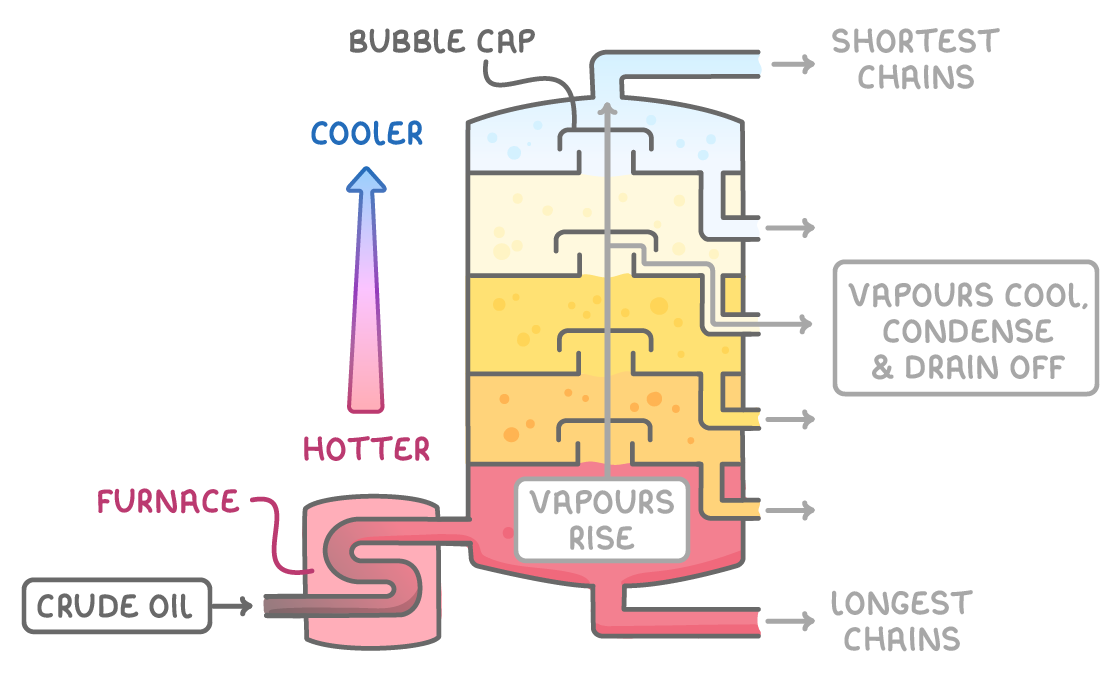
Why the fractions separate where they do
- Two kinds of attraction are at work:
- Covalent bonds - Strong bonds holding the atoms inside each molecule together.
- Intermolecular forces - Much weaker forces between molecules.
- Heating gives molecules enough energy to overcome the intermolecular forces between them and turn into a gas. The covalent bonds do not break at these temperatures, so molecules pass through intact.
- The bigger a molecule, the more intermolecular forces hold it to its neighbours, so more energy is needed to pull it free. This is why long molecules have higher boiling points than short ones.
TermDefinition
HydrocarbonA compound made of hydrogen and carbon atoms only.
AlkaneA hydrocarbon where every carbon-to-carbon bond is a single bond.
FractionA mixture of substances with similar boiling points that is collected together during fractional distillation. In crude oil, the molecules in a fraction have a similar number of carbon atoms.
Key points to remember
How were these notes?