4.5 - Ceramics, Polymers & Composites
Glass and clay ceramics
- A ceramic is a solid that is not a metal and is not built from carbon compounds, and has a high melting point.
- Ceramics are stiff, hard-wearing, brittle, and insulators of heat and electricity.
- They do not corrode or rot.
The two main types are glass and clay ceramics:
- Glass - Usually transparent, can be shaped while hot, and brittle when thin.
- Clay ceramics - Include pottery and bricks. A clay brick has a high compressive strength, so it can support heavy loads without breaking.
Composites
- A composite is made of one material embedded in another:
- The reinforcement - Fibres or fragments of the first material.
- The matrix (or binder) - A second material surrounding them and holding them in place.
- The combination has properties neither material has on its own, allowing composites to be designed for specific uses.
- Their main drawback is cost.
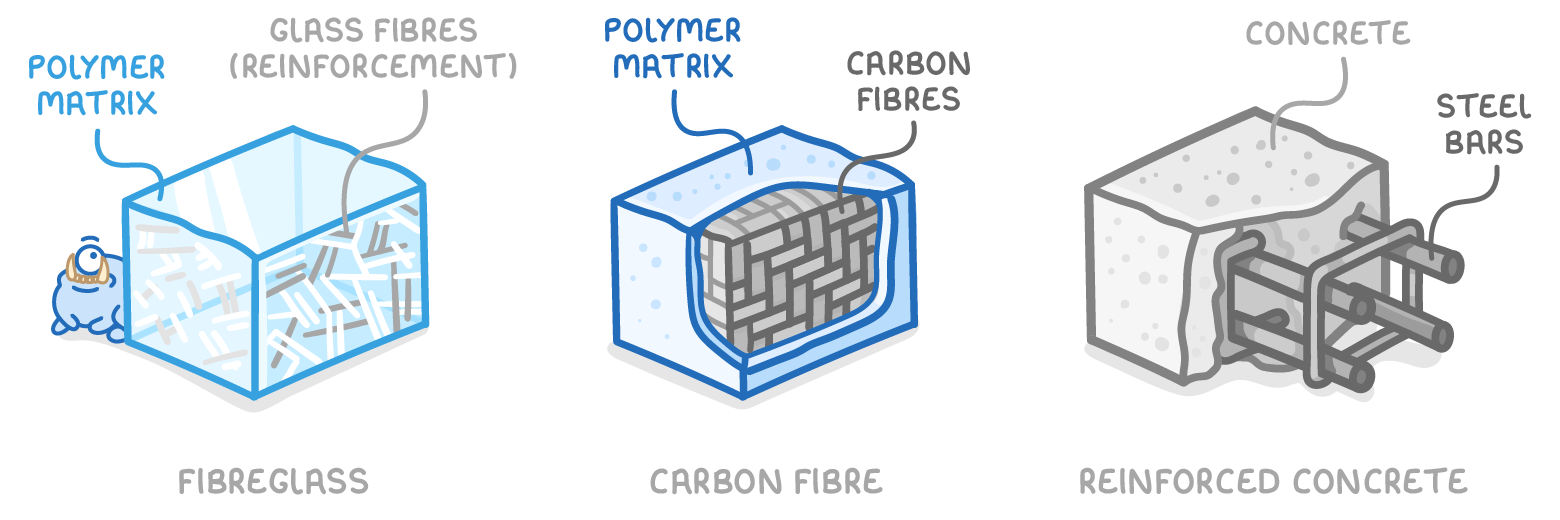
| Composite | Made of | Properties and uses |
|---|---|---|
| Fibreglass | Glass fibres in a polymer matrix | Low density and strong - boats, skis, surfboards |
| Carbon fibre | Carbon fibres in a polymer matrix | Very strong and light - aircraft and sports cars |
| Reinforced concrete | Steel bars set into concrete | Strong in both compression and tension - building construction |
What holds a polymer together
A polymer is a material made of very large molecules, each built from many small repeating units joined into a long chain by covalent bonds.
Bonds along and between the chains
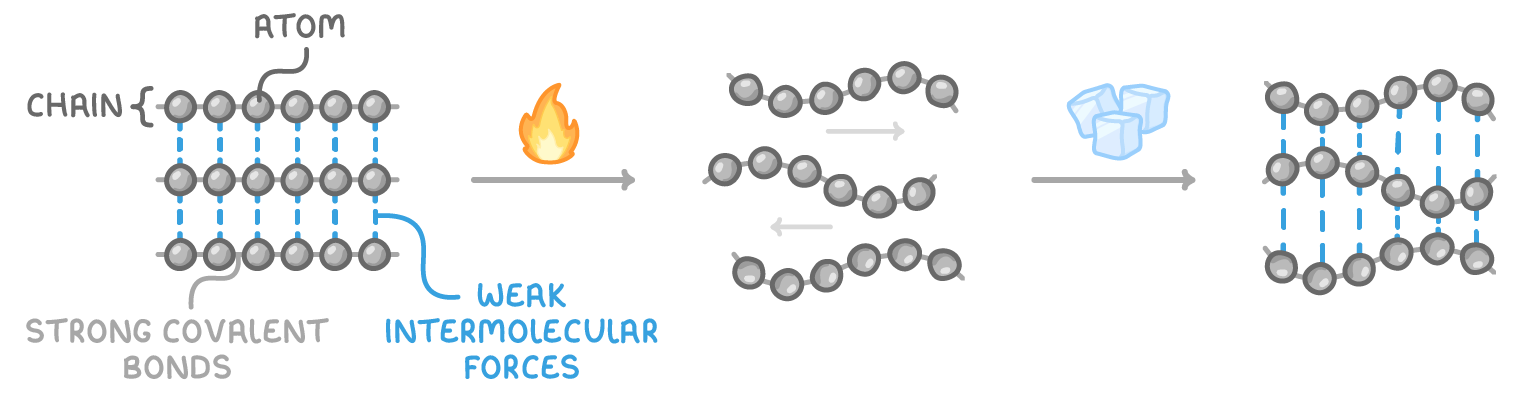
- Along a chain, atoms are held together by strong covalent bonds. These do not break when a polymer melts.
- Between chains, there are only weak intermolecular forces.
- Because the chains are so long, the large number of intermolecular forces adds up to a strong overall attraction. This is why almost all polymers are solids at room temperature.
- The total attraction is still weaker than the bonding in giant covalent or ionic structures, so polymers have lower melting points.
How the chains lie sets the properties
- Chains close together - More intermolecular forces between them, so the material is stiffer, harder, stronger, and has a higher melting point.
- Chains further apart - Chains slide over one another easily, so the material is flexible, softer, and melts at a lower temperature.
- Longer chains - Greater surface contact, leading to stronger total intermolecular forces.
Softening and cross-links
- Polymers soften over a range of temperatures before melting as chains gradually pull apart.
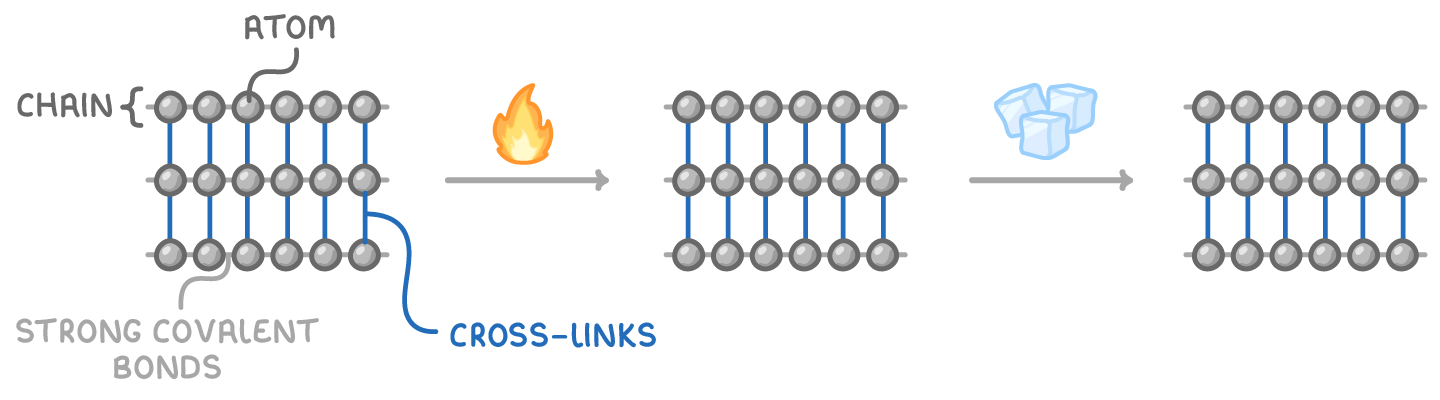
- Some polymers have cross-links - covalent bonds joining one chain directly to another:
- Without cross-links, separate chains slide past each other when heated, so the polymer softens and can be remoulded.
- With cross-links, chains cannot slide, making the polymer strong, hard, stiff, and resistant to melting when heated.
TermDefinition
CeramicA hard, non-metal solid with a high melting point that is not made from carbon compounds, such as glass or brick.
CompositeA material made of one material embedded in another, combining properties neither has on its own.
PolymerA very large molecule built from many small repeating units joined into long chains.
Cross-linkA covalent bond joining one polymer chain directly to another.
Key points to remember
How were these notes?