4.8 - Reuse & Recycling
Why we reduce, reuse and recycle
- Most manufactured goods come from raw materials taken from the Earth, which are in limited supply (finite), such as metal ores.
- Extracting raw materials is damaging and expensive:
- Uses large amounts of energy to extract and process them, mostly from burning fossil fuels.
- Damages the environment through quarrying and mining, which scar the landscape, destroy habitats, and produce waste.
Three ways to conserve raw materials
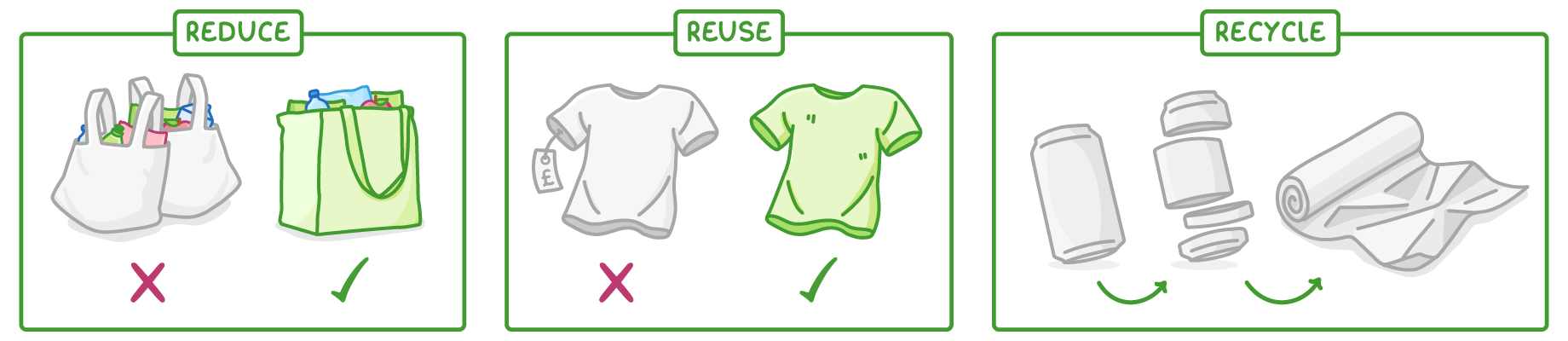
- Reducing - Using less of a material in the first place, saving raw resources, energy, and environmental damage.
- Reusing - Using a product again in its current form, requiring far less energy than recycling because it isn't broken down or reprocessed.
- Recycling - Breaking down a used product into its raw material to make something new.
All three approaches conserve finite resources, save energy, and reduce waste sent to landfill.
The economic case
- Processes that use less energy cost less to run, especially for materials that are expensive to extract.
- Recycling is an industry that creates jobs in collecting, sorting, and reprocessing waste.
- Recycling isn't always worth doing: the cost of collecting and reprocessing must be weighed against the cost of making the material from scratch.
What decides whether recycling is worth it
Whether a material is worth recycling is judged by weighing several factors:
- Finite deposits - Recycling is most urgent for materials derived from limited resources, such as metal ores and crude oil.
- Amount available - Enough material must be discarded and collected to make industrial-scale recycling practical.
- Collection and sorting costs - Separating mixed waste into pure materials takes time, money, and energy.
- Purity - Contaminated materials that can't easily be cleaned can't be recycled economically.
- Energy use - The energy used in transport and reprocessing must be less than the energy needed to extract and refine new material.
- Demand - There must be an end market for the recycled material.
- Environmental impact - The recycling process itself must produce less environmental harm than producing new material.
PET drinks bottles reused and recycled
- Drinks bottles are commonly made from a polymer called PET.
- Used bottles can be dealt with in two ways:
- Reuse - Used again without being broken down.
- Recycling - Broken down and processed into new products.
Reusing a PET bottle
- Bottles can simply be refilled.
- Filled with water and left in sunlight, they can disinfect water for drinking, as UV light passes through the plastic and kills pathogens.
- Reusing uses less energy than recycling, as the plastic doesn't need to be melted.
Recycling a PET bottle
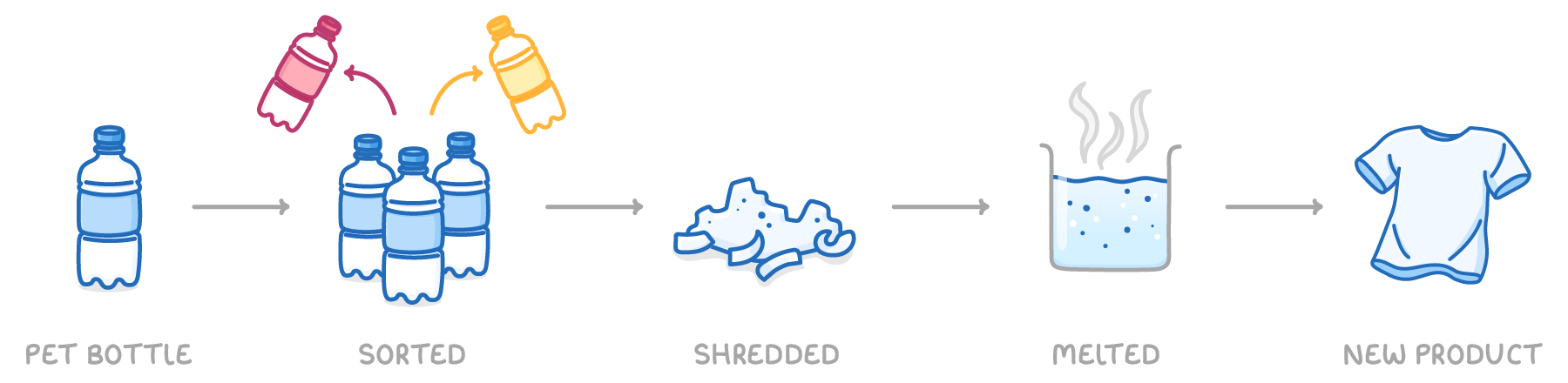
- Plastic waste is sorted to separate PET from other plastics.
- The PET is shredded into flakes and washed.
- The flakes are melted down and reformed into new products, such as clothing fibres or packaging.
Why recycling PET is worth it
- Saves energy - Making PET from scratch requires crude oil and extensive processing; recycling uses up to 75% less energy.
- Conserves crude oil - About 2.4 dm3 of crude oil is saved for every kilogram of PET recycled.
- Reduces landfill - Keeps bulky, non-biodegradable waste out of landfill sites.
TermDefinition
Reducing (waste)Using less of a material in the first place.
ReusingUsing a product again in its current form without breaking it down.
RecyclingBreaking down a used product into its raw materials to make something new.
Key points to remember
How were these notes?