7.4 - Preparing an Insoluble Salt by Precipitation
The technique
Aim
To make a pure, dry sample of an insoluble salt, lead(II) sulfate, by mixing two soluble solutions that between them supply its two ions.
Background
- An insoluble salt doesn't dissolve in water, so it can't be crystallised out of a solution the way a soluble salt is.
- It forms as a precipitate when two solutions that contain its ions are mixed. This is a precipitation reaction.
- All nitrates are soluble, and so are all sodium, potassium, and ammonium compounds. A nitrate is a reliable source of the metal ion, and a sodium, potassium, or ammonium compound is a reliable source of the negative ion.
- You can't start from the insoluble salt in solution, but you can start from two soluble compounds that between them supply its ions, such as barium chloride and magnesium sulfate for barium sulfate. The other two ions stay dissolved.
- So in this practical you mix lead(II) nitrate and magnesium sulfate solutions to precipitate lead(II) sulfate, then filter, wash, and dry it.
Method
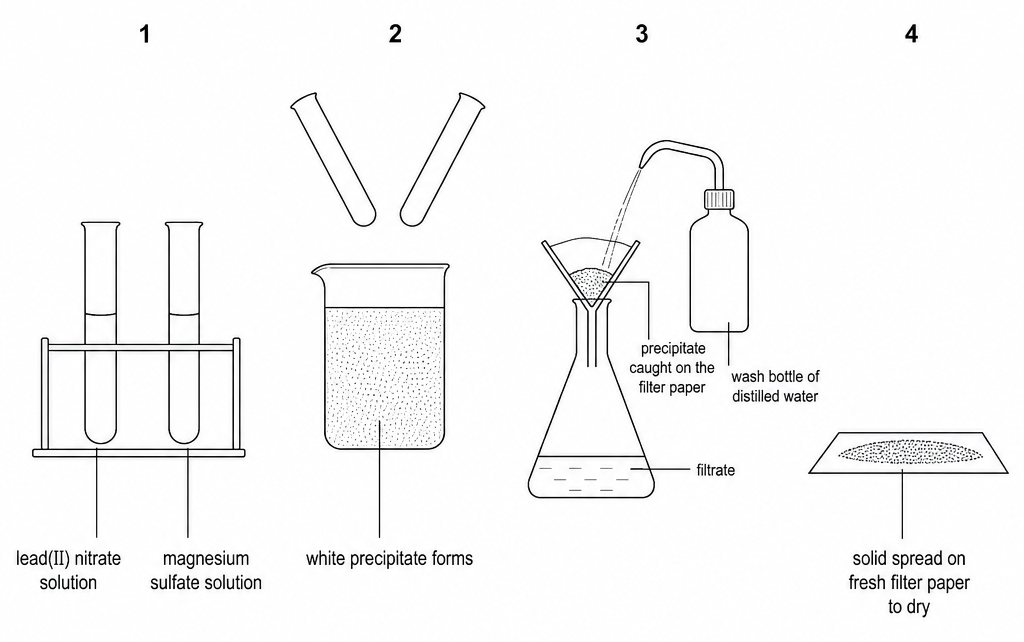
- Make the two solutions - Dissolve a spatula of lead(II) nitrate in distilled water in one test tube, and a spatula of magnesium sulfate or sodium sulfate in distilled water in another.
- Mix them - Pour both into a small beaker and stir. A white precipitate of lead(II) sulfate forms straight away.
- Filter - Pour the mixture through a filter funnel and paper into a conical flask, keeping the liquid below the rim of the paper.
- Rinse the beaker - Rinse it with a little distilled water and pour that through the filter too, so no product is left behind.
- Wash the precipitate - Pour more distilled water over the solid while it's still on the filter paper.
- Dry the solid - Scrape it onto a fresh piece of filter paper, so it doesn't soak up filtrate from the old one, and leave it to dry. A low-temperature oven or a desiccator also works.
Safety
- Eye protection - Wear it throughout.
- Lead compounds are toxic - Wash your hands after handling them, and never taste the product.
- Barium compounds are toxic too - Except barium sulfate, which is so insoluble that it passes through the body unabsorbed and is safe to use in medicine.
Common exam questions
Question 1
Why is distilled water used to dissolve the two solids, rather than tap water?
Tap water contains dissolved ions of its own, which could contaminate the product. Distilled water brings in no extra ions.
Question 2
Why is the precipitate washed on the filter paper before it's dried?
Washing rinses off the dissolved magnesium nitrate in the liquid clinging to the solid. If it were left, it would dry onto the solid and make the sample impure.
Question 3
Why can't one solution simply be added in excess, the way the solid is when making a soluble salt?
Both starting compounds are dissolved, so adding more of one just leaves more of it in the mixture. There's no way to filter off the excess, unlike a solid that never dissolved.
Question 4
Suggest a suitable way to dry the sample, and one way that would not be suitable.
Leaving it between filter paper, or in a low-temperature oven or a desiccator, is suitable. Strong direct heating isn't, because it risks scattering the fine solid or decomposing it, and removes the water no better.
Question 5
Write a word equation for making lead(II) sulfate from lead(II) nitrate and magnesium sulfate solutions.
Lead(II) nitrate + magnesium sulfate → lead(II) sulfate + magnesium nitrate
If state symbols are asked for, lead(II) sulfate is (s), because it's the precipitate, and the other three are (aq).