3.13 - Covalent Bonding
Covalent bonding
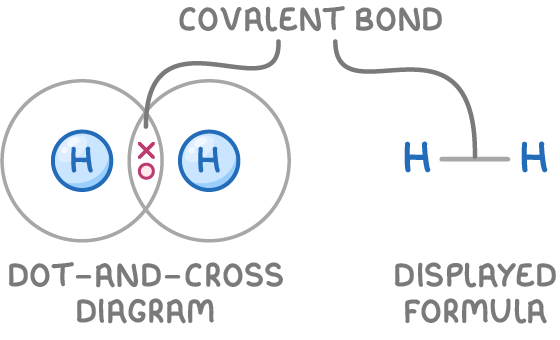
- A covalent bond forms when two non-metal atoms share a pair of electrons.
- The bond is held together by the strong electrostatic attraction between the shared pair of negatively charged electrons and the positively charged nuclei of the atoms.
- Atoms share electrons to gain a full outer shell (a stable noble-gas arrangement).
- Several non-metal elements exist as diatomic molecules (e.g. H2, N2, O2, Cl2).
Hydrogen (H2)
- Each hydrogen atom has one outer electron and needs one more for a full outer shell.
- Two hydrogen atoms share one pair of electrons, forming a single covalent bond (H-H).
Representing covalent bonds
- Dot-and-cross diagram - Shows outer-shell electrons, using dots for one atom and crosses for the other, with the shared pair in the overlap between shells.
- Displayed formula - Shows each shared pair of electrons as a single line: H-H.
Example covalent molecules
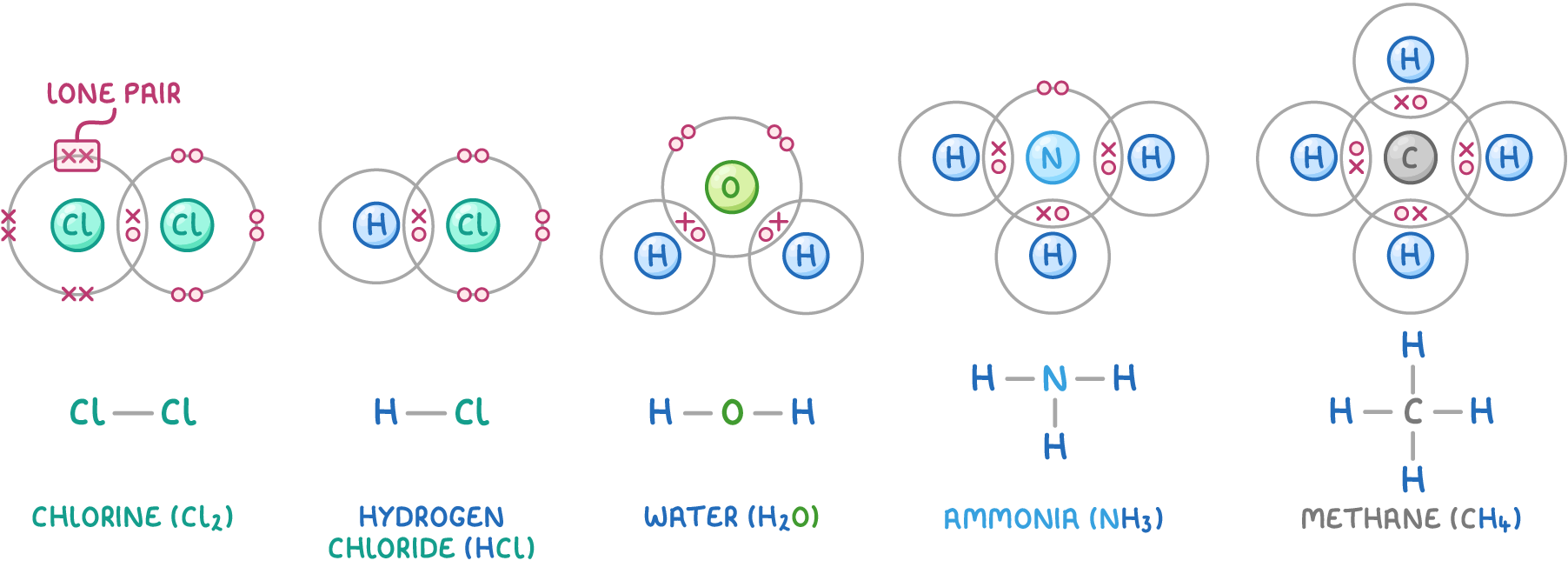
A lone pair is a pair of outer-shell electrons that isn't shared in a covalent bond.
Single-bond molecules
- Chlorine, Cl2 - Two chlorine atoms share one pair of electrons (one single bond), leaving each chlorine with three lone pairs.
- Hydrogen chloride, HCl - Hydrogen and chlorine share one pair of electrons (one single bond), leaving chlorine with three lone pairs.
- Water, H2O - Oxygen shares one pair of electrons with each of two hydrogen atoms (two single bonds), leaving oxygen with two lone pairs.
- Ammonia, NH3 - Nitrogen shares one pair of electrons with each of three hydrogen atoms (three single bonds), leaving nitrogen with one lone pair.
- Methane, CH4 - Carbon shares one pair of electrons with each of four hydrogen atoms (four single bonds), leaving no lone pairs.
Double and triple bonds
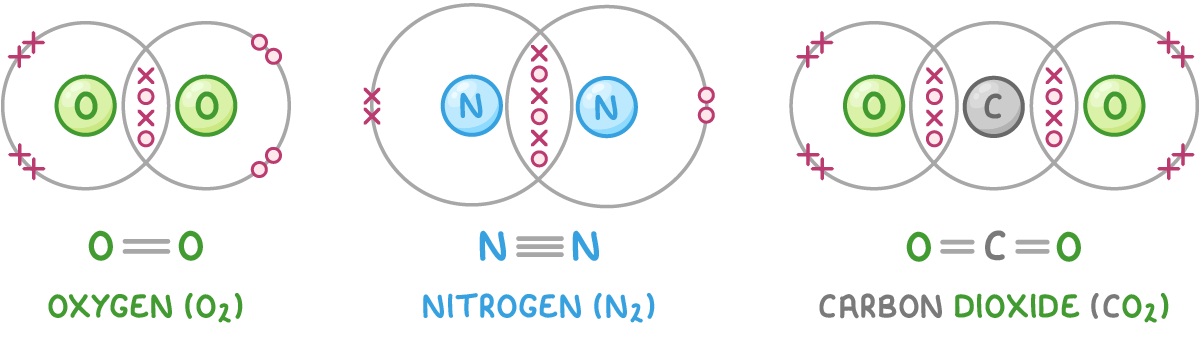
- Oxygen, O2 - Two oxygen atoms share two pairs of electrons to form a double covalent bond (O=O), leaving each atom with two lone pairs.
- Nitrogen, N2 - Two nitrogen atoms share three pairs of electrons to form a triple covalent bond (N≡N), leaving each atom with one lone pair.
- Carbon dioxide, CO2 - Carbon shares two pairs of electrons with each of two oxygen atoms, forming two double bonds (O=C=O).
Displayed formulas
- A single line represents a single bond, a double line represents a double bond, and a triple line represents a triple bond.
- Displayed formulas show only the bonds, so lone pairs aren't drawn.
Comparing bonding diagrams and deducing formulas
Ways to represent molecules
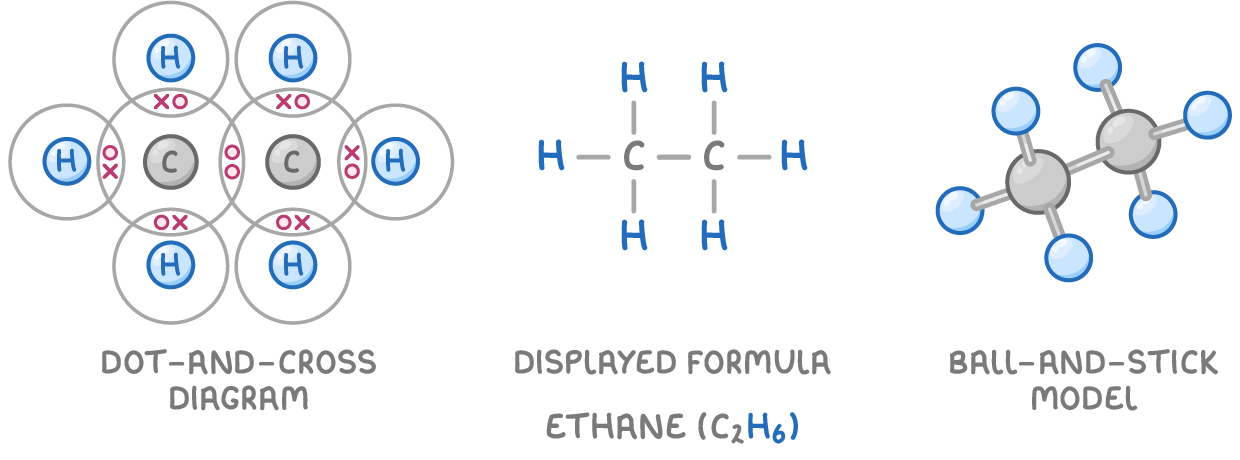
- Dot-and-cross diagram - Shows where the outer electrons come from and how they're shared, but doesn't show 3D shape or relative atom sizes.
- Displayed formula - Shows how atoms are connected and the types of bonds, but doesn't show 3D shape or which atom each electron came from.
- 3D model (ball-and-stick) - Shows the 3D arrangement of atoms in space, but doesn't show outer-shell electrons.
Deducing a molecular formula
- Count the number of atoms of each element in the diagram or model to write the molecular formula.
- For example, a molecule containing 2 carbon atoms and 6 hydrogen atoms has the formula C2H6 (ethane).
TermDefinition
Covalent bondA strong bond formed when two atoms share a pair of electrons.
Diatomic moleculeA molecule made of two atoms covalently bonded together, such as H2, O2 or Cl2.
Lone pairA pair of outer-shell electrons that is not shared in a covalent bond.
Molecular formulaA formula that shows the actual number of atoms of each element in one molecule.
Key points to remember
How were these notes?