6.4 - Making Soluble Salts
Making a salt from an acid and an excess solid
- A soluble salt dissolves in water, so it can't simply be filtered out of the reaction mixture.
- To make it, react the acid with an insoluble solid added in excess (more than can react). The acid is completely used up, and the leftover unreacted solid is filtered out.
- Four types of solid can be used, each providing the metal for the salt:
| Solid added | Products |
|---|---|
| Metal | Salt + hydrogen |
| Metal oxide | Salt + water |
| Metal hydroxide | Salt + water |
| Metal carbonate | Salt + water + carbon dioxide |
The method
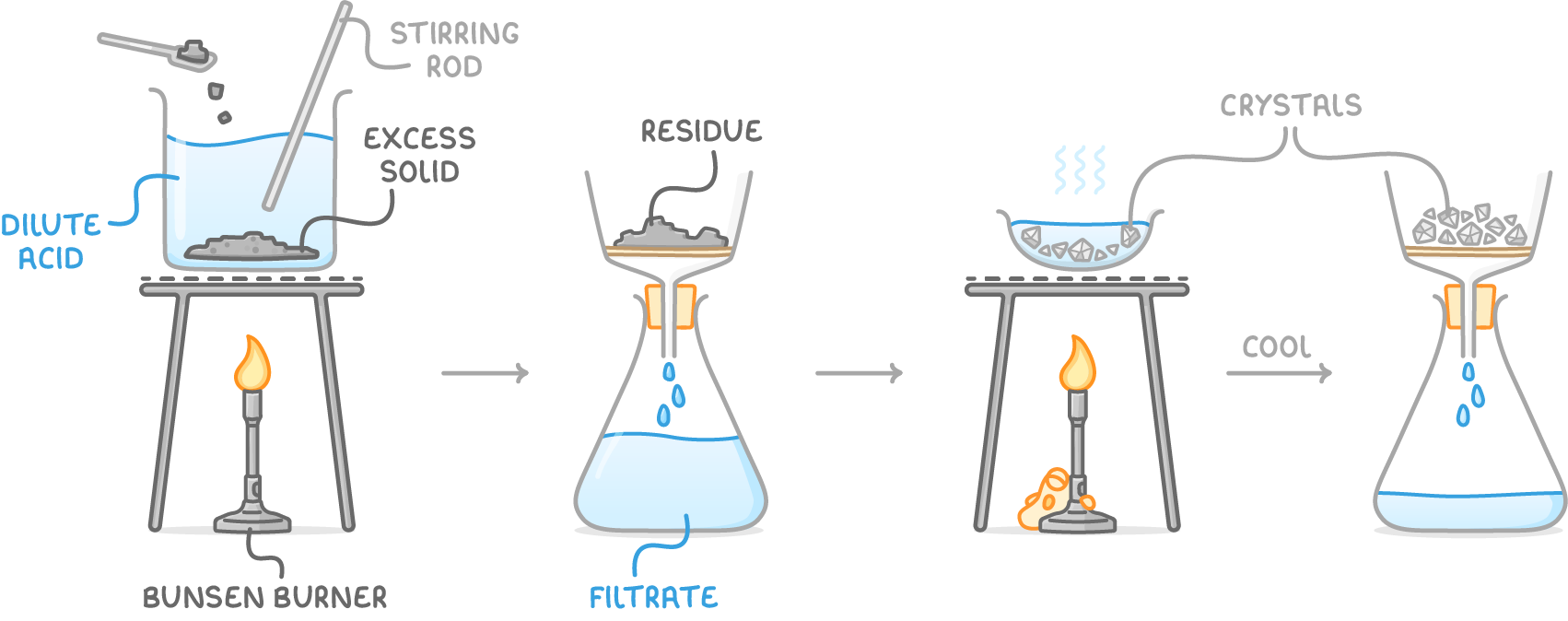
- Measure a volume of dilute acid into a beaker and warm it gently with a Bunsen burner.
- Add the solid a little at a time, stirring.
- Keep adding until the solid stops disappearing and settles on the bottom, showing it's in excess and all the acid has reacted. (With a carbonate, fizzing stops too.)
- Filter the mixture. The unreacted solid stays behind as the residue; the filtrate is pure salt solution.
- Heat the solution gently to evaporate off some of the water until the crystallisation point is reached (crystals start to form at the edge).
- Leave the concentrated solution to cool and crystallise.
- Filter the crystals off and dry them between sheets of filter paper, in a low-temperature oven, or in a desiccator.
Key points
- Adding the solid in excess ensures all the acid is used up, preventing acid from contaminating the crystals.
- Evaporation speed affects crystal size - Slow evaporation gives larger crystals; rapid heating gives small crystals or powder.
Worked example - Making zinc chloride
How would you make a pure, dry sample of zinc chloride crystals?
Step 1 - Find the acid from the second half of the name
Zinc chloride needs dilute hydrochloric acid.
Step 2 - Find the metal from the first half
It's a zinc salt, so the solid must contain zinc (zinc metal, zinc oxide, zinc hydroxide or zinc carbonate).
Step 3 - Choose an insoluble form of the metal
The solid must be insoluble so excess can be filtered off. Zinc carbonate or zinc oxide works well.
Step 4 - Write the reaction
ZnCO3(s) + 2HCl(aq) → ZnCl2(aq) + H2O(l) + CO2(g)
Step 5 - Separate the salt
Warm the dilute hydrochloric acid, add zinc carbonate a little at a time until fizzing stops and excess solid settles, filter off the excess, evaporate part of the water, leave to crystallise, then filter and dry the crystals.
Choosing the right starting material
- Very reactive metals (sodium, potassium) react dangerously with acids and can't be added directly.
- Copper does not react with dilute hydrochloric or sulfuric acid at all, so copper salts must be made from copper(II) oxide or copper(II) carbonate instead.
Making a salt from an acid and an alkali
- An alkali is a soluble base. Because it dissolves, any excess added can't be filtered out and would contaminate the salt.
- Instead, find the exact volume of acid needed to neutralise a fixed volume of alkali using a titration with an indicator, then repeat without the indicator.
The method
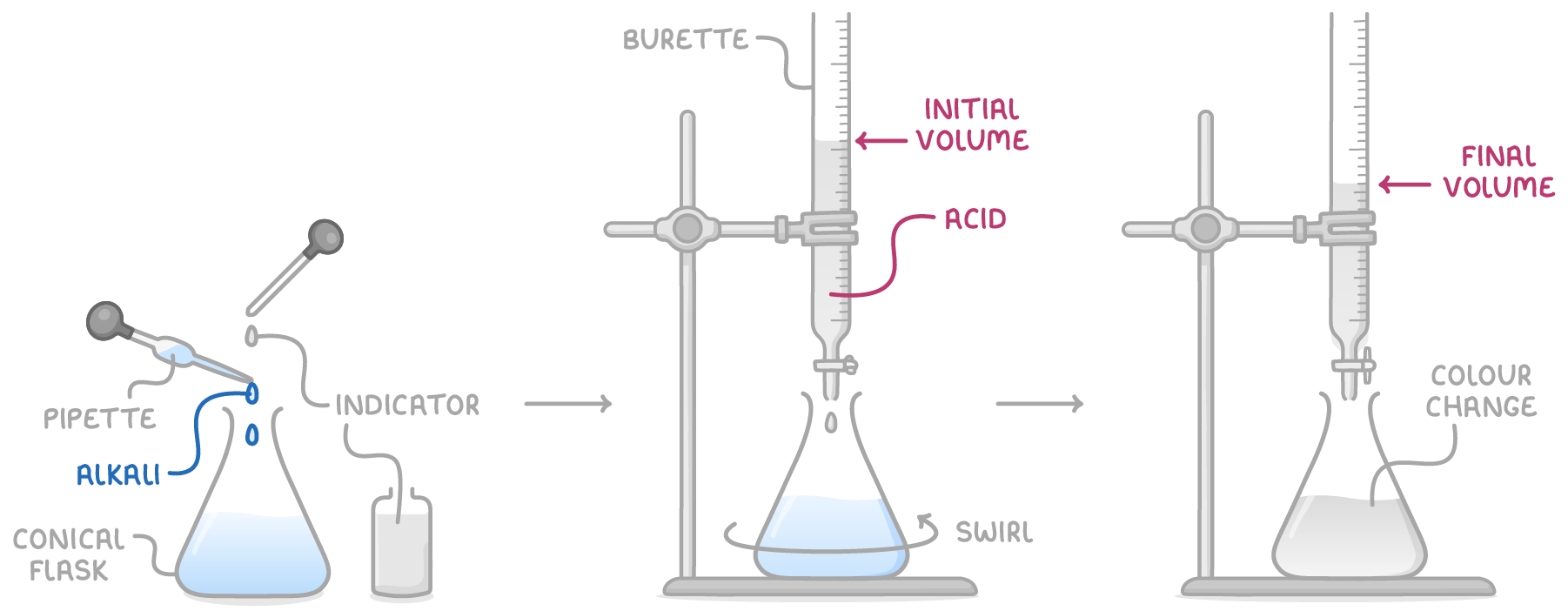
- Use a pipette to measure a fixed volume of alkali (e.g. 25.0 cm3) into a conical flask.
- Add a few drops of a single indicator that gives a sharp colour change (such as methyl orange or phenolphthalein). Do not use universal indicator, as its colour changes too gradually.
- Fill a burette with the acid and note the initial volume.
- Run the acid into the flask while swirling, adding it drop by drop near the end until the indicator changes colour (the end point).
- Record the final burette reading to find the exact volume of acid needed.
- Repeat the reaction using the exact same volumes of acid and alkali without indicator, so the dye doesn't contaminate the salt. Alternatively, keep the first mixture and remove the indicator by stirring in charcoal, warming, and filtering.
- Heat the solution gently to evaporate off part of the water, leave it to cool and crystallise, then filter off and dry the crystals.
Worked example - Making potassium chloride
How would you make a pure, dry sample of potassium chloride crystals?
Step 1 - Find the acid from the second half of the name
Potassium chloride needs dilute hydrochloric acid.
Step 2 - Choose the base
- Potassium compounds are all soluble, so an excess-solid method can't be used.
- Use the titration route with potassium hydroxide solution (an alkali).
Step 3 - Write the reaction
KOH(aq) + HCl(aq) → KCl(aq) + H2O(l)
Step 4 - Find the exact reacting volume
- Pipette 25.0 cm3 of potassium hydroxide solution into a conical flask, add a few drops of indicator, and titrate with hydrochloric acid from a burette until the colour changes.
- Note the volume of acid used (e.g. 23.6 cm3).
Step 5 - Prepare the pure salt and crystallise
- Mix 25.0 cm3 of potassium hydroxide solution with 23.6 cm3 of hydrochloric acid without indicator.
- Evaporate part of the water, leave to cool and crystallise, then filter and dry the crystals.
All sodium and potassium salts are made by titration because all their compounds are soluble.