6.5 - Making Insoluble Salts
The solubility rules, and predicting a precipitate
- A substance that dissolves in water is soluble; one that doesn't is insoluble.
- An insoluble salt made in water appears as a solid precipitate.
The solubility rules
| Compound | Soluble or insoluble in water |
|---|---|
| All sodium, potassium, and ammonium salts | Soluble |
| All nitrates | Soluble |
| Common chlorides | Soluble, except silver chloride and lead(II) chloride |
| Common sulfates | Soluble, except barium sulfate, calcium sulfate, and lead(II) sulfate |
| Common carbonates | Insoluble, except sodium, potassium, and ammonium carbonates |
| Common hydroxides | Insoluble, except sodium, potassium, and ammonium hydroxides (calcium hydroxide dissolves slightly) |
Nitrates, sodium, potassium, and ammonium compounds have no exceptions - they're always soluble.
What happens when two solutions are mixed
- In solution, a salt's positive and negative ions are separate and free to move through the water.
- Mixing two solutions puts four kinds of ion into one liquid, creating two new pairings of positive and negative ions.
- Check each new pairing against the solubility rules:
- If one pairing is insoluble, its ions join together to form a solid called a precipitate, and the reaction is a precipitation reaction.
- If both pairings are soluble, all four ions stay dissolved and no precipitate forms.
Predicting what a mixture will do
- Write down the ions each solution supplies.
- Pair them the other way round to find the two new possibilities.
- Check each possibility against the solubility rules.
Worked example - Predicting a precipitate
Copper(II) sulfate solution is mixed with sodium carbonate solution. Does a precipitate form, and if so what is it?
Step 1 - Write down the ions each solution supplies
- Copper(II) sulfate solution supplies Cu2+ and SO42-.
- Sodium carbonate solution supplies Na+ and CO32-.
Step 2 - Pair them the other way round
The two new possibilities are copper(II) carbonate and sodium sulfate.
Step 3 - Check each against the rules
- Common carbonates are insoluble apart from sodium, potassium, and ammonium - so copper(II) carbonate is insoluble.
- All sodium salts are soluble - so sodium sulfate stays dissolved.
Step 4 - State the answer
One pairing is insoluble, so a precipitate does form: copper(II) carbonate, a green solid.
CuSO4(aq) + Na2CO3(aq) → CuCO3(s) + Na2SO4(aq)
The state symbols carry the answer: everything marked (aq) stays dissolved, and the (s) is the precipitate.
Making an insoluble salt by precipitation
- An insoluble salt can't be crystallised out of a solution, because it doesn't dissolve.
- It's made by mixing solutions containing its two ions, causing the insoluble salt to form as a solid precipitate.
Choosing the right two starting solutions
Between them the starting solutions must supply the two ions needed:
- Both starting compounds must be soluble:
- Every nitrate dissolves, making nitrates a reliable source of the metal ion.
- Every sodium, potassium, and ammonium compound dissolves, making them a reliable source of the negative ion.
- The other pairing must be soluble too, so it stays dissolved in the water and can be washed away from the solid.
Example - Choosing solutions for lead(II) sulfate
- To make lead(II) sulfate (insoluble), lead(II) ions and sulfate ions have to meet in solution.
- Lead(II) nitrate is soluble (all nitrates are), so it supplies the lead(II) ions.
- Sodium sulfate is soluble (all sodium salts are), so it supplies the sulfate ions.
- Mixing them leaves sodium nitrate in the solution.
- Pb(NO3)2(aq) + Na2SO4(aq) → PbSO4(s) + 2NaNO3(aq)
Method
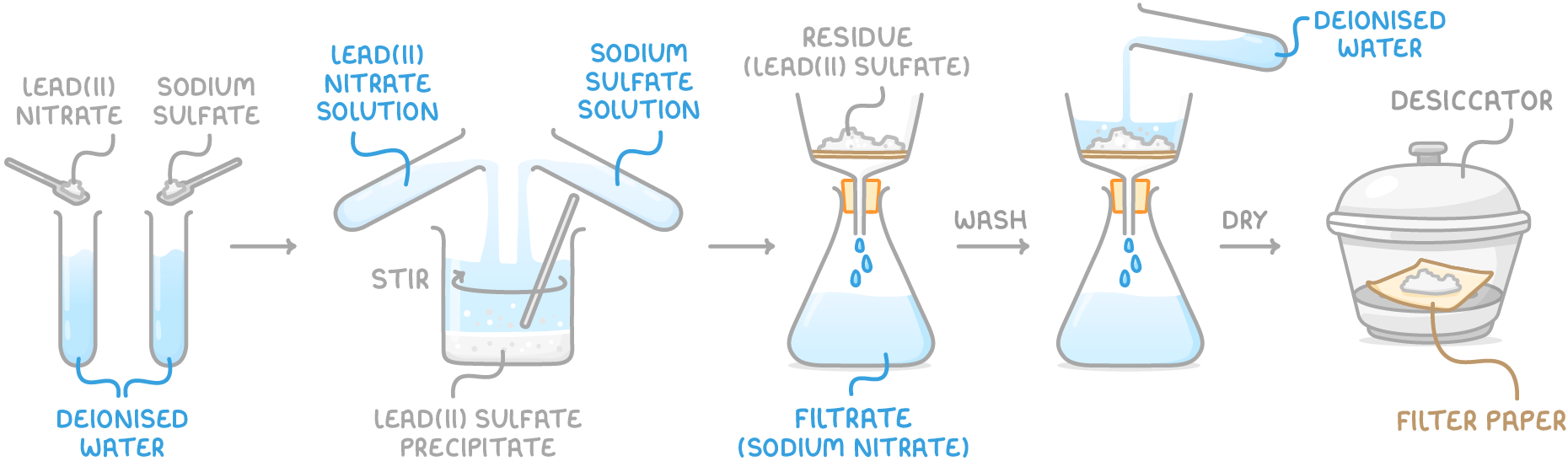
- Dissolve about a spatula of lead(II) nitrate in deionised water in one test tube, and a spatula of sodium sulfate in deionised water in another, until fully dissolved. Deionised water is used so no stray ions are introduced.
- Pour the two solutions into a small beaker and stir. Insoluble lead(II) sulfate precipitates immediately.
- Filter the mixture using filter paper and a funnel. The precipitate is collected as the residue; the solution drains through as the filtrate.
- Rinse the beaker with a little deionised water and pour that through too, so no product is left behind.
- Wash the solid on the filter paper with deionised water to remove any dissolved sodium nitrate.
- Leave the solid to dry on fresh filter paper, in a warm oven or in a desiccator (a sealed container holding a drying agent).
TermDefinition
SolubleDescribes a substance that can dissolve in a solvent, such as water.
InsolubleDescribes a substance that cannot dissolve in a solvent, such as water.
PrecipitateAn insoluble solid that forms in a solution during a chemical reaction, usually when two solutions are mixed.
ResidueThe material left behind after a process. In filtration, it is the insoluble solid left on the filter paper.
FiltrateThe liquid or solution that passes through the filter paper during filtration.
DesiccatorA sealed container holding a drying agent, used to dry a solid.
Key points to remember
How were these notes?