7.6 - Electrolysis of Aqueous Solutions
The experiment
Aim
To predict the products of electrolysing an aqueous solution using inert electrodes, then test the prediction.
Background
- An aqueous solution contains the dissolved compound's ions, and also H+ and OH- ions from the water. Only one ion is discharged at each electrode.
- At the cathode, hydrogen is given off unless the metal in the compound is less reactive than hydrogen, in which case the metal is deposited.
- At the anode, a halogen is given off if a halide is present. Otherwise the hydroxide ions are discharged and oxygen is given off.
- You can't see which ions are discharged, but you can see what forms at each electrode.
- So in this practical you predict the products for a solution, electrolyse it with inert electrodes, and test what forms to check your prediction.
Variables
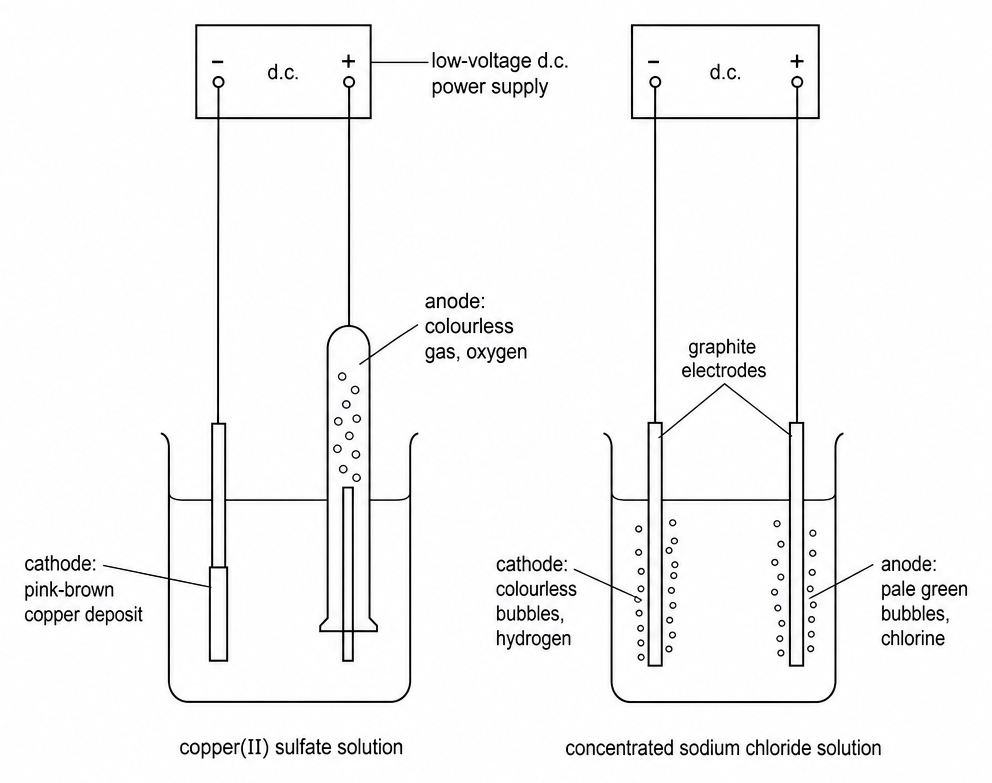
- Independent variable - The solution electrolysed, such as copper(II) sulfate solution or concentrated sodium chloride solution.
- Dependent variable - What forms at each electrode.
- Control variables - The electrode material, the distance between the electrodes, the voltage, and the volume of solution.
Method
- Set up the cell - Half-fill a beaker with the solution, dip two graphite or platinum electrodes into it a fixed distance apart, and connect them to a low-voltage d.c. power supply.
- Predict the products - Before switching on, list the ions present and predict what will form at each electrode.
- Switch on and watch - Look for a gas, a solid coating, or a change in the colour of the solution.
- Test any gas - Collect it in an upside-down test tube full of the solution held over the electrode, and test it. A small cell may make too little gas to test, so the product is identified from the prediction and the bubbling.
- Repeat with another solution - Such as copper(II) sulfate in place of sodium chloride, and compare the products.
Safety
- Eye protection - Wear it throughout.
- Chlorine is toxic - Keep the voltage low and the electrolysis brief, and work in a well-ventilated room or a fume cupboard. Never smell a gas directly.
- Hydrogen is flammable - Keep naked flames away from the cell.
Common exam questions
Question 1
Why are the electrodes made of graphite or platinum rather than a reactive metal?
They take no part in the reaction, so the products come only from the ions in the solution. A reactive metal electrode would dissolve at the anode instead.
Question 2
Why is a direct current supply used, and not an alternating one?
A direct current always flows the same way, so one electrode stays the cathode and the other the anode. An alternating current would keep swapping them, and no product would build up.
Question 3
Why does electrolysing concentrated sodium chloride solution give chlorine at the anode, but a very dilute solution gives oxygen?
A concentrated solution has enough chloride ions reaching the anode to be discharged instead of hydroxide ions. In a very dilute solution there are too few, so hydroxide ions are discharged and oxygen is given off.
Question 4
How do you test the gases collected at the electrodes for hydrogen, oxygen, and chlorine?
Hydrogen burns with a squeaky pop when a lit splint is held at the mouth of the tube. Oxygen relights a glowing splint. Chlorine turns damp blue litmus paper red and then quickly bleaches it white.
Question 5
Why does the blue colour of copper(II) sulfate solution fade during electrolysis with inert electrodes?
Copper ions are removed from the solution as they're deposited on the cathode. The concentration of copper ions, which cause the blue colour, falls.