4.4 - Graphene & Fullerenes
Graphene
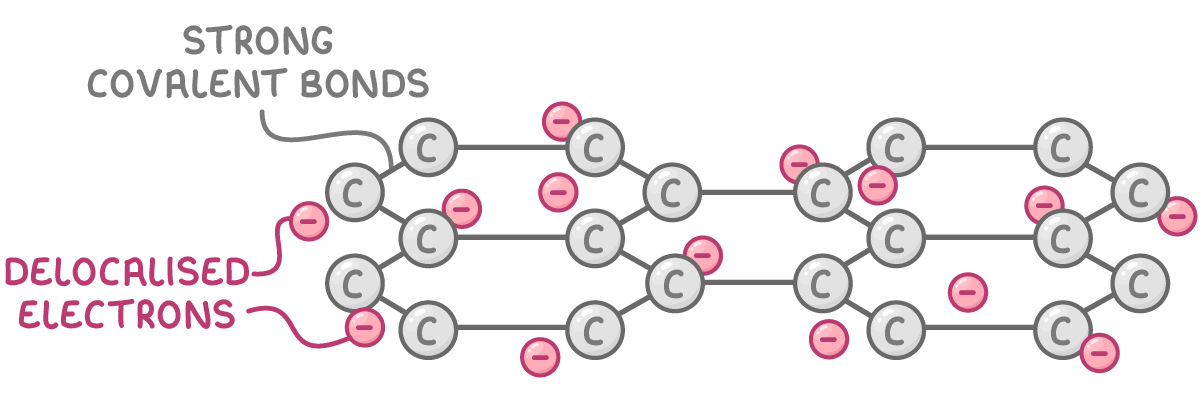
- Graphene is a single layer of graphite, just one atom thick, making it a two-dimensional form of carbon.
- Within the layer, each carbon atom is joined to three neighbours by strong covalent bonds in a repeating pattern of hexagons.
Properties
- Very strong and light - Held together by strong covalent bonds throughout the sheet.
- Transparent - Being one atom thick allows light to pass straight through.
- Excellent conductor of electricity and heat - each carbon atom has one delocalised electron free to move across the whole sheet.
Uses
- Composite materials - Reinforces other materials to improve strength without adding much weight.
- Electronics - Its thinness and high conductivity make it valuable in miniature circuits.
- Batteries and solar cells - Used in batteries to make them lighter and faster to recharge, and in solar cells, where it lets light through and conducts electricity.
Fullerenes - Buckminsterfullerene and nanotubes
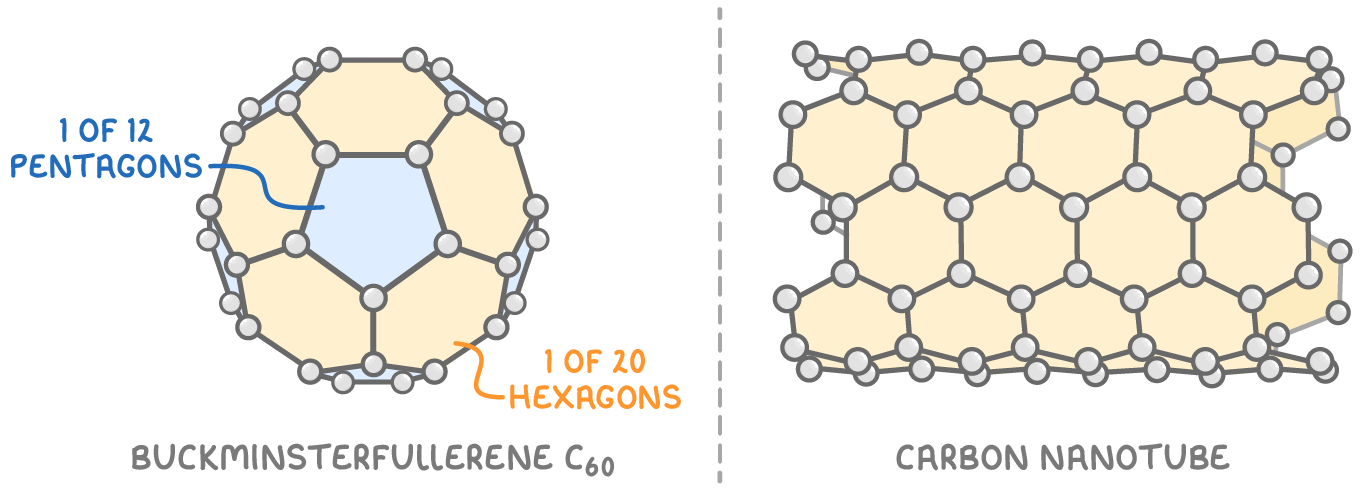
- Fullerenes are molecules of carbon atoms with hollow shapes - spherical cages or hollow tubes.
- Most rings are hexagons, but fullerenes also contain rings of five (pentagons) or seven carbon atoms that curve the sheet into closed structures.
Structure
- Unlike diamond and graphite, fullerenes are discrete molecules, not giant covalent structures.
- Strong covalent bonds hold the atoms together within each molecule, but only weak intermolecular forces hold separate molecules to one another.
Buckminsterfullerene (C60)
- A hollow spherical molecule with the formula C60, made of twenty hexagons and twelve pentagons.
- Slippery with a lower melting point than diamond or graphite, because only the weak intermolecular forces between molecules need to be overcome.
- Poor conductor of electricity because delocalised electrons cannot move between separate molecules.
Carbon nanotubes
- Cylindrical fullerenes with a very high length-to-diameter ratio.
- High tensile strength - They resist snapping when stretched because of their network of strong covalent bonds.
- Good conductors of electricity and heat, as delocalised electrons move freely along the tube.
Uses
- Drug delivery - Hollow spheres can cage drug molecules and deliver them to specific parts of the body.
- Lubricants - Spherical fullerenes roll easily between surfaces.
- Catalysts - A large surface area provides many sites for reactions.
- Reinforcing materials and electronics - Nanotubes' high tensile strength and conductivity make them ideal for high-tech composite materials and miniature circuits.
TermDefinition
GrapheneA single layer of graphite, one atom thick, consisting of carbon atoms arranged in hexagons.
FullereneA molecule of carbon atoms with a hollow shape, such as a sphere or a tube.
BuckminsterfullereneA hollow spherical fullerene molecule with the formula C60.
Carbon nanotubeA cylindrical fullerene molecule with a very high length-to-diameter ratio (it is very long compared with its width).
Key points to remember
How were these notes?