2.14 - Ionic Compounds
The properties of an ionic compound
- An ionic compound is built from huge numbers of ions packed together into a giant structure.
- Ionic compounds share a characteristic set of properties.
High melting and boiling points
- Ionic compounds have high melting points and high boiling points.
- Sodium chloride (table salt) melts at 801 °C and boils at 1,413 °C.
Soluble in water
Most ionic compounds dissolve in water.
Conducting electricity
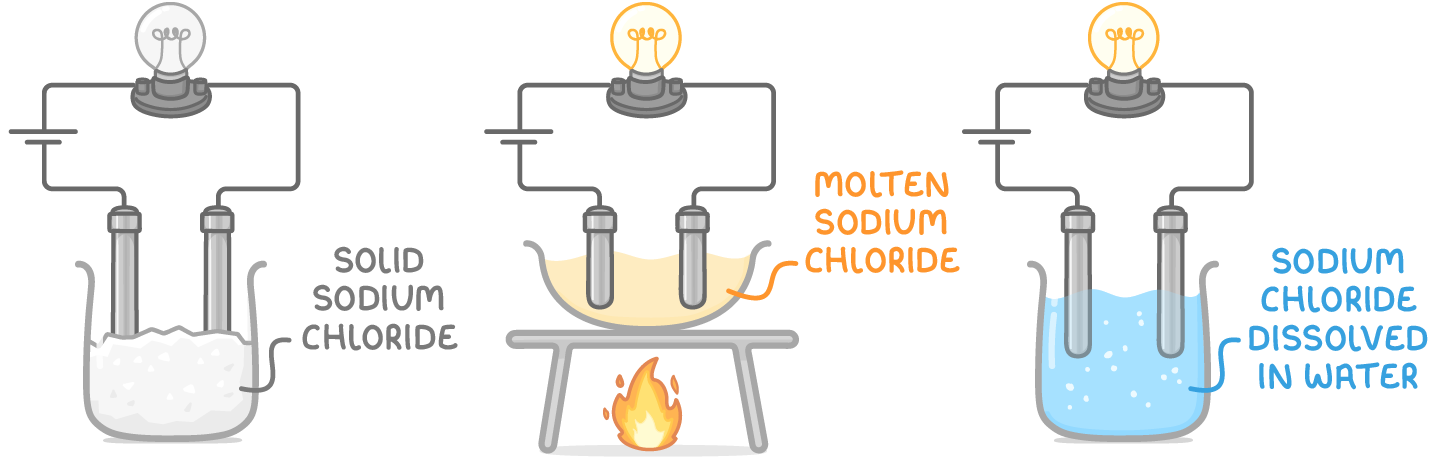
- As a solid, an ionic compound can't conduct electricity.
- When molten or dissolved in water, it conducts electricity.
The giant ionic lattice - Why it explains those properties
- Oppositely charged ions are attracted to each other by strong electrostatic forces acting in all directions.
- This forms a giant ionic lattice: a regular, repeating 3D arrangement of alternating positive and negative ions.
- In sodium chloride, each sodium ion (Na+) is surrounded by six chloride ions (Cl-), and each chloride ion is surrounded by six sodium ions.
Why melting and boiling points are high
- A giant lattice is held together by many strong ionic bonds.
- Breaking these strong electrostatic attractions throughout the lattice requires a large amount of energy, so ionic compounds have high melting and boiling points.
Why conductivity depends on state
- In a solid, ions are fixed in position in the lattice and can't move, so they can't carry an electric charge.
- When molten or dissolved in water, the lattice breaks apart and the ions are free to move, so they can carry electrical current.
Why the formula is a ratio
The lattice is a continuous structure with no separate molecules, so its formula is the simplest whole-number ratio of positive to negative ions that balances the overall charge to zero (e.g. NaCl, MgCl2).
Ways of drawing a lattice, and their limits
- Space-filling model - Shows the packing and relative sizes of ions, but only shows the outer surface and hides the inside of the structure.
- Ball-and-stick model - Shows the 3D arrangement and ion positions clearly, but suggests false gaps between ions and isn't to scale.
- 2D diagram - Shows the alternating charges and ion ratios simply, but flattens a 3D lattice into a single layer.
- Dot-and-cross diagram - Shows electron transfer between individual atoms, but doesn't show the giant 3D lattice structure.

Finding the formula from a lattice diagram
- Count the number of each ion shown in the diagram, then simplify the numbers to their simplest whole-number ratio (the empirical formula).
- For example, the 2D diagram above shows 8 Na+ ions and 8 Cl- ions, which simplifies to a 1:1 ratio, giving NaCl.
TermDefinition
Empirical formulaA formula that shows the simplest whole-number ratio of the atoms or ions of each element in a compound.
Giant ionic latticeA regular, repeating 3D arrangement of alternating positive and negative ions.
Key points to remember
How were these notes?