2.12 - Group 0 - The Noble Gases
The noble gases and why they are unreactive
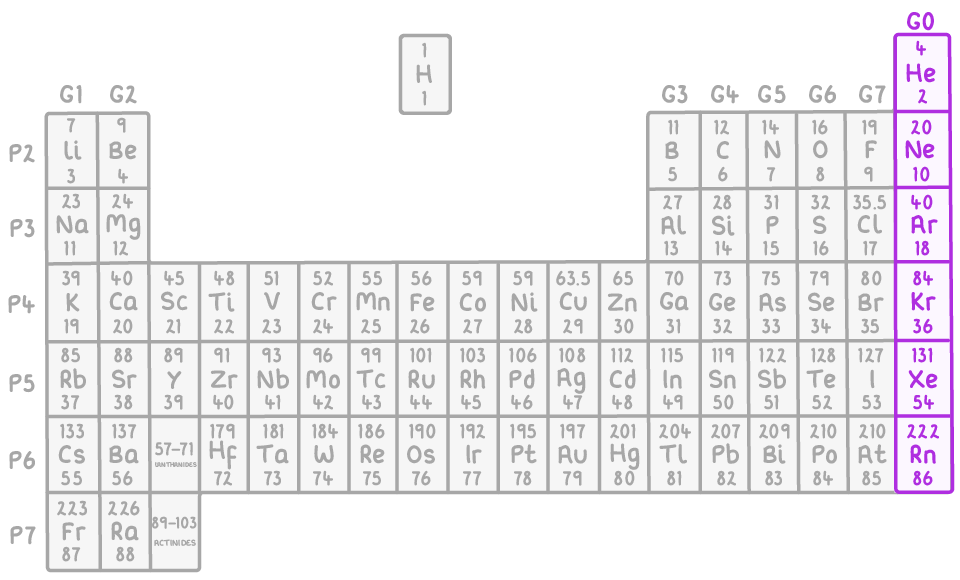
- Group 0 contains the noble gases: helium, neon, argon, krypton, xenon and radon.
- They are all colourless, non-flammable gases at room temperature.
Why they are unreactive
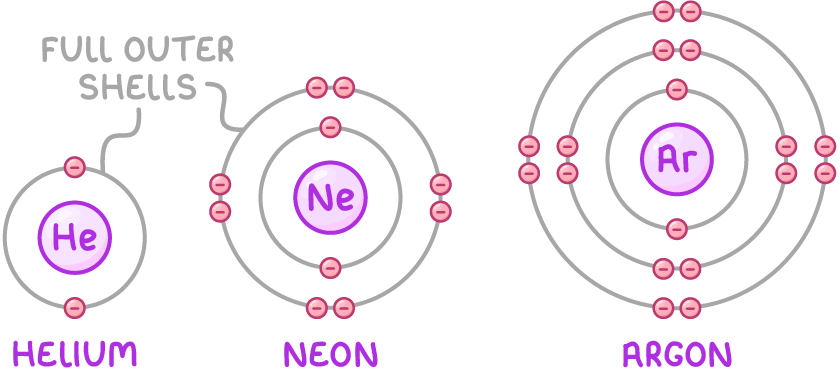
- Every noble gas atom has a full outer shell of electrons (2 for helium, 8 for the others), giving them a stable electron arrangement.
- Because their outer shell is full, they don't need to gain, lose or share electrons.
- This makes them inert (unreactive), so they don't readily form compounds.
- They exist as single, unbonded atoms (monatomic).
The trend in physical properties down Group 0
- The noble gases all have very low melting and boiling points, so they're all gases at room temperature.
- Going down Group 0:
- Boiling point and melting point increase
- Density increases
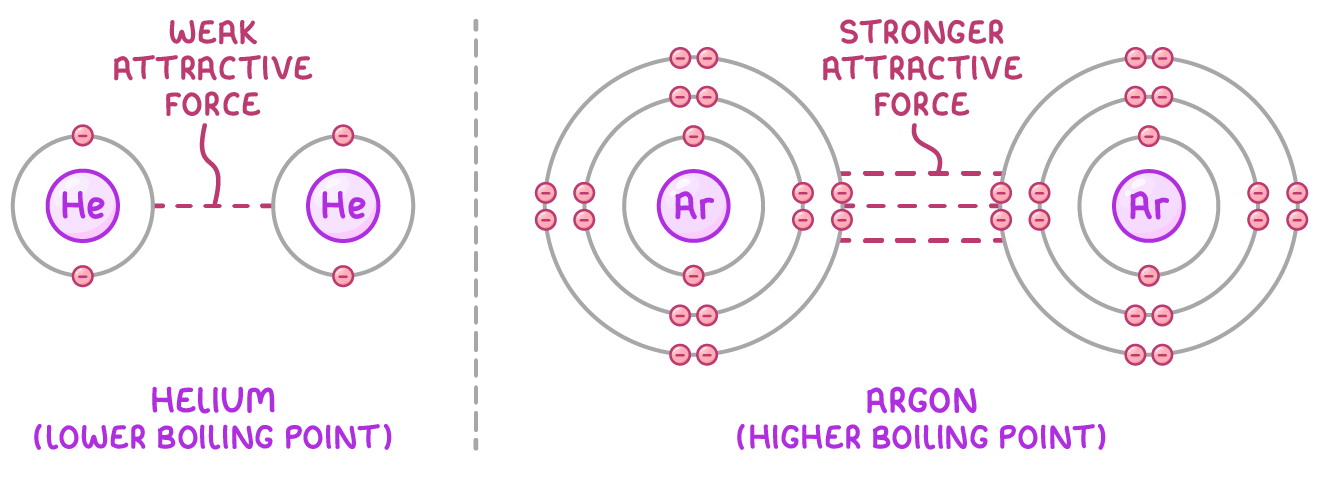
- Boiling points increase down the group because the atoms have more electrons. This increases the attractive forces between atoms, so more energy is needed to pull them apart.
| Noble gas | Boiling point (°C) |
|---|---|
| helium | -269 |
| neon | -246 |
| argon | -186 |
| krypton | -153 |
| xenon | ? |
| radon | -62 |
Predicting missing properties
- Because the trend is steady, a missing value can be estimated by taking the average of the elements above and below it.
- To estimate the boiling point of xenon (between krypton and radon):
This gives an estimate of about -108 °C (its actual boiling point is -108 °C).
TermDefinition
InertUnreactive, so it does not take part in a reaction. The noble gases are inert because their atoms have a stable arrangement of electrons.
MonatomicExisting as single, unbonded atoms.
Key points to remember
How were these notes?