3.17 - Electrolysis - Molten Compounds
What electrolysis is, and the apparatus
- Electrolysis is the process of splitting an ionic compound using electricity.
- The compound being broken down is the electrolyte: a molten ionic compound or aqueous solution containing ions that are free to move, so it conducts electricity and is decomposed by it.
Why the ions must be free to move
- In a solid, ions are fixed in a lattice and cannot move, so no current flows.
- Freeing the ions requires either:
- Melting the compound so the ions can move within the liquid.
- Dissolving it in water so the ions separate and move through the solution.
The apparatus
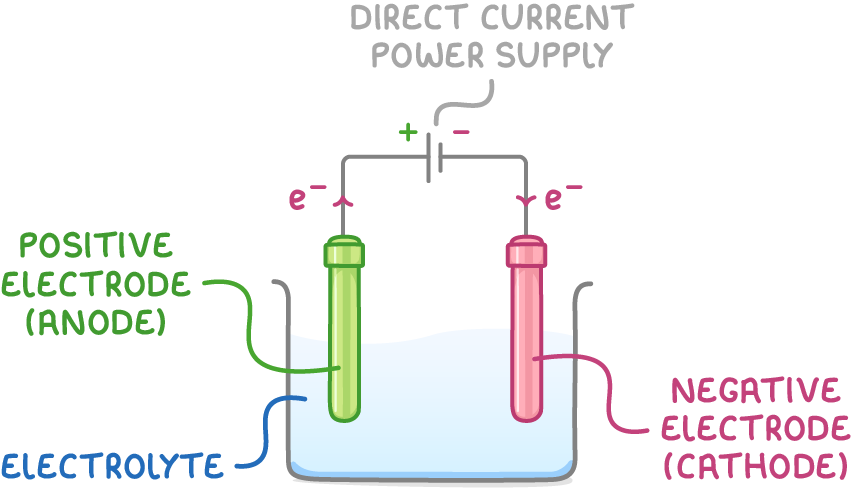
- Two electrodes (conducting rods) are placed in the electrolyte and connected to a d.c. power supply:
- Cathode - The negative electrode, connected to the negative terminal.
- Anode - The positive electrode, connected to the positive terminal.
- A direct current (d.c.) is used so each electrode keeps a constant charge and the products form at separate electrodes.
Inert electrodes
- Electrodes are usually made of graphite or platinum.
- These are good conductors of electricity and are inert (unreactive), so they don't take part in the reaction.
Names of the ions
- A cation is a positive ion, which moves to the cathode.
- An anion is a negative ion, which moves to the anode.
Predicting the products of a molten compound
- A molten ionic compound containing two elements breaks down into those two elements:
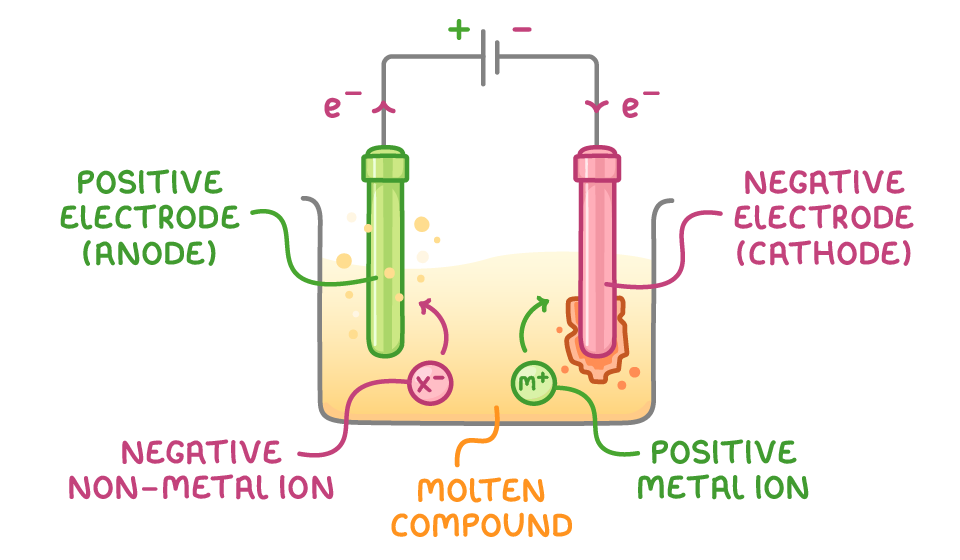
- Metal - Forms positive ions, which are attracted to the negative electrode (cathode) and discharged there.
- Non-metal - Forms negative ions, which are attracted to the positive electrode (anode) and discharged there.
- Non-metals that exist as diatomic molecules (such as bromine, chlorine and oxygen) form gas molecules at the anode.
Worked example - Products of molten lead(II) bromide
What is produced at each electrode when molten lead(II) bromide is electrolysed?
Step 1 - Identify the ions
Lead(II) bromide (PbBr2) is made of lead ions (Pb2+) and bromide ions (Br-).
Step 2 - Send each ion to its electrode
- Pb2+ ions are positive, so they move to the negative electrode (cathode) - lead is produced, forming a silvery-grey liquid.
- Br- ions are negative, so they move to the positive electrode (anode) - bromine is produced, forming a red-brown vapour.
Step 3 - Write the word equation
lead(II) bromide → lead + bromine
The same steps work for any molten compound of two elements. Molten lithium chloride is made of Li+ and Cl- ions, so lithium forms at the negative electrode and chlorine at the positive electrode, seen as bubbles of a pale green gas.
What happens at each electrode
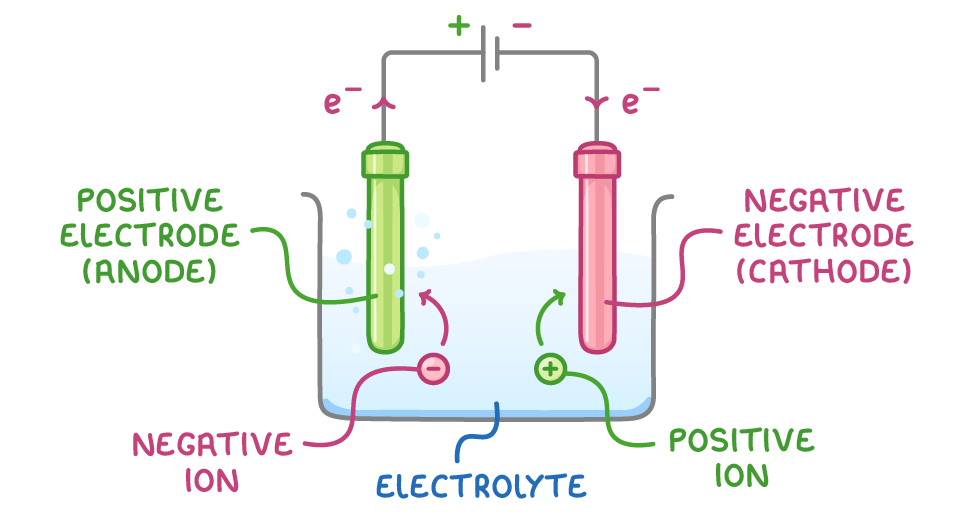
When the current flows, ions move towards the oppositely charged electrodes:
- Positive ions move to the cathode (negative electrode).
- Negative ions move to the anode (positive electrode).
Reactions at the electrodes
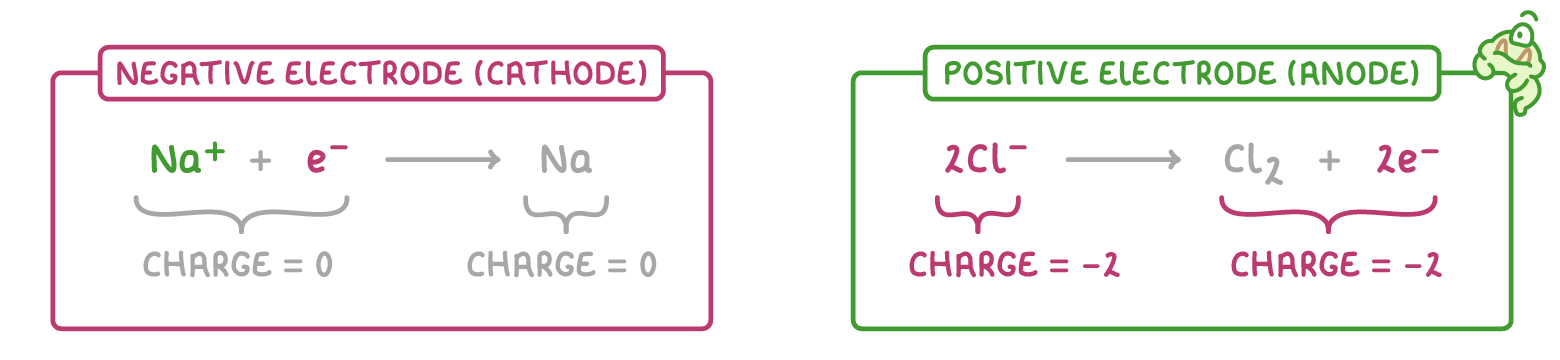
- At the cathode (negative electrode) - Positive ions gain electrons to become neutral atoms.
- At the anode (positive electrode) - Negative ions lose electrons to become neutral atoms or molecules.
- When an ion loses its charge to become a neutral atom or molecule, it's said to be discharged.
How charge moves through the circuit
- In the wires and power supply, the current is carried by moving electrons.
- In the electrolyte, the current is carried by moving ions.
The half equations at the electrodes
- A half equation shows the reaction and electron transfer at a single electrode.
- The symbol e- represents an electron (a single negative charge).
Writing a half equation
- Write the reactant ion on the left and the neutral product on the right.
- Balance the atoms. Non-metals that form diatomic molecules (e.g. Cl2, Br2, O2) need two ions on the left.
- Add electrons to balance the charges:
- At the cathode (negative electrode), ions gain electrons, so write them on the left side.
- At the anode (positive electrode), ions lose electrons, so write them on the right side.
Worked example - Half equations for molten PbBr2
Write the half equation at each electrode for the electrolysis of molten lead(II) bromide, which contains Pb2+ and Br- ions.
Step 1 - Cathode (negative electrode)
Pb2+ gains two electrons to form a neutral lead atom:
Pb2+ + 2e- → Pb
Step 2 - Anode (positive electrode)
Two Br- ions each lose one electron to form a Br2 molecule:
2Br- → Br2 + 2e-
Step 3 - Identify oxidation and reduction
- Reduction (gain of electrons) happens at the cathode: Pb2+ is reduced to Pb.
- Oxidation (loss of electrons) happens at the anode: Br- is oxidised to Br2.