5.6 - Changing the Position of Equilibrium
Predicting shifts - Le Chatelier's principle
Le Chatelier's principle - When a condition is changed in a system at equilibrium, the system responds in a way that counteracts the change, shifting the position of equilibrium.
Example - ammonia synthesis:
N2(g) + 3H2(g) ⇌ 2NH3(g)
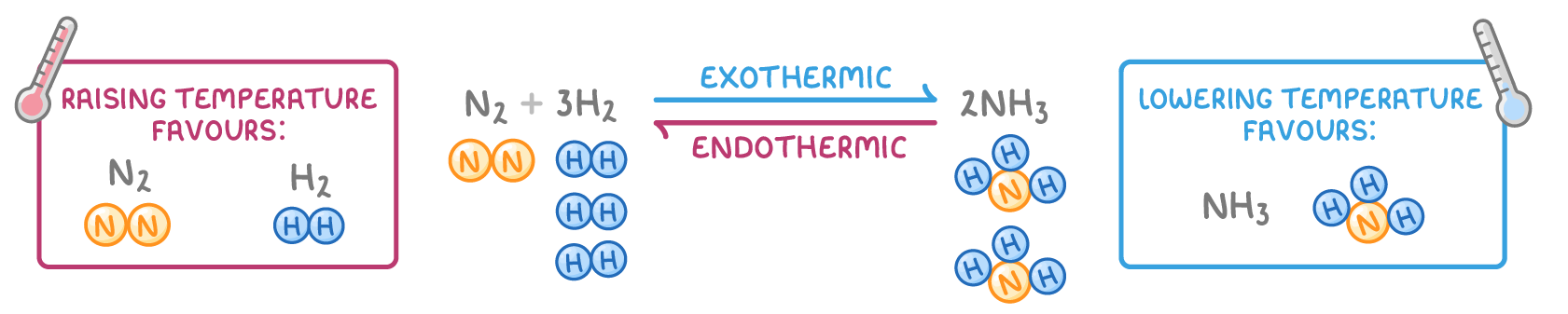
The forward reaction is exothermic; the reverse reaction is endothermic.
Temperature
- Raising the temperature shifts the equilibrium in the endothermic direction to take in energy and counteract the rise.
- Lowering the temperature shifts the equilibrium in the exothermic direction to release energy and counteract the fall.
- In the example: raising the temperature shifts it left (favouring N2 and H2); lowering it shifts it right (favouring NH3).
Pressure
- Applies where reactants or products include gases.
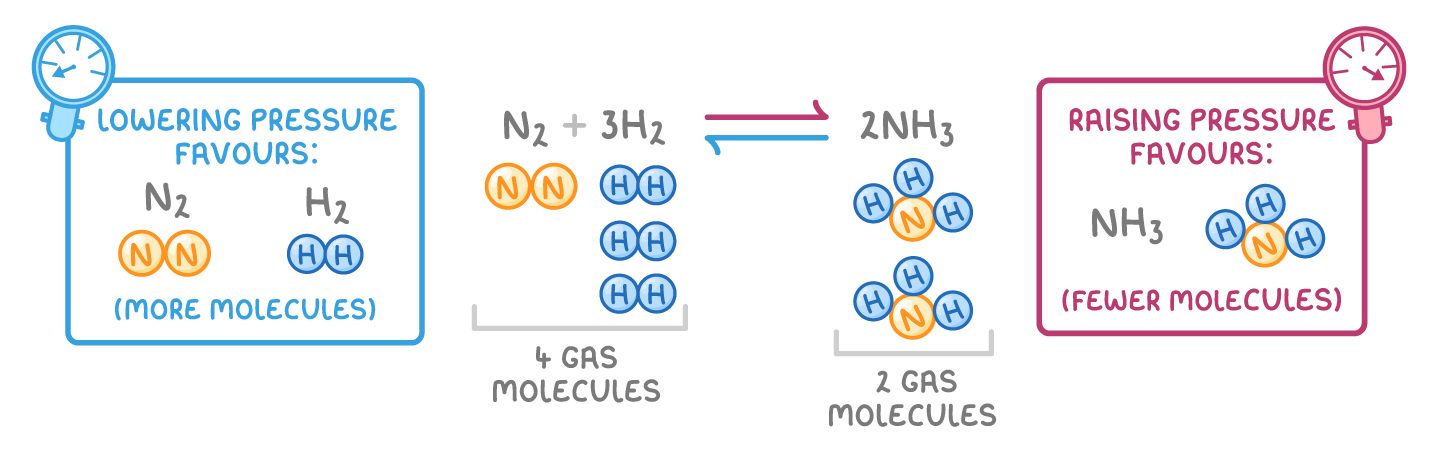
- Raising the pressure shifts the equilibrium towards the side with fewer gas molecules to counteract the rise.
- Lowering the pressure shifts the equilibrium towards the side with more gas molecules.
- In the example: there are four gas molecules on the left and two on the right, so raising the pressure shifts it right (favouring NH3); lowering it shifts it left.
Concentration
- Increasing the concentration of a substance shifts the equilibrium away from that side to use it up.
- Decreasing the concentration of a substance shifts the equilibrium towards that side to replace it.
- Adding more N2 or H2 shifts the equilibrium right, making more NH3; removing NH3 as it forms also shifts it right.

Catalysts
- A catalyst has no effect on the position of equilibrium.
- It speeds up the forward and reverse reactions by exactly the same amount, so equilibrium is reached more quickly without changing the yield.
Choosing conditions for a reversible reaction
The conditions used in industrial reactions are a compromise between yield, rate, safety, and cost.
Cost and safety of extreme conditions
- Very high pressure - Needs thicker, more expensive reaction vessels and pipework to contain safely, increasing equipment and maintenance costs.
- Very high temperature - Requires large amounts of energy to reach and maintain, raising running costs and fuel consumption.
Balancing rate and yield
- The chosen conditions must give an acceptable rate as well as an acceptable yield.
- For an exothermic reaction, a lower temperature shifts equilibrium towards the products but makes the reaction too slow. A compromise temperature is used to balance yield and rate.
TermDefinition
Le Chatelier's principleThe principle that if a condition is changed in a system at equilibrium, the position of equilibrium shifts to counteract the change.
Key points to remember
How were these notes?