1.2 - Development of the Atomic Model
Dalton's spheres and the plum pudding model
At the start of the 19th century, John Dalton proposed that atoms are solid spheres that can't be divided, and that each element is made of its own type of atom.
Thomson's discovery of the electron
- In 1897, J J Thomson discovered the electron - a tiny, negatively charged particle from inside atoms.
- This showed that atoms aren't indivisible and contain smaller parts.
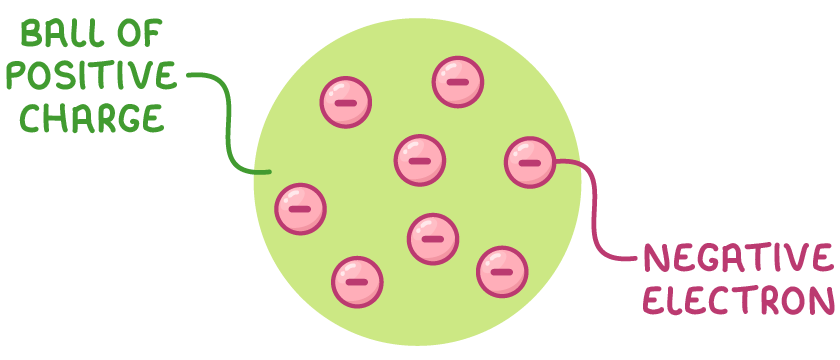
Thomson proposed the plum pudding model
- The atom is a ball of positive charge with negative electrons embedded throughout it.
- The positive and negative charges balance, so the atom carries no overall charge.
Alpha scattering and the nuclear model
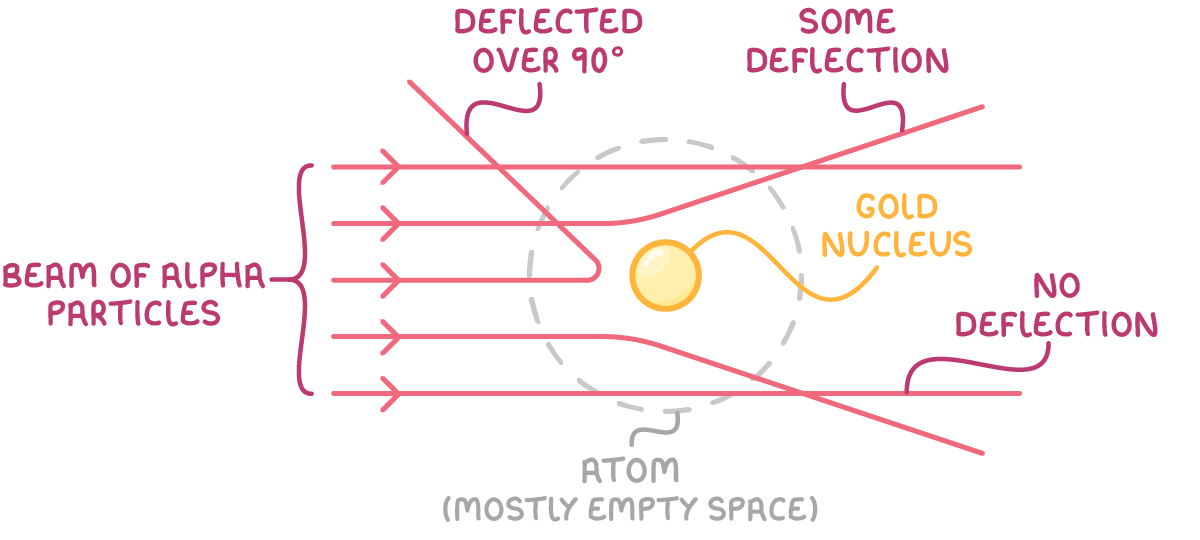
In 1909, Ernest Rutherford fired a beam of positively charged alpha particles at a thin sheet of gold foil.
What was expected vs what happened
- Under the plum pudding model, the positive charge was thought to be thinly spread, so alpha particles were expected to pass straight through with little or no deflection.
- Actual results:
- Most alpha particles passed straight through.
- Some were deflected through large angles.
- A small number bounced back towards the source (deflected by more than 90°).
Rutherford explained these observations with the nuclear model
- Most of the atom is empty space, so most alpha particles pass straight through.
- The positive charge is concentrated in a tiny central nucleus, which repels alpha particles passing close to it.
- Almost all the mass is concentrated in the nucleus, which turns back particles hitting it directly.
Nuclear model vs plum pudding model
| Plum pudding model | Nuclear model | |
|---|---|---|
| Positive charge | Spread evenly through the whole atom | Concentrated in a tiny central nucleus |
| Mass | Spread evenly through the whole atom | Almost all concentrated in the nucleus |
| Electrons | Embedded throughout the positive material | Orbiting outside the nucleus |
| Empty space | None | Almost the entire atom |
Refining the nuclear model
The problem with Rutherford's model
In Rutherford's model, the negative electrons in a cloud should be attracted to the positive nucleus and spiral inwards, causing the atom to collapse.
Bohr's electron shells
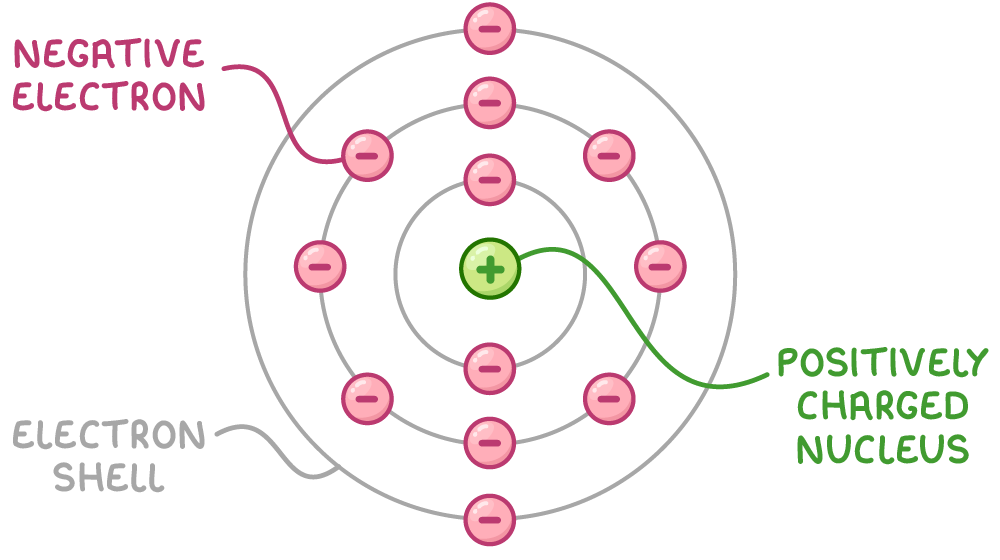
- Niels Bohr adapted the nuclear model, proposing that electrons orbit the nucleus in fixed shells.
- Each shell is at a fixed distance from the nucleus and has a fixed energy.
- Electrons can't exist between shells, which prevents them from spiralling into the nucleus and keeps the atom stable.
- Bohr's theoretical calculations matched experimental observations.
TermDefinition
ElectronA tiny, negatively charged particle found in atoms.
Plum pudding modelAn early model of the atom as a ball of positive charge with negative electrons embedded in it.
Nuclear modelA model of the atom with a tiny, dense, positively charged nucleus at the centre, surrounded by electrons.
NucleusThe tiny, positively charged centre of an atom, which contains the protons and neutrons and almost all of the atom's mass.
Key points to remember
How were these notes?