4.7 - Tests for Gases
Tests for the common gases
Hydrogen
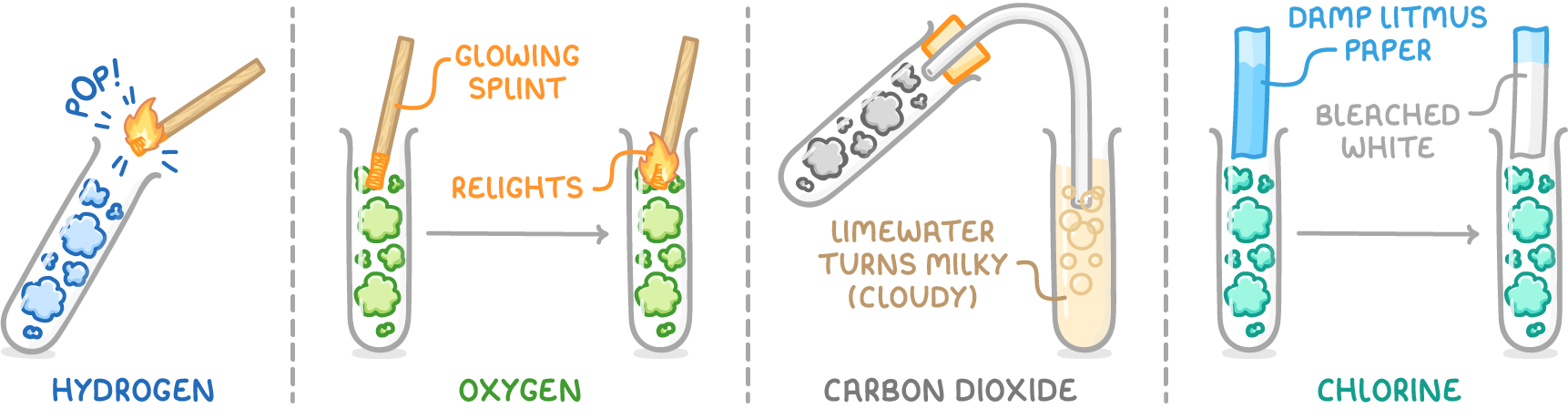
- Hold a lit splint at the open end of a test tube of the gas.
- Hydrogen burns quickly with a squeaky pop.
Oxygen
- Insert a glowing splint into a test tube of the gas.
- If the gas is oxygen, the splint relights.
Carbon dioxide
- Bubble the gas through limewater (a colourless solution of calcium hydroxide).
- If the gas is carbon dioxide, the limewater turns cloudy (milky) as a white precipitate of calcium carbonate forms.
Chlorine
- Chlorine has a sharp, choking smell, but it is toxic, so an unknown gas is never smelled deliberately.
- Hold damp blue litmus paper in the gas.
- Chlorine bleaches the paper white (it may turn red briefly first because chlorine is acidic in solution).
- Damp universal indicator paper can be used instead: it turns red and is then bleached white.
- The paper must be damp so the gas can dissolve in the water.
TermDefinition
LimewaterA solution of calcium hydroxide in water that turns milky or cloudy when carbon dioxide is bubbled through it.
Key points to remember
How were these notes?