2.2 - Purity & Formulations
What "pure" means in chemistry
- In everyday language, "pure" means nothing has been added to a substance and it's in its natural state (e.g. pure milk).
- In chemistry, a pure substance is a single element or a single compound, with nothing else mixed in.
- Anything made of more than one substance mixed together is a mixture, so no mixture is chemically pure.
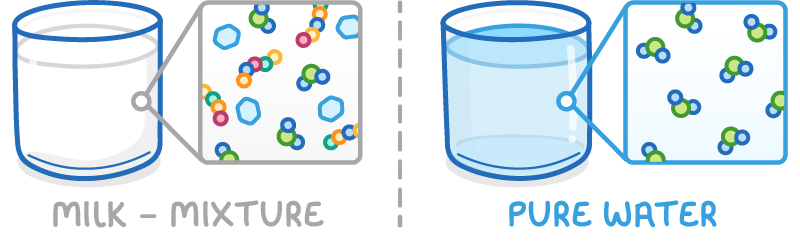
Milk and water compared
- Milk is pure in the everyday sense, but chemically it's a mixture of water, fats, sugars, and proteins.
- Pure water contains only water molecules, so it's pure in both senses.
Telling whether a sample is pure
- A pure substance melts and boils at specific, fixed temperatures.
- A mixture melts and boils over a range of temperatures.
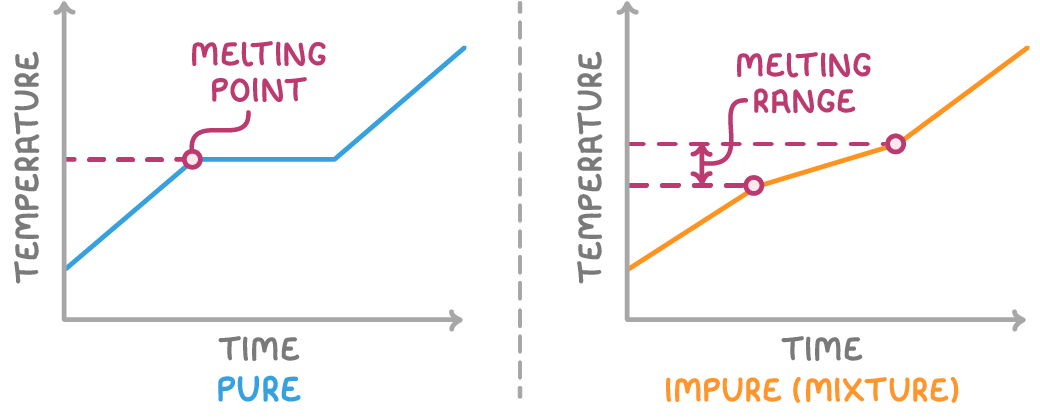
How impurities shift the values
- An impurity lowers the melting point and widens the melting range.
- An impurity raises the boiling point and widens the boiling range.
- For example, pure water freezes at 0 °C and boils at 100 °C. Dissolved salt lowers its melting point (to about -2 °C) and raises its boiling point (to above 100 °C).
Identifying substances and purity
You can test purity and identify an unknown substance by comparing its measured melting and boiling points against reference values in a data book:
- Pure substance - Melts and boils sharply at the exact reference values.
- Impure substance - Melts over a range below the reference melting point, and boils over a range above the reference boiling point.
Purity matters outside the laboratory too. Foods and drugs have to be made to a known purity, because an impurity in either is something a person takes in without intending to.
Formulations
- A formulation is a mixture that has been designed as a useful product.
- Formulations are made by mixing components in carefully measured quantities, where each component has a specific purpose to give the product the required properties.
- Everyday examples include fuels, cleaning agents, paints, medicines, alloys, fertilisers, and foods.
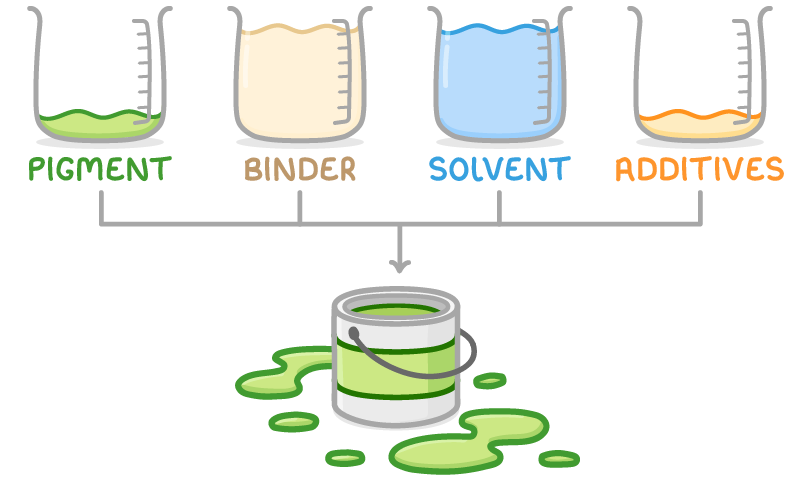
Components of paint
- Pigment - Provides colour.
- Binder - Forms a film that holds the pigment in place on the surface.
- Solvent - Dissolves the other components and adjusts viscosity so it spreads easily.
- Additives - Further modify properties such as drying time or water resistance.
TermDefinition
Pure substanceA substance that consists of a single element or a single compound, with nothing else mixed in.
FormulationA mixture that has been designed as a useful product, with carefully measured quantities of each component.
Key points to remember
How were these notes?