2.11 - Ionic Bonding
Ionic bonding
- There are three types of strong chemical bond - ionic, covalent, and metallic.
- Ionic bonding happens between a metal and a non-metal.
- The metal atom transfers electrons to the non-metal atom:
- The metal loses electrons to become a positive ion.
- The non-metal gains electrons to become a negative ion.
- Both ions end up with a full outer shell.
- The ionic bond is the strong electrostatic attraction between these oppositely charged ions.
Dot-and-cross diagrams
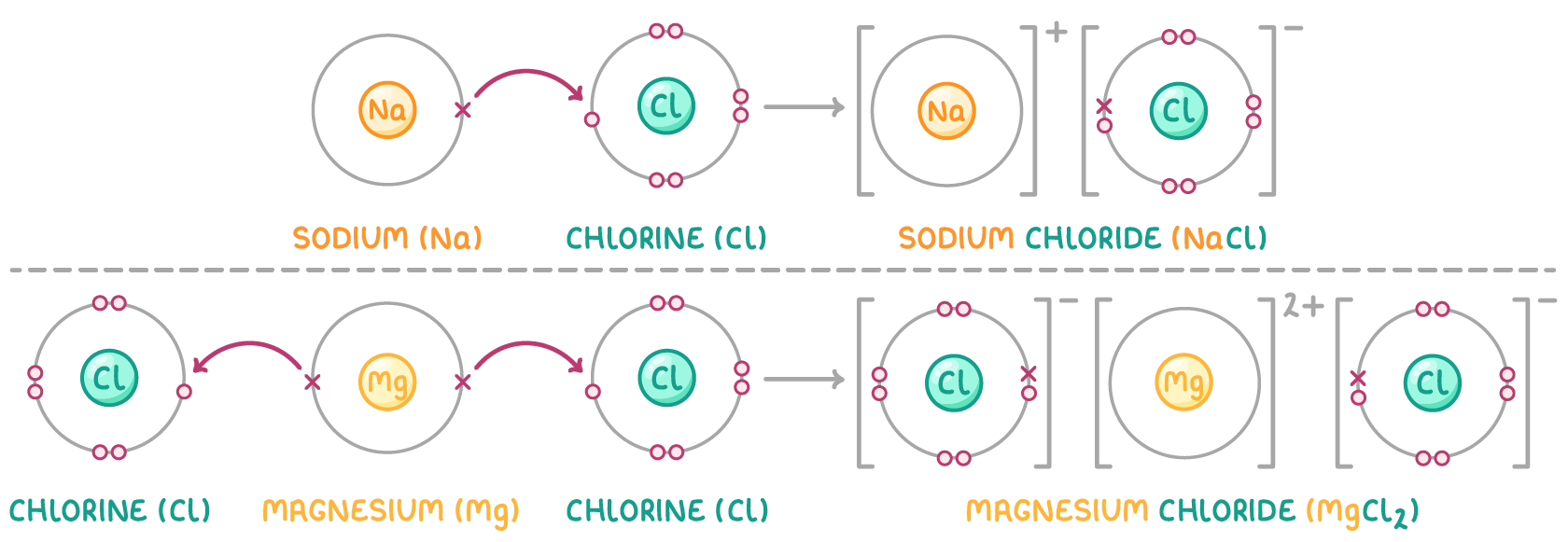
- These show the electron transfer that produces the ions.
- Electrons from one atom are drawn as dots and those from the other as crosses. An arrow shows an electron moving from the metal to the non-metal.
- Usually only the outer shell is drawn, as that's the only one that changes.
- Each finished ion goes in square brackets, with its charge in the top right corner.
Examples of ion formation
- Sodium chloride (NaCl) - The sodium atom loses its one outer electron to become Na+; the chlorine atom gains it to become Cl-.
- Magnesium chloride (MgCl2) - The magnesium atom loses two outer electrons, one to each of two chlorine atoms, becoming Mg2+; each chlorine gains one electron to become Cl-.
Limits of a dot-and-cross diagram
- The size of the ions
- The true arrangement of the ions in the structure
- How many ions a real sample contains
Worked example - Dot-and-cross diagram for K2O
Draw a dot-and-cross diagram to show the formation of potassium oxide, K2O.
Step 1 - Identify the two ions and their charges
- Potassium is in Group 1 - a potassium atom has one outer electron and loses it to form K+.
- Oxygen is in Group 6 - an oxygen atom has six outer electrons and gains two to form O2-.
Step 2 - Work out how many of each ion are needed
- Each potassium atom gives away one electron, but each oxygen atom needs two.
- So one oxygen atom needs an electron from two separate potassium atoms.
- Two K+ ions and one O2- ion balance the charges to zero (+2 and 2−).
Step 3 - Show the electron transfer
- Draw the two potassium atoms and the oxygen atom.
- Draw an arrow from each potassium atom's outer electron to the oxygen atom.
- The oxygen atom gains two electrons to complete its outer shell of eight.
Step 4 - Draw the finished ions
- Draw only the outer shell of each ion.
- Put each ion in square brackets with its charge in the top right corner.
- Draw the two potassium ions either side of the oxide ion.
Step 5 - Answer
- Two K+ ions, each with an empty outer shell, drawn either side of one O2- ion with a full outer shell of eight.
- Check: two ions of +1 and one ion of 2− cancel to zero.

TermDefinition
Ionic bondThe strong electrostatic attraction between oppositely charged ions.
Key points to remember
How were these notes?