3.3 - Conservation of Mass
The law of conservation of mass
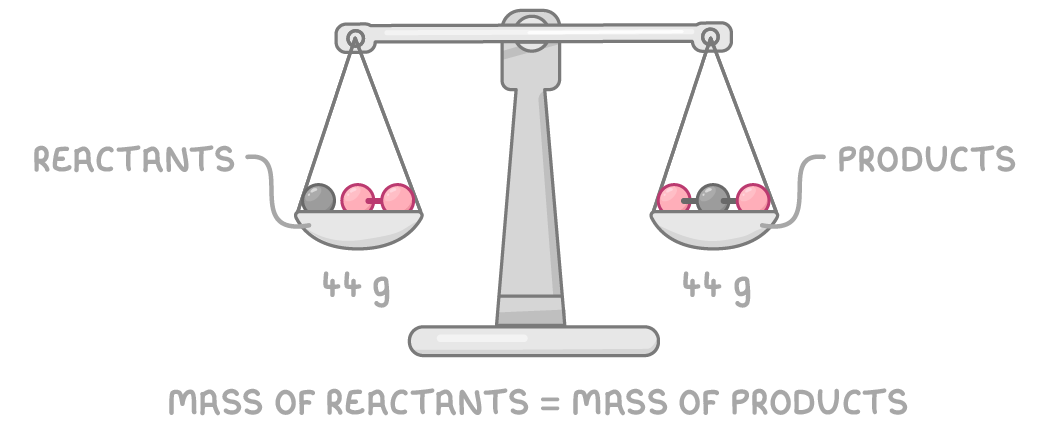
- In any chemical reaction, the total mass of the products equals the total mass of the reactants.
- This is the law of conservation of mass, and it holds for every reaction.
- No atoms are created or destroyed; they're only rearranged into new substances. Because every starting atom is present in the products, total mass cannot change.
Calculating an unknown mass
- Conservation of mass lets you calculate a missing mass by arithmetic.
- If 12 g of carbon reacts completely with 32 g of oxygen, the mass of carbon dioxide produced must be 12 + 32 = 44 g.
Demonstrating conservation in a closed system
- A closed system is a sealed container that no substances can enter or leave.
- When a precipitation reaction is carried out in a closed flask on a balance, an insoluble solid (precipitate) forms, but the mass reading on the balance does not change:
- CuSO4(aq) + 2NaOH(aq) → Cu(OH)2(s) + Na2SO4(aq)
Checking an equation by total relative formula mass
- You can check a balanced equation against the law of conservation of mass by calculating the total relative formula mass (Mr) on each side.
- Multiply each Mr by the balancing number in front of the formula, then add them up for each side:
Working with the numbers
- The balancing number in front multiplies the entire formula (e.g. 2LiF means two lots of LiF).
- A subscript is already included in that formula's own Mr (e.g. O2 is one molecule of two oxygen atoms, counted once).
- Keep decimals in the working if a relative atomic mass includes one (e.g. Cl = 35.5).
Worked example - Total Mr on each side
Sodium burns in chlorine to form sodium chloride. Use relative formula masses to show that mass is conserved.
2Na + Cl2 → 2NaCl
Relative atomic masses: Ar(Na) = 23, Ar(Cl) = 35.5
Step 1 - Total the relative formula masses on the left
There are two sodium atoms and one Cl2 molecule (two chlorine atoms).
Mr(Cl2) = 2 × 35.5 = 71
Total for reactants = (2 × 23) + 71 = 117
Step 2 - Total the relative formula masses on the right
One NaCl is one sodium atom and one chlorine atom, and there are two of them.
Mr(NaCl) = 23 + 35.5 = 58.5
Total for products = 2 × 58.5 = 117
Step 3 - Compare the two totals
Both sides total 117, so they're equal and mass is conserved.
Why mass appears to change in an open vessel
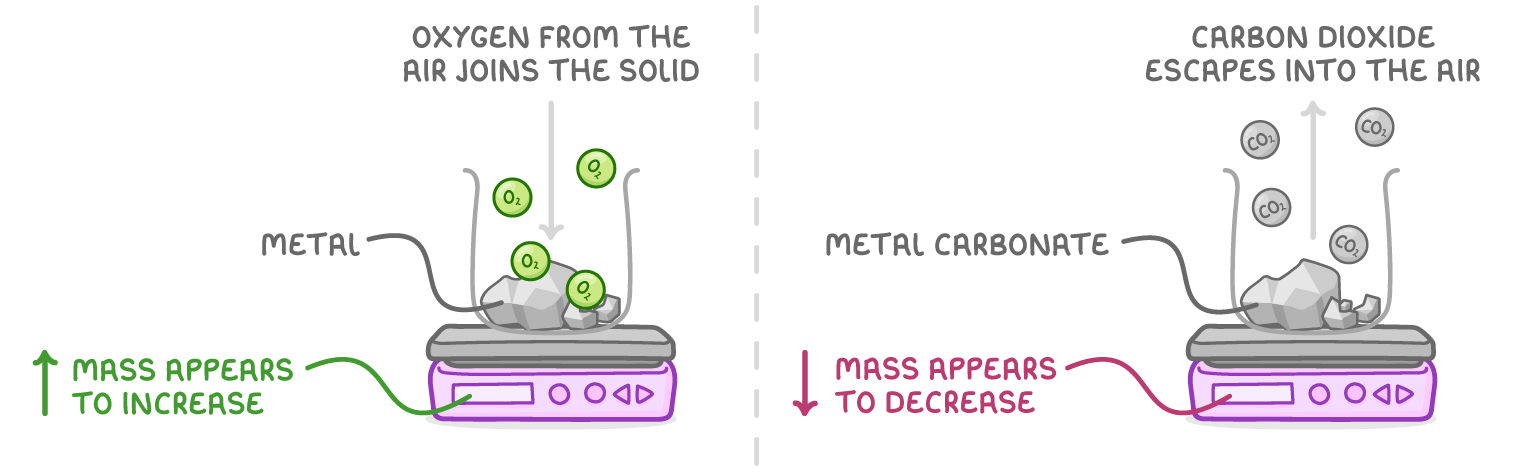
- In a non-enclosed system (an open container), the reading on a balance can change during a reaction.
- Total mass is still conserved: the change happens because a gas has either entered or escaped the container.
When the mass appears to increase
- Happens when a reactant is a gas from the air and the product is a solid or liquid.
- The gas wasn't on the balance at the start, but it gets incorporated into the product inside the container:
- metal(s) + oxygen(g) → metal oxide(s)
The mass increases by the mass of oxygen that reacted.
When the mass appears to decrease
- Happens when a reactant decomposes or reacts to produce a gas in an open container.
- The gas escapes into the surrounding air, so it's no longer weighed:
- metal carbonate(s) → metal oxide(s) + carbon dioxide(g)
The mass decreases by the mass of carbon dioxide that escaped.
Worked example - Explaining a rise in mass
A student heats 2.40 g of magnesium ribbon in an open crucible until it stops burning. The white solid left has a mass of 4.00 g. Explain why the mass has increased.
2Mg(s) + O2(g) → 2MgO(s)
Step 1 - Find the gas and see which side it's on
Oxygen is the only gas, and it's on the left (a reactant). Magnesium and magnesium oxide are both solids, so neither left the crucible.
Step 2 - Work out what the balance was weighing
- At the start - Magnesium alone (2.40 g). The oxygen was in the air, so it wasn't on the balance.
- At the end - Magnesium oxide, which contains magnesium bonded to oxygen.
- Mass increase = 4.00 - 2.40 = 1.60 g of oxygen added.
Step 3 - Answer
The mass increased because oxygen gas from the air reacted with the magnesium to form solid magnesium oxide. The oxygen wasn't on the balance at the start, but became part of the weighed solid product.