1.4 - Isotopes & Relative Atomic Mass
What an isotope is
- Every atom of an element has the same number of protons in its nucleus.
- That proton count is the atomic number (or proton number), and it's what determines which element an atom is.
- Isotopes are atoms of the same element with the same number of protons but different numbers of neutrons.
Isotopes have different mass numbers
- Mass number (or nucleon number) = number of protons + number of neutrons.
- Isotopes of an element share an atomic number but have different mass numbers.
- Most elements exist naturally as a mixture of two or more isotopes.
Carbon as an example
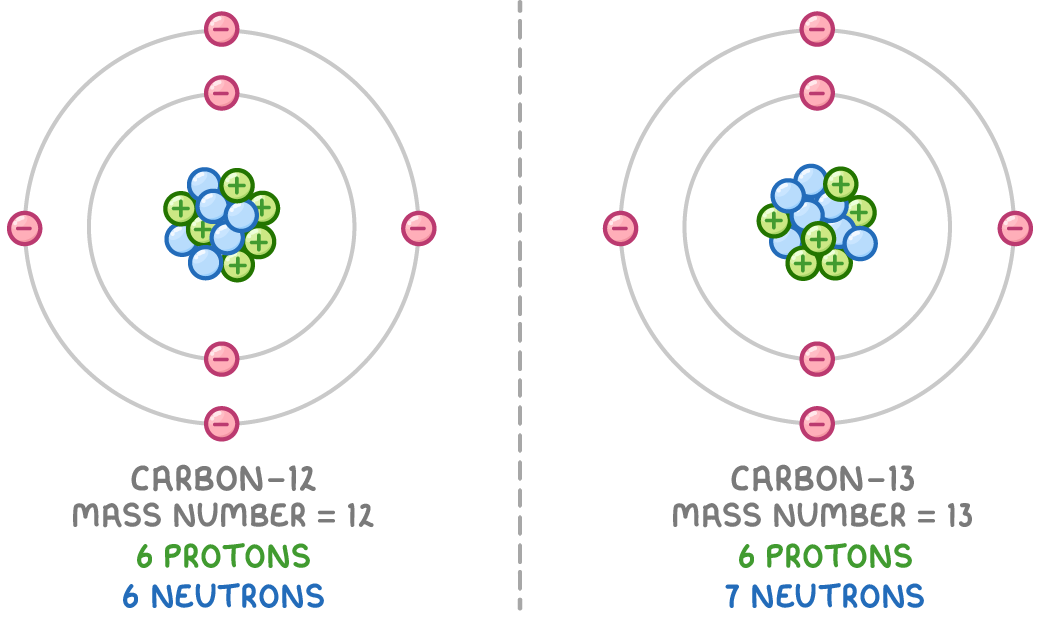
- Carbon-12 - 6 protons, 6 neutrons, 6 electrons.
- Carbon-13 - 6 protons, 7 neutrons, 6 electrons.
- Both are carbon because both have 6 protons; they differ only in their neutron count and mass number.
Relative atomic mass
- Most elements are a mixture of isotopes with different masses, so relative atomic mass () is used to describe the element as a whole.
- The mass of an atom is compared against the carbon-12 atom, which is defined as having a mass of exactly 12.
- Relative atomic mass () is the average mass of an atom of an element compared with one twelfth of the mass of a carbon-12 atom.
It's a weighted average across isotopes
- is a weighted average of the masses of the different isotopes.
- It takes into account both the mass of each isotope and its relative abundance (how common it is).
Whole number or not
- One isotope - equals that isotope's mass number, so it's a whole number.
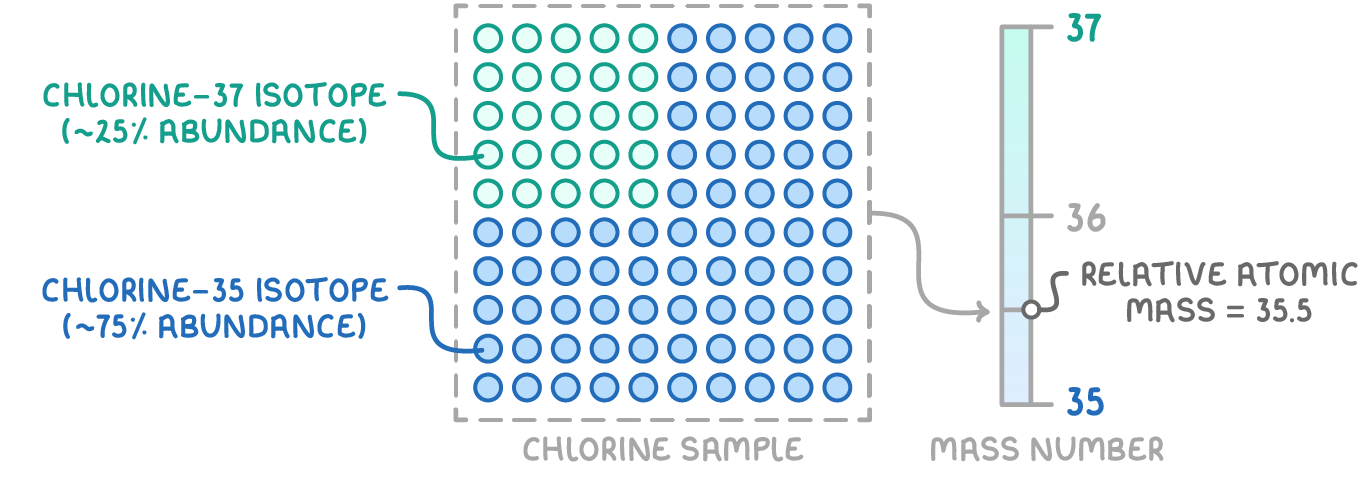
- More than one isotope - The average is pulled towards the more common isotope, so usually isn't a whole number.
- Chlorine is the standard example: it has two main isotopes, chlorine-35 and chlorine-37. Because chlorine-35 is much more abundant, chlorine's is 35.5.
Relative atomic mass vs mass number
- Mass number - The number of protons plus neutrons in one specific atom (always a whole number).
- Relative atomic mass () - the average mass of all the isotopes of an element, taking abundance into account (often not a whole number).
TermDefinition
Atomic numberThe number of protons in the nucleus of an atom.
IsotopeOne of two or more forms of the same element whose atoms have the same number of protons but different numbers of neutrons.
Mass numberThe total number of protons and neutrons in the nucleus of an atom.
Relative atomic massThe average mass of an atom of an element, taking into account the abundance (how common) of each isotope. It is measured on a scale where a carbon-12 atom has a mass of exactly 12.
Key points to remember
How were these notes?