3.8 - Bond Energy Calculations
Bond breaking and bond making
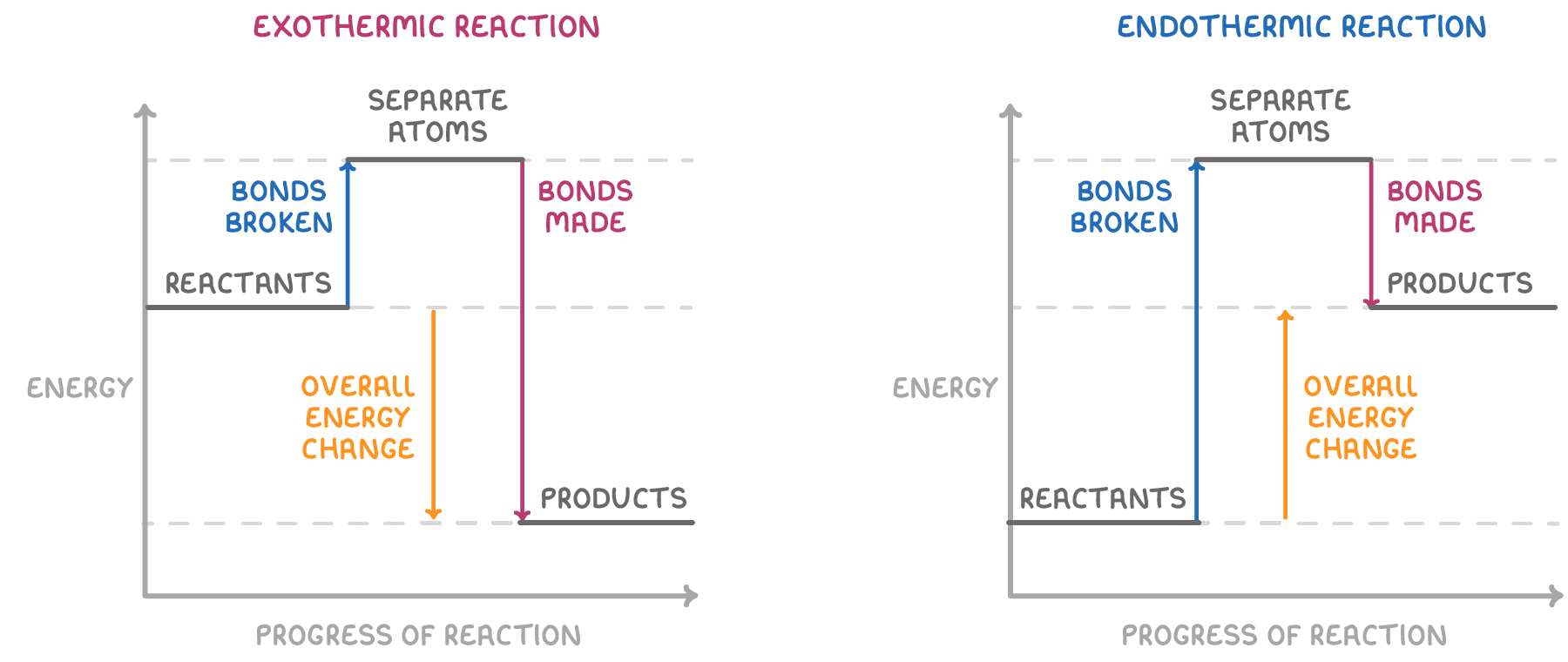
Every chemical reaction breaks bonds in the reactants and makes new bonds in the products.
Breaking bonds is endothermic
Breaking bonds is an endothermic process - it takes energy in from the surroundings.
Making bonds is exothermic
Making bonds is an exothermic process - it gives energy out to the surroundings.
The overall energy change is the balance
Whether a reaction gives out or takes in energy overall depends on the balance:
- If more energy is given out making new bonds than is taken in breaking old ones, the reaction is exothermic.
- If more energy is taken in breaking old bonds than is given out making new ones, the reaction is endothermic.
Calculating an energy change from bond energies
- A bond energy is the energy needed to break a specific bond (and the energy given out when that bond forms).
- A larger bond energy means a stronger bond.
Formula for the energy change
Energy change = energy taken in breaking bonds - energy given out making bonds
The method
- Write out the displayed formulae - Draw every reactant and product showing all bonds so they can be counted. Balancing numbers multiply all bonds in that molecule.
- Total the bond energies of bonds broken - Add up the bond energies for all bonds in the reactants.
- Total the bond energies of bonds made - Add up the bond energies for all bonds in the products.
- Subtract bonds made from bonds broken - Energy change = (bonds broken) - (bonds made).
- Read the sign:
- A negative value means the reaction is exothermic.
- A positive value means the reaction is endothermic.
A double or triple bond has its own supplied bond energy value - don't multiply it by 2 or 3.
Worked example - Energy change for H2 + Cl2
Hydrogen reacts with chlorine to form hydrogen chloride:
H2(g) + Cl2(g) → 2HCl(g)
Use the bond energies below to calculate the energy change and state whether the reaction is exothermic or endothermic.
- H-H bond energy = 436 kJ
- Cl-Cl bond energy = 242 kJ
- H-Cl bond energy = 431 kJ
Step 1 - Write the equation with every bond shown
H-H + Cl-Cl → H-Cl + H-Cl
- Bonds broken (reactants): one H-H bond and one Cl-Cl bond.
- Bonds made (products): two H-Cl bonds.
Step 2 - Total the bonds broken
Energy taken in breaking bonds = (1 × H-H) + (1 × Cl-Cl) = 436 + 242 = 678 kJ
Step 3 - Total the bonds made
Energy given out making bonds = 2 × H-Cl = 2 × 431 = 862 kJ
Step 4 - Subtract bonds made from bonds broken
Energy change = 678 - 862 = -184 kJ
Step 5 - Read the sign
The value is negative, so the reaction is exothermic.
Energy change = -184 kJ