2.12 - Ionic Compounds
The properties of an ionic compound
- An ionic compound is built from huge numbers of ions packed together into a giant structure.
- Ionic compounds share a characteristic set of properties.
High melting and boiling points
- Ionic compounds have high melting points and high boiling points.
- Sodium chloride (table salt) melts at 801 °C and boils at 1,413 °C.
Soluble in water
Most ionic compounds dissolve in water.
Conducting electricity
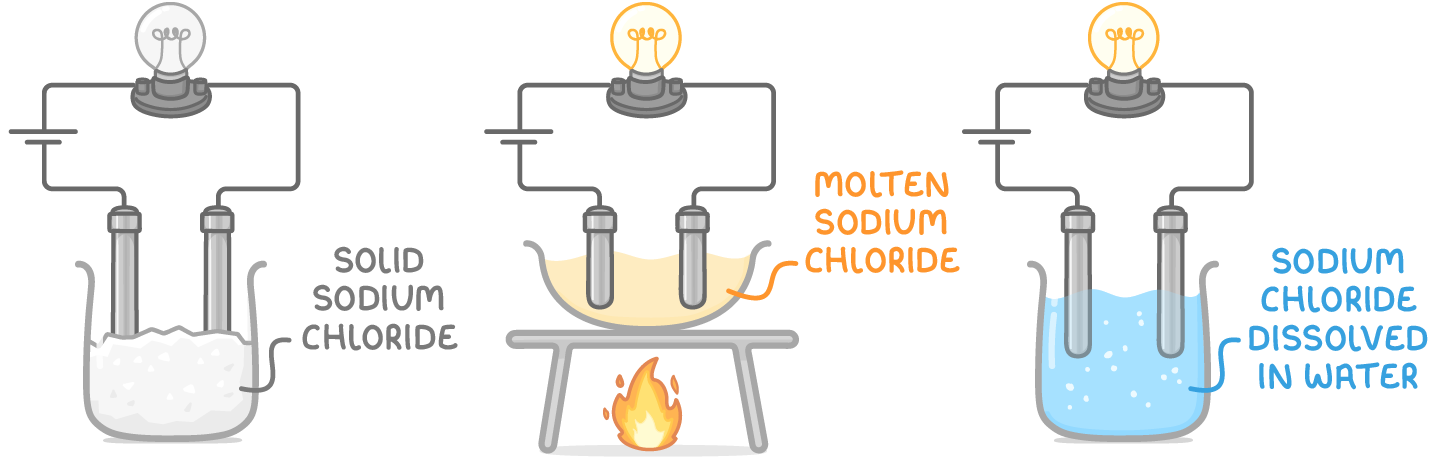
- As a solid, an ionic compound can't conduct electricity.
- When molten or dissolved in water, it conducts electricity.
The giant ionic lattice - Why it explains those properties
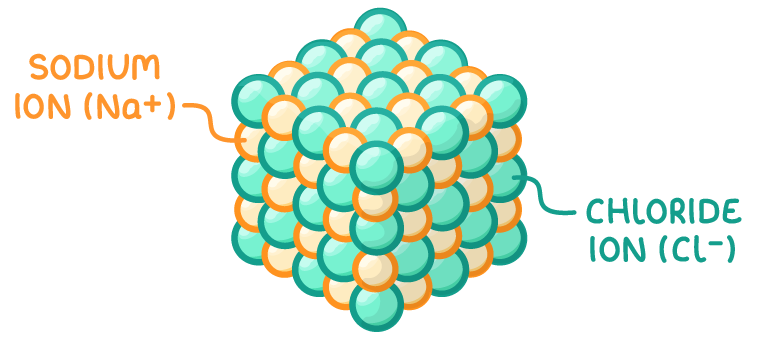
- Oppositely charged ions are attracted to each other by strong electrostatic forces acting in all directions.
- This forms a giant ionic lattice: a regular, repeating 3D arrangement of alternating positive and negative ions.
- In sodium chloride, each sodium ion (Na+) is surrounded by six chloride ions (Cl-), and each chloride ion is surrounded by six sodium ions.
Why melting and boiling points are high
- A giant lattice is held together by many strong ionic bonds.
- Breaking these strong electrostatic attractions throughout the lattice requires a large amount of energy, so ionic compounds have high melting and boiling points.
Why conductivity depends on state
- In a solid, ions are fixed in position in the lattice and can't move, so they can't carry an electric charge.
- When molten or dissolved in water, the lattice breaks apart and the ions are free to move and carry charge.
Why the formula is a ratio
The lattice is a continuous structure with no separate molecules, so its formula is the simplest whole-number ratio of positive to negative ions that balances the overall charge to zero (e.g. NaCl, MgCl2).
TermDefinition
Giant ionic latticeA regular, repeating 3D arrangement of alternating positive and negative ions.
Key points to remember
How were these notes?