2.9 - Electronic Structure
Electron shells and writing an electronic structure
- Electrons occupy shells (also called energy levels) around the nucleus.
- The innermost shell has the lowest energy and fills first.
Rules for filling shells
- Each shell holds a maximum number of electrons:
- First shell holds up to 2
- Second shell holds up to 8
- Third shell holds up to 8 (for elements up to calcium)
- An atom's number of electrons equals its atomic number (number of protons).
Why the outer shell matters
- A full outer shell is a very stable arrangement - the elements of Group 0 already have full outer shells.
- Most atoms have an incomplete outer shell, so they react to achieve a full outer shell.
Writing the electronic structure
- As numbers - Listed from the innermost shell outwards, separated by commas. For example, sodium is 2,8,1.
- As a diagram - The nucleus in the middle, occupied shells drawn as circles, and electrons drawn as dots or crosses on each circle (the diagram of sodium below uses small circles).
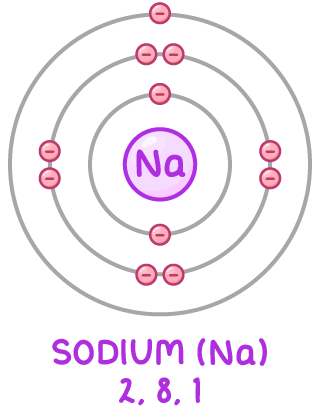
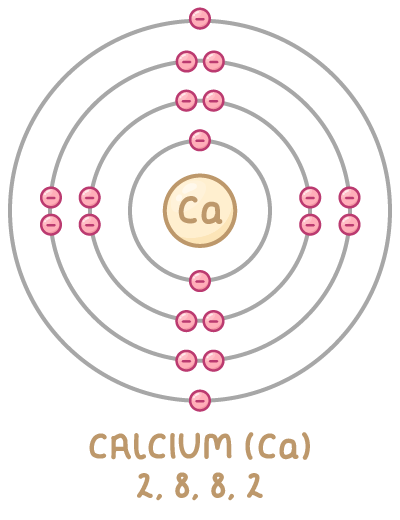
Worked example - Electronic structure of calcium
Work out the electronic structure of calcium.
Step 1 - Find the number of electrons
- Calcium's atomic number is 20, so it has 20 protons.
- An atom has no overall charge, so it must have 20 electrons.
Step 2 - Fill the first shell
The first shell holds a maximum of 2. That leaves 18 to place.
Step 3 - Fill the second shell
The second shell holds a maximum of 8. That leaves 10.
Step 4 - Fill the third shell
The third shell holds a maximum of 8. That leaves 2.
Step 5 - Place what's left
- The third shell is now full, so the last 2 electrons begin a fourth shell.
- The electronic structure of calcium is 2,8,8,2.
Check: the numbers add up to the atomic number - 2 + 8 + 8 + 2 = 20.
Electronic structure and the periodic table
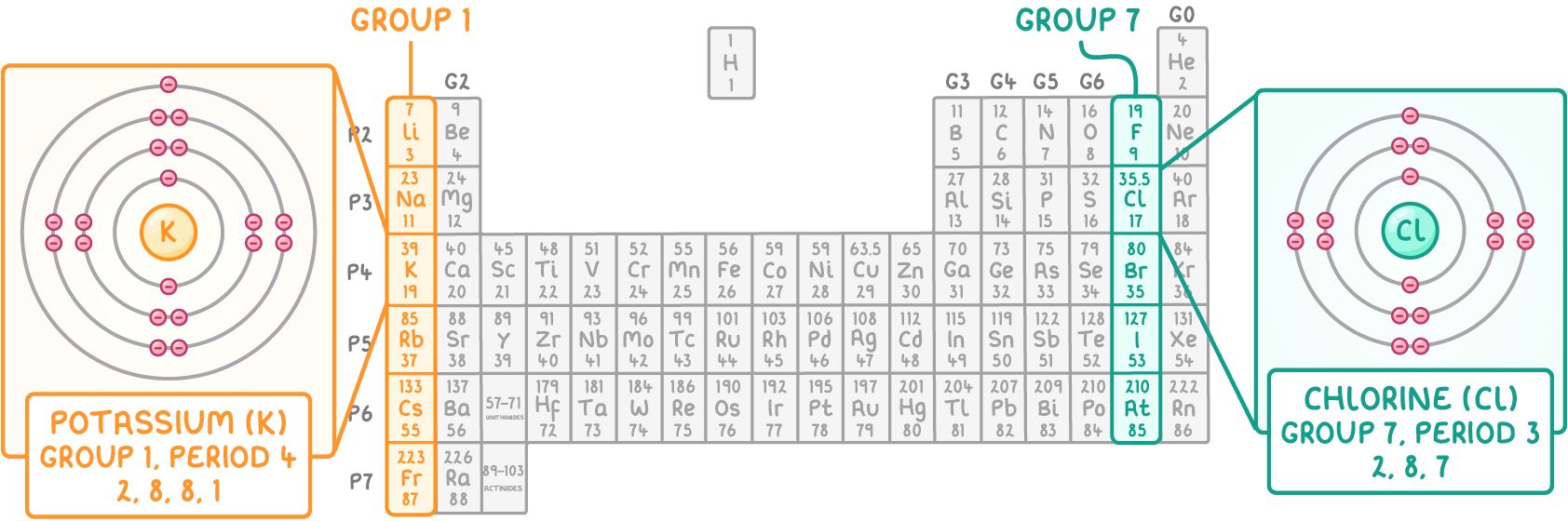
- The group number gives the number of outer-shell electrons (Groups 1 to 7).
- Group 0 is the exception: these atoms have a full outer shell of 8 electrons (except helium, which has 2).
- The period number gives the number of occupied shells. A Period 2 element has electrons in two shells, and a Period 4 element has electrons in four shells.
Putting the two together
- Potassium sits in Group 1 and Period 4: four shells are occupied and the outer shell holds 1 electron, giving 2,8,8,1.
- Chlorine has the electronic structure 2,8,7: three occupied shells place it in Period 3, and seven outer electrons place it in Group 7.
Why a group shares its chemistry
- When atoms react, only the outer-shell electrons are involved.
- Elements in the same group have the same number of outer electrons, so they react in similar ways and share chemical properties.
TermDefinition
Electron shellA region around the nucleus of an atom where electrons are found, also called an energy level.
Electronic structureThe arrangement of electrons in the shells of an atom.
Key points to remember
How were these notes?