7.3 - Preparing a Soluble Salt
The technique
Aim
To make a pure, dry sample of a soluble salt, copper(II) sulfate, by reacting dilute sulfuric acid with an insoluble copper compound.
Background
- An acid reacts with an insoluble metal oxide or carbonate to make a salt, so copper(II) oxide or carbonate with dilute sulfuric acid gives copper(II) sulfate.
- Copper(II) sulfate is a soluble salt, so it dissolves in the water as it forms and can't be filtered out of the mixture.
- You can't see when all the acid has reacted, but you can see when the solid stops disappearing. Adding the solid in excess means all the acid is used up, and the leftover solid can be filtered off.
- So in this practical you add the solid in excess, filter off what's left over, and crystallise the salt from the solution.
Method
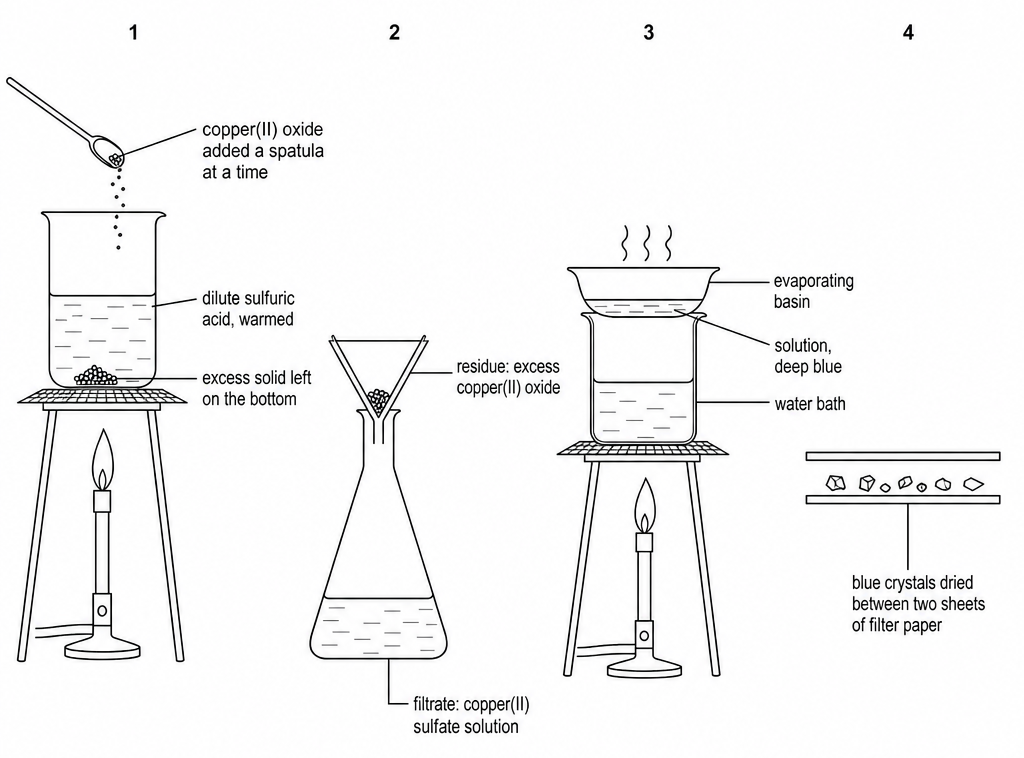
- Warm the acid - Measure dilute sulfuric acid into a beaker, warm it gently on a tripod and gauze, then turn the Bunsen burner off.
- Add the solid - Add copper(II) oxide or copper(II) carbonate a spatula at a time, stirring after each addition. It disappears and the solution turns blue. The carbonate also fizzes.
- Stop when the solid is in excess - Once some stays undissolved on the bottom after stirring, and with the carbonate, once the fizzing stops.
- Filter - Filter the mixture. The unreacted solid stays on the filter paper as the residue, and the blue solution that runs through is the filtrate.
- Evaporate - Heat the filtrate gently in an evaporating basin on a water bath, until about half has gone or crystals appear at the edge.
- Leave it to crystallise - Leave the basin to cool for at least a day. The cooler solution can't hold as much salt, so crystals grow.
- Dry the crystals - Filter them off and pat them dry between two sheets of filter paper, or dry them in a low-temperature oven or a desiccator.
Safety
- Eye protection - Dilute sulfuric acid is an irritant and can splash as the solid is stirred in.
- Hot apparatus - The evaporating basin and water bath stay hot well after heating stops.
Common exam questions
Question 1
Why is excess solid used rather than excess acid?
The leftover solid never dissolved, so it can be filtered off to leave a solution of only the salt. Leftover acid would stay dissolved in the filtrate and end up in the crystals.
Question 2
Why is a water bath or electric heater used to evaporate the solution, rather than heating it directly with a Bunsen burner?
Direct heating is harder to control, and can make the solution spit or boil over, which loses product and is a hazard.
Question 3
Why should the solution not be evaporated to dryness?
Boiling it dry leaves a powder rather than crystals. For a hydrated salt such as copper(II) sulfate, it can also drive off the water that is part of the crystals and leave the white anhydrous salt.
Question 4
Name two other substances that could be reacted with the same acid to make the same salt.
Any two of the metal's oxide, hydroxide, or carbonate, or the metal itself if it's above hydrogen in the reactivity series, other than the one already used.
Question 5
Write a word equation for making a salt from a metal carbonate and a dilute acid.
Metal carbonate + acid → salt + water + carbon dioxide
With a metal oxide or hydroxide instead, there's no carbon dioxide, so metal oxide + acid → salt + water.