6.4 - Life Cycle Assessments
What a life cycle assessment covers
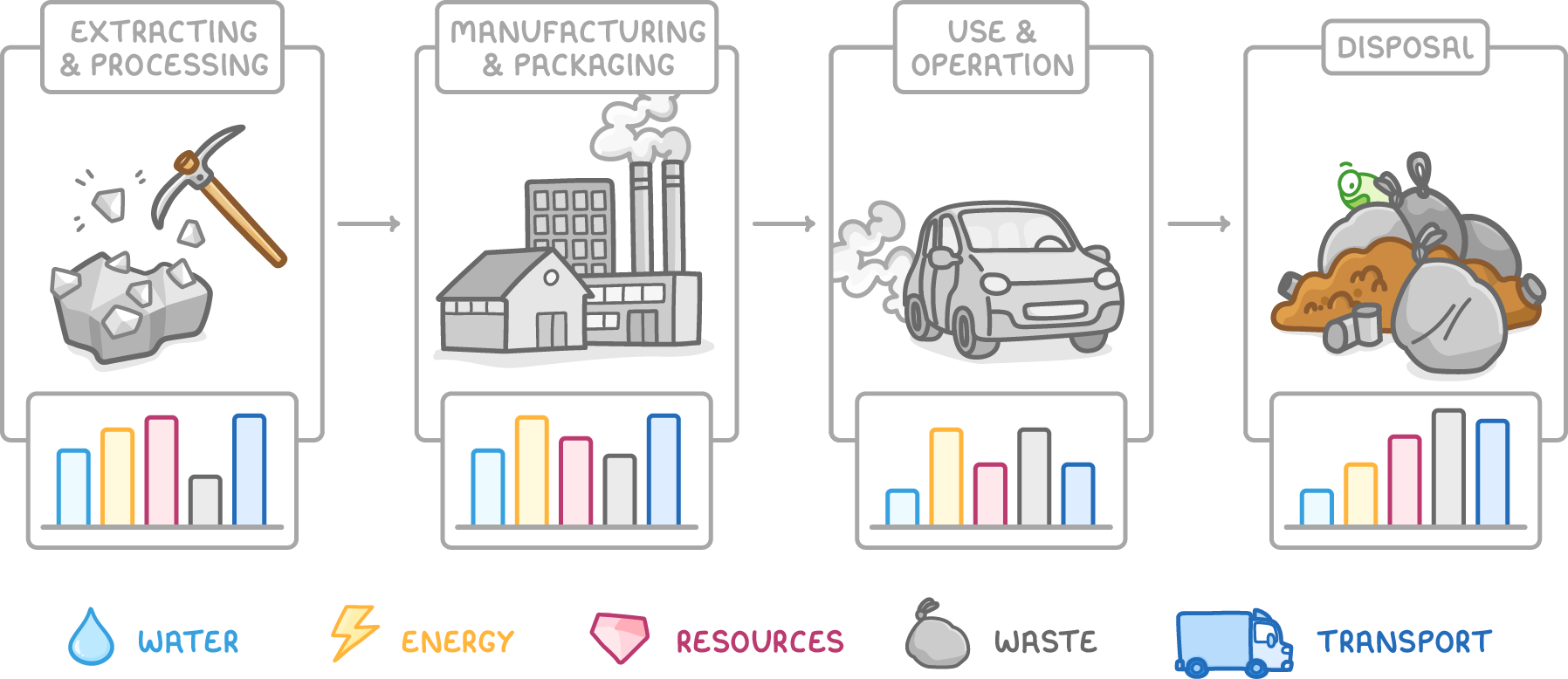
- A life cycle assessment (LCA) works out a product's effect on the environment over its whole life - from getting the raw materials to disposing of it once it's finished with.
- At every stage it counts: water used, energy used, resources taken from the environment, and waste produced.
- Transport is counted alongside every stage, because moving raw materials, the finished product, and waste all use energy and release pollutants.
The four stages
- Extracting and processing the raw materials - Mining, quarrying, or felling timber damages land and destroys habitats. Processing the raw materials into usable forms takes a lot of energy and releases pollutants.
- Manufacturing and packaging - Making the product and packaging uses energy, water, and other resources, releases pollutants, and produces waste.
- Use and operation - Includes the harm done while it's used (such as burning fuels releasing greenhouse gases, or fertilisers polluting waterways) and how long the product lasts before being thrown away.
- Disposal - Space used in landfill, and how easily the material breaks down (biodegradable vs non-biodegradable). Burning waste releases pollutants, though it can generate electricity. Recycling and reusing reduce the amount that needs disposal.
Worked example - Comparing a plastic and a paper bag
A life cycle assessment compares a plastic shopping bag with a paper shopping bag. All figures are for a thousand bags. Decide which bag does less harm to the environment.
| Stage | Plastic bags | Paper bags |
|---|---|---|
| Extracting and processing raw materials | 6 kg crude oil, 500 MJ energy | 50 kg timber, 3,000 MJ energy |
| Manufacturing and packaging | 1,500 MJ energy, 5 m3 water, 20 kg waste | 5,000 MJ energy, 40 m3 water, 90 kg waste |
| Using the product | each bag used about 4 times | each bag used once |
| Disposal | does not break down in landfill | breaks down in landfill |
| Total energy used | 2,000 MJ | 8,000 MJ |
Step 1 - Identify the products and measures
- Two products: a plastic bag and a paper bag.
- Measures: mass of raw material, energy, water, and waste (as figures), plus number of uses and whether it breaks down in landfill (a description).
- Energy is the only measure given at more than one stage.
Step 2 - Compare every measure, stage by stage
- Extraction - Paper takes 50 kg raw material vs 6 kg, and 3,000 MJ vs 500 MJ - plastic is better on both. But paper is made from timber, which is renewable, while plastic is made from crude oil, which is finite.
- Manufacturing - Paper uses 5,000 MJ vs 1,500 MJ, 40 m3 water vs 5 m3, and produces 90 kg waste vs 20 kg - plastic is better on all three.
- Use - each plastic bag is used about 4 times, each paper bag once - about four times as many paper bags are needed for the same shopping.
- Disposal - The paper bag breaks down in landfill and the plastic bag doesn't, so paper is better here.
Step 3 - Total the measure given at more than one stage
- Plastic: 500 + 1,500 = 2,000 MJ.
- Paper: 3,000 + 5,000 = 8,000 MJ.
- Difference = 8,000 - 2,000 = 6,000 MJ, which means the plastic bags use 75% less energy.
Step 4 - Reach one judgement
- The plastic bag does less harm overall: it uses less raw material, less energy, less water, produces less waste, and is reused more times.
- The paper bag is better only at disposal and in using a renewable raw material, which don't outweigh the differences across the other stages.
TermDefinition
Life cycle assessmentAn evaluation of a product's impact on the environment over its whole life, from extracting raw materials to disposal.
Key points to remember
How were these notes?