5.5 - Reversible Reactions & Equilibrium
Reversible reactions
- In a reversible reaction, the products can react together to re-form the original reactants, so the reaction can run in either direction.
- A reversible reaction is written with the ⇌ symbol in place of the usual arrow:
- A + B ⇌ C + D
The direction a reversible reaction runs in, and how far it goes, depends on the conditions (such as temperature, pressure, and concentration).
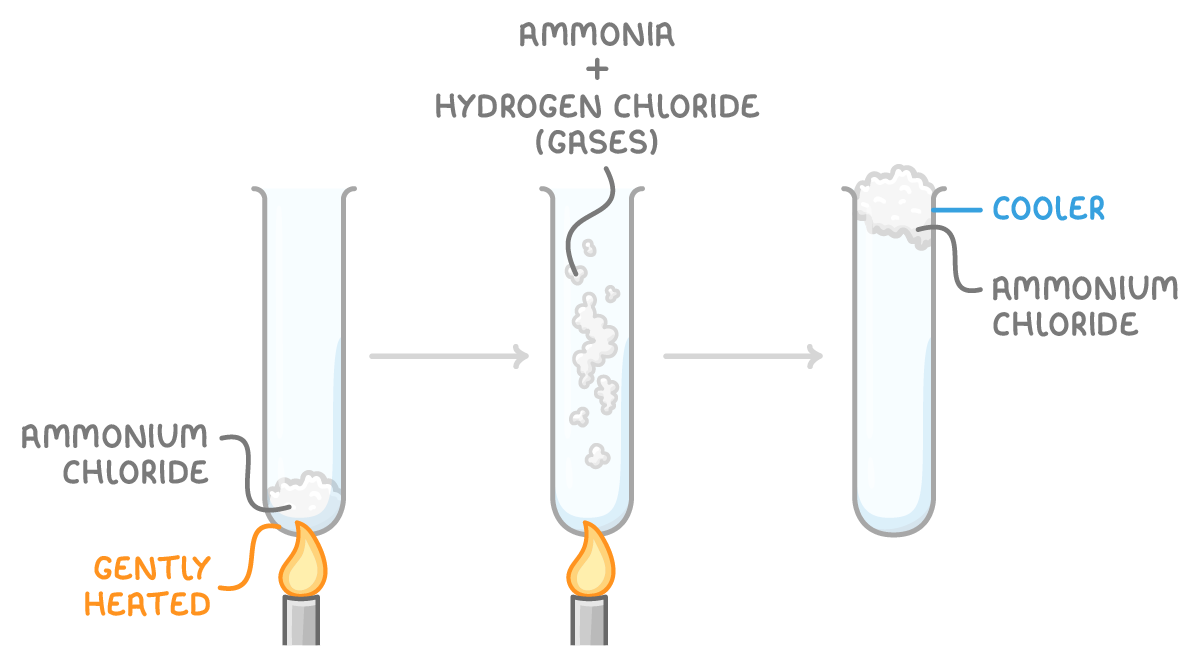
Example - Heating ammonium chloride
- Heating white solid ammonium chloride breaks it down into ammonia and hydrogen chloride (both colourless gases).
- Cooling the gases lets them recombine into solid ammonium chloride again.
- Ammonium chloride ⇌ ammonia + hydrogen chloride
Equilibrium
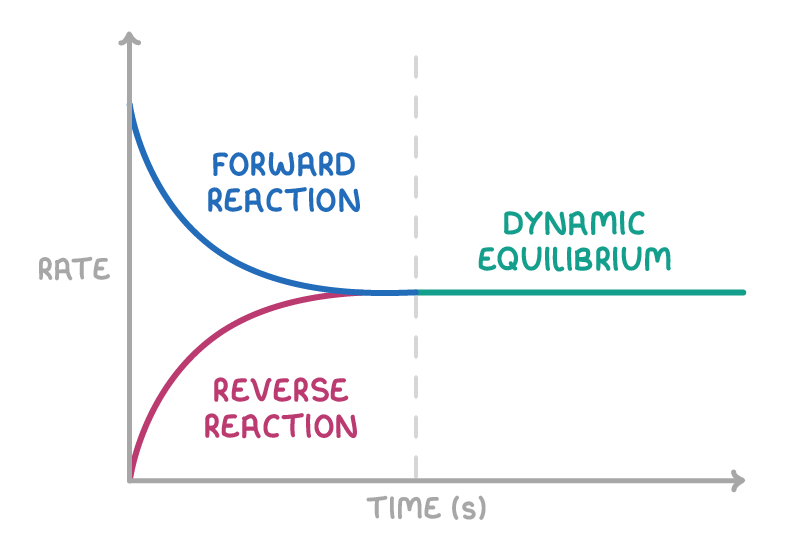
- A reversible reaction reaches equilibrium when it happens in a closed system (where no reactants or products can escape) and the forward and reverse reactions happen at exactly the same rate.
- As reactants turn into products:
- Reactant concentration falls, so the forward reaction slows down.
- Product concentration rises, so the reverse reaction speeds up.
- The two rates become equal, and the concentrations of reactants and products stop changing.
Dynamic equilibrium
Equilibrium is dynamic - it does not mean the reaction has stopped. Both the forward and reverse reactions keep happening at the same rate.
Position of equilibrium
- Being at equilibrium does not mean reactants and products are present in equal amounts.
- The position of equilibrium describes which side the mixture settles towards:
- Lies to the right - more product than reactant
- Lies to the left - more reactant than product
- Where it settles depends on the reaction and the conditions.
Example - Making ammonia
In a closed system, nitrogen and hydrogen react to form ammonia until the reaction reaches equilibrium:
N2 + 3H2 ⇌ 2NH3
Energy changes in reversible reactions
- If a reversible reaction is exothermic in one direction, it is endothermic in the other.
- The same amount of energy is transferred in each direction: the energy taken in by the endothermic reaction equals the energy released by the exothermic reaction.
Hydrated and anhydrous compounds
- Hydrated - A compound with water chemically combined within its crystals
- Anhydrous - A compound with that water removed
Example - Copper(II) sulfate
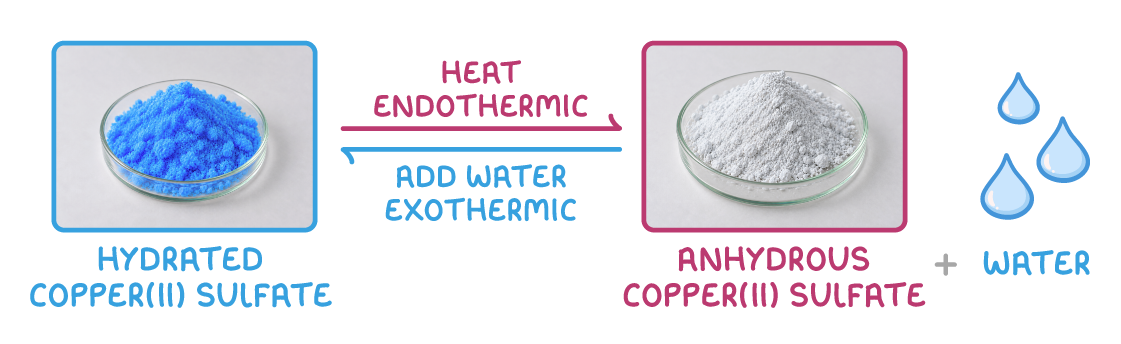
- Heating blue hydrated copper(II) sulfate crystals drives off water to leave white anhydrous copper(II) sulfate powder. This is endothermic.
- Adding water back to the white powder turns it blue again and releases heat. This is exothermic.
- Hydrated copper(II) sulfate (blue) ⇌ anhydrous copper(II) sulfate (white) + water
TermDefinition
Reversible reactionA chemical reaction where the products can react together to re-form the original reactants.
EquilibriumThe state reached by a reversible reaction in a closed system when the forward and reverse reactions happen at exactly the same rate.
Closed systemA system in which no substances can enter or leave, although energy can be transferred.
Dynamic equilibriumA state where the forward and reverse reactions keep happening at the same rate, so the concentrations of reactants and products do not change.
Position of equilibriumA description of whether an equilibrium mixture contains more products or more reactants.
HydratedDescribes a substance that is chemically combined with water, such as a salt whose crystals contain water of crystallisation.
AnhydrousDescribes a substance that contains no water, such as a salt that has had its water of crystallisation removed.
Key points to remember
How were these notes?