2.3 - Metals & Non-Metals
Where metals and non-metals sit
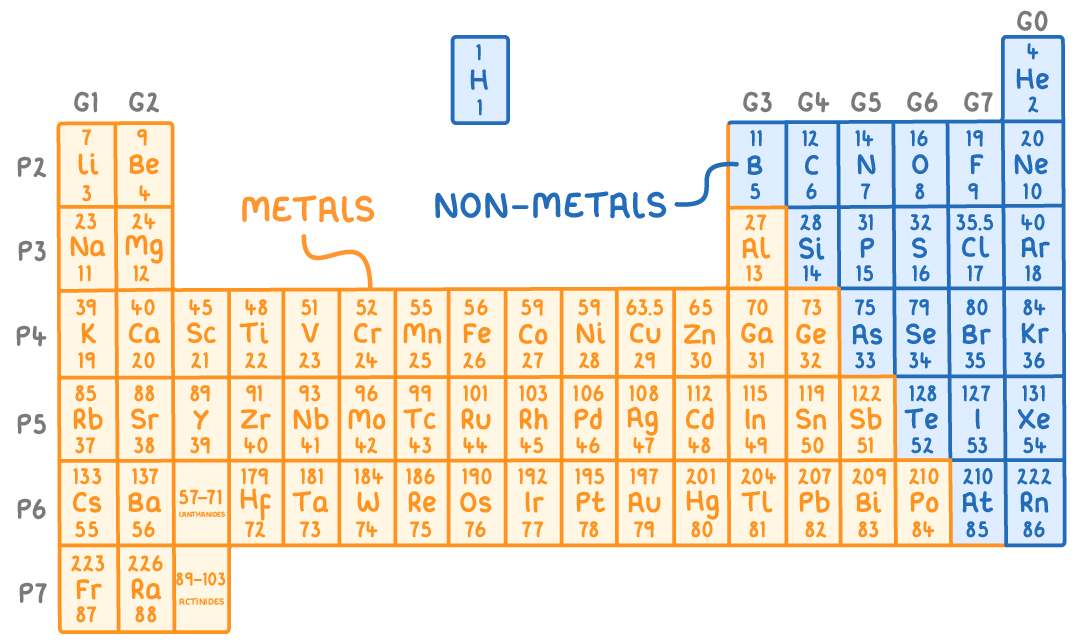
- Most elements in the periodic table are metals. They sit towards the left and the bottom.
- Non-metals occupy the smaller region at the top right.
- The two regions are split by a stepped dividing line that runs from boron to astatine:
- Everything to the left of the line is a metal, except hydrogen, which is a non-metal.
- Everything to the right of the line is a non-metal.
Elements along the dividing line
Elements lying along the dividing line show some properties of metals and some of non-metals, giving them intermediate character (metalloids).
How character changes across a period
Metallic character decreases gradually from left to right across a period, moving from metals on the left to non-metals on the right.
Telling metals and non-metals apart
Metals and non-metals have distinctly different physical properties:
| Property | Metals | Non-metals |
|---|---|---|
| Appearance | Shiny (lustrous) | Dull |
| Conduction of heat and electricity | Good conductors of both | Poor conductors (graphite is an exception for electricity) |
| Malleability and ductility | Malleable (hammered into shape) and ductile (drawn into wires) | Brittle when solid |
| Melting and boiling point | Generally high | Generally low |
| State at room temperature | Nearly all solid (mercury is liquid) | Solids, liquids, or gases |
| Density | Generally high | Generally low |
| Sonority | Sonorous (ring when struck) | Not sonorous |
The oxide test
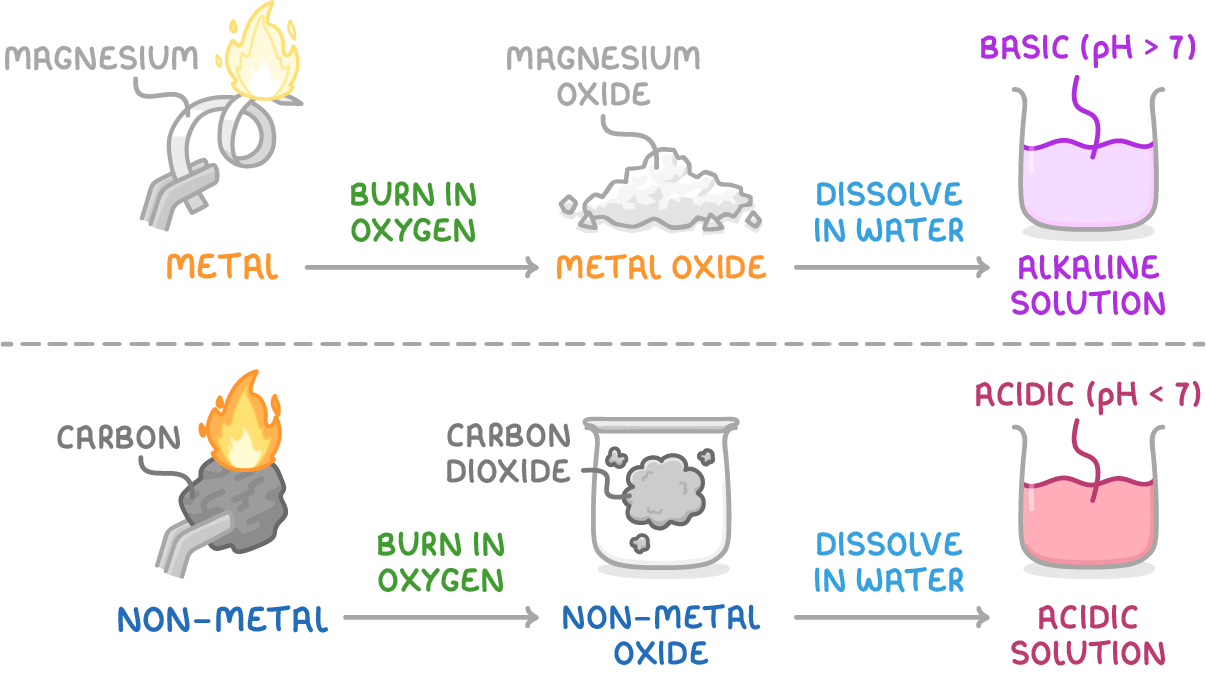
- Metals form basic oxides - They neutralise acids, and soluble metal oxides dissolve in water to give alkaline solutions with a pH above 7.
- Magnesium burns in oxygen to give magnesium oxide, which is basic.
- Non-metals form acidic oxides - They neutralise bases, and soluble non-metal oxides dissolve in water to give solutions with a pH below 7.
- Carbon burns in oxygen to give carbon dioxide, which dissolves to give an acidic solution (pH below 7).
Classifying an unknown element
Two key tests determine whether an element is a metal or a non-metal:
- Electrical conductivity (metals conduct; non-metals do not, with the exception of graphite).
- Acid-base character of its oxide (metals form basic oxides; non-metals form acidic oxides).
TermDefinition
MetalloidAn element that shows some properties of metals and some of non-metals.
MalleableAble to be hammered or pressed into shape without breaking.
DuctileAble to be drawn into wires.
SonorousMaking a ringing sound when struck.
Basic oxideA metal oxide that neutralises acids to form a salt and water. Those that dissolve in water give alkaline solutions.
Acidic oxideA non-metal oxide that neutralises bases to form a salt and water. Those that dissolve in water give acidic solutions.