7.7 - Catalysts for the Decomposition of Hydrogen Peroxide
The experiment
Aim
To compare how well different solids catalyse the decomposition of hydrogen peroxide solution into water and oxygen, by measuring the volume of oxygen gas produced.
Background
- A catalyst speeds up a reaction without being used up.
- Hydrogen peroxide decomposes very slowly on its own, into water and oxygen, 2H2O2(aq) → 2H2O(l) + O2(g). This is a decomposition reaction.
- Manganese(IV) oxide, copper(II) oxide, and zinc oxide all catalyse this reaction, but not equally well.
- You can't see the rate directly, but you can measure the volume of oxygen given off at set times.
- So in this practical you add the same mass of each solid to the same hydrogen peroxide solution and collect the oxygen. The faster the oxygen is produced, the better the catalyst.
Variables
- Independent variable - The solid added, with one run that has no solid.
- Dependent variable - The volume of oxygen produced at set times.
- Control variables - The mass of solid, and the volume and concentration of the hydrogen peroxide solution.
Method
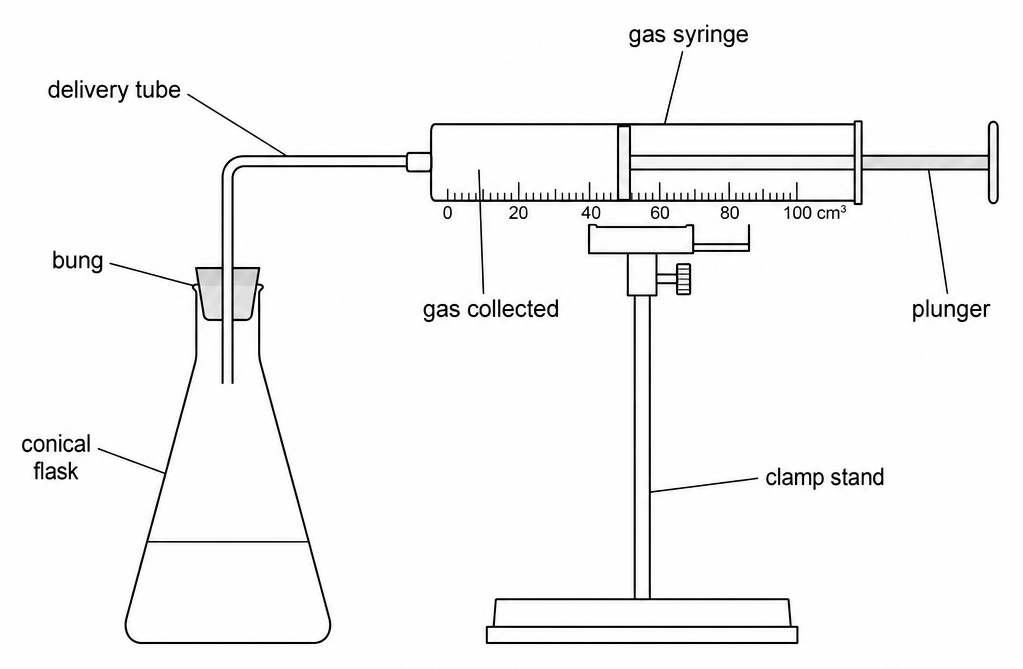
- Measure the hydrogen peroxide - Put a fixed volume of hydrogen peroxide solution of known concentration into a conical flask.
- Weigh the solid - Weigh out a fixed mass of the first solid, and record the exact mass.
- Add the solid - Add it to the flask, fit the bung and delivery tube to the gas syringe at once, and start the stopclock.
- Record the volume - Read the gas syringe every 20 seconds until the volume stops increasing.
- Test the gas - Put a glowing splint into a sample of the gas.
- Recover the solid - Filter it out of the mixture, then wash, dry, and weigh it.
- Repeat with each solid - Keep everything else the same, and do one run with no solid added.
- Repeat each run - Do each run three times, and use the mean volume at each time.
Safety
- Eye protection - Hydrogen peroxide solution is an irritant, and corrosive at higher concentrations, so wash off any spills at once.
- Powders - Some of the solids are irritants, so avoid breathing in the powder and wash your hands after handling them.
- Gas syringe - A fast reaction can push the plunger out, so point it away from people and use only the small mass of solid stated.
Worked example - Comparing catalysts for H2O2
A student added 1 g of manganese(IV) oxide, 1 g of copper(II) oxide, and 1 g of zinc oxide to three identical flasks. Each flask held 50 cm3 of hydrogen peroxide solution of the same concentration. The student measured the volume of oxygen produced every 20 seconds.
| Time in s | 0 | 20 | 40 | 60 | 80 | 100 |
|---|---|---|---|---|---|---|
| Manganese(IV) oxide, volume in cm3 | 0 | 32 | 44 | 48 | 48 | 48 |
| Copper(II) oxide, volume in cm3 | 0 | 14 | 26 | 36 | 44 | 48 |
| Zinc oxide, volume in cm3 | 0 | 4 | 8 | 12 | 16 | 20 |
Identify the most effective catalyst, explain the final volumes, and say how the student could show the catalyst had not been used up.
Step 1 - Plot the graph
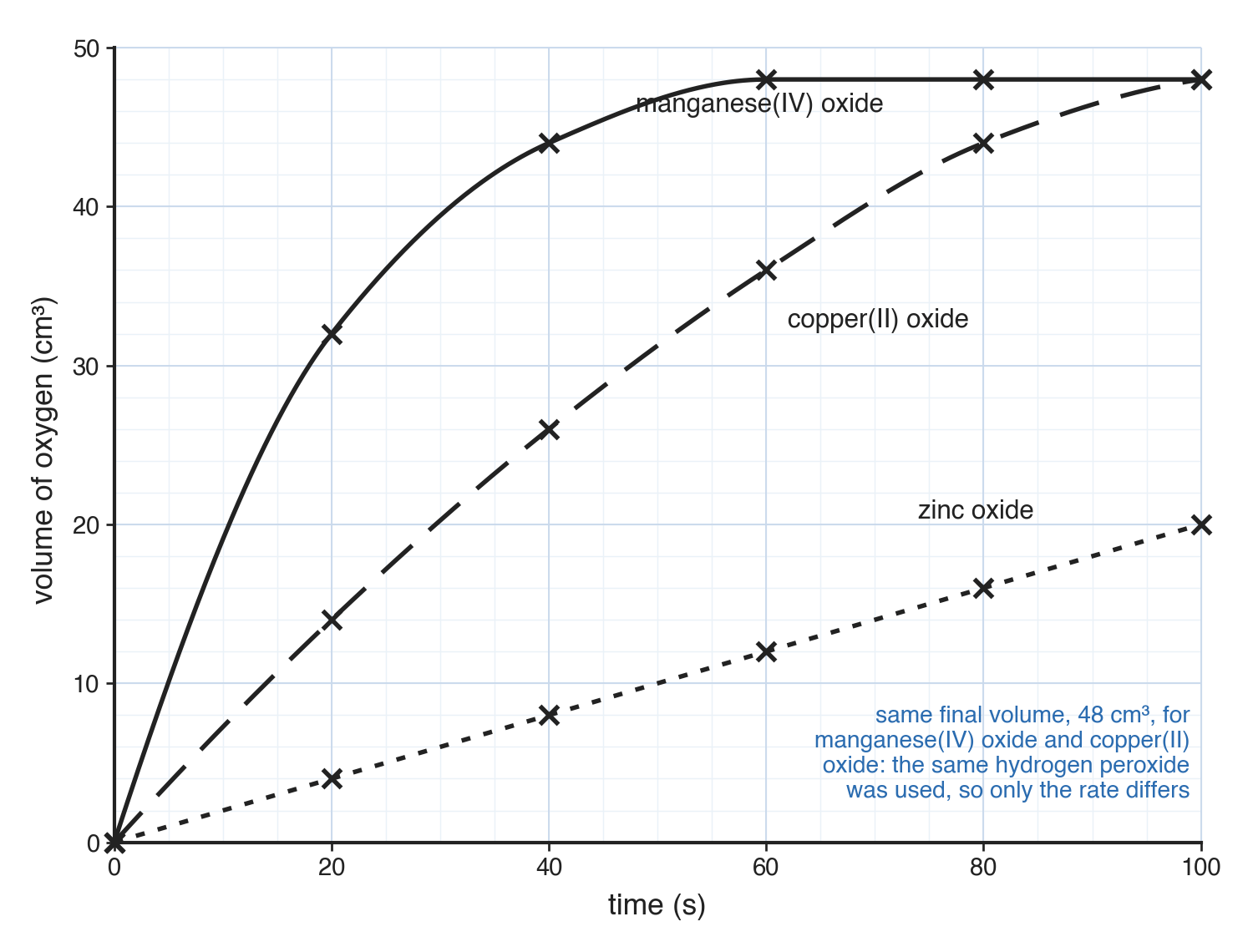
Plot the volume of oxygen against time, and draw a smooth curve for each solid on the same axes, starting from the origin.
Step 2 - Compare the curves
- Manganese(IV) oxide gives the steepest curve, and levels off first, at 48 cm3 by 60 s.
- Copper(II) oxide is slower, but reaches the same 48 cm3 by 100 s.
- Zinc oxide is much slower, and has only produced 20 cm3 by 100 s.
Step 3 - Identify the most effective catalyst
Manganese(IV) oxide is the most effective. It gives the fastest rate at the start and reaches the final volume in the shortest time.
Step 4 - Explain the final volumes
The same amount of hydrogen peroxide was used in each flask, so manganese(IV) oxide and copper(II) oxide both give the same total volume of oxygen, 48 cm3. Only the rate differs. Zinc oxide had not finished in the 100 s measured, so its 20 cm3 is not a final volume. Given long enough, it would reach 48 cm3 as well.
Step 5 - Show the catalyst isn't used up
Filter the manganese(IV) oxide out once the reaction finishes, then wash, dry, and weigh it. Its mass is still 1 g, which shows it hasn't been used up.
Common exam questions
Question 1
Why is a run with no solid added included?
It shows how fast the reaction goes without a catalyst, so there's something to compare with. Without it, nothing shows that the solids speed the reaction up at all.
Question 2
How is the gas shown to be oxygen?
A glowing splint put into the gas relights.
Question 3
Use collision theory to explain why adding a catalyst increases the rate of oxygen production.
A catalyst provides a different pathway for the reaction with a lower activation energy. A greater proportion of collisions have enough energy to react, so the reaction is faster.
Question 4
Why must the flask be sealed as soon as the solid is added?
The reaction starts as soon as the solid touches the hydrogen peroxide solution. Any delay lets oxygen escape before it's measured, so the volume readings are too low.
Question 5
A student repeats the experiment using twice the mass of the same catalyst. What effect does this have?
The rate increases, because there's more catalyst surface for the hydrogen peroxide to react on, giving more frequent successful collisions. The final volume of oxygen stays the same.