6.5 - Reactions of Alkanes
Combustion and the tests for the products
- Alkanes are generally unreactive because their C-C and C-H bonds are strong single covalent bonds, so they take part in very few reactions.
- Burning is the main reaction they undergo, which is why they matter as fuels. A fuel is a substance that releases energy as heat when it's burned.
Complete combustion
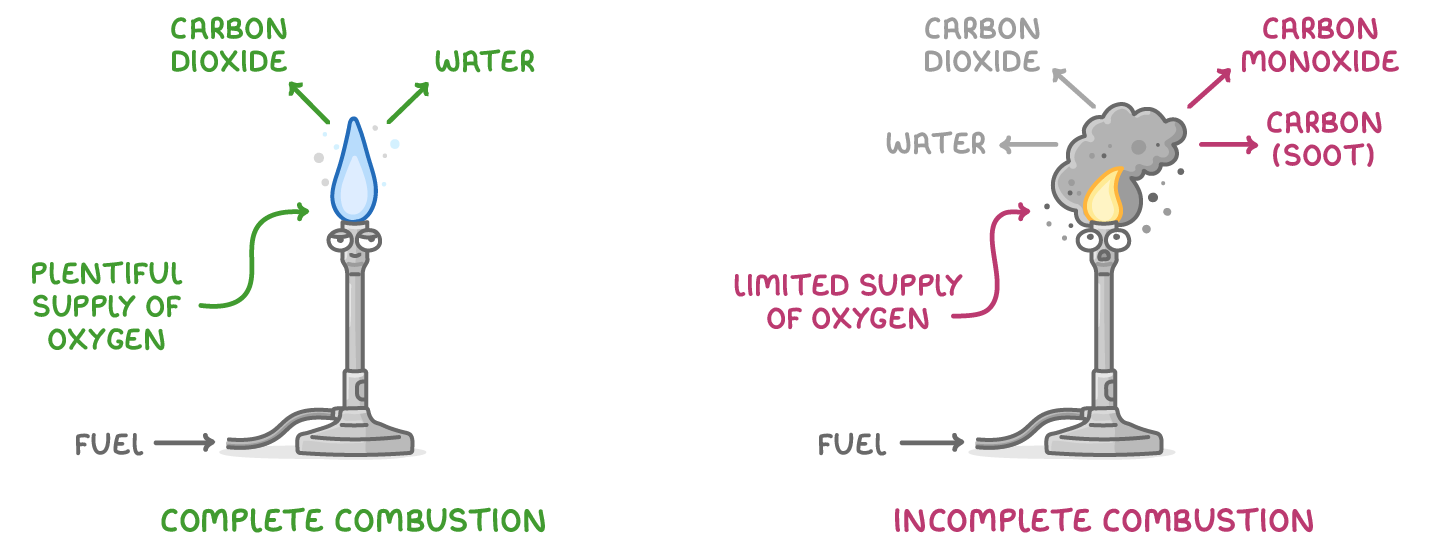
- When a hydrocarbon burns in a plentiful supply of oxygen, the reaction is called complete combustion.
- Every carbon atom is oxidised to carbon dioxide and every hydrogen atom to water:
- hydrocarbon + oxygen → carbon dioxide + water
For methane, the simplest hydrocarbon:
CH4 + 2O2 → CO2 + 2H2O
Complete combustion releases a large amount of energy, which is why hydrocarbons are used as fuels.
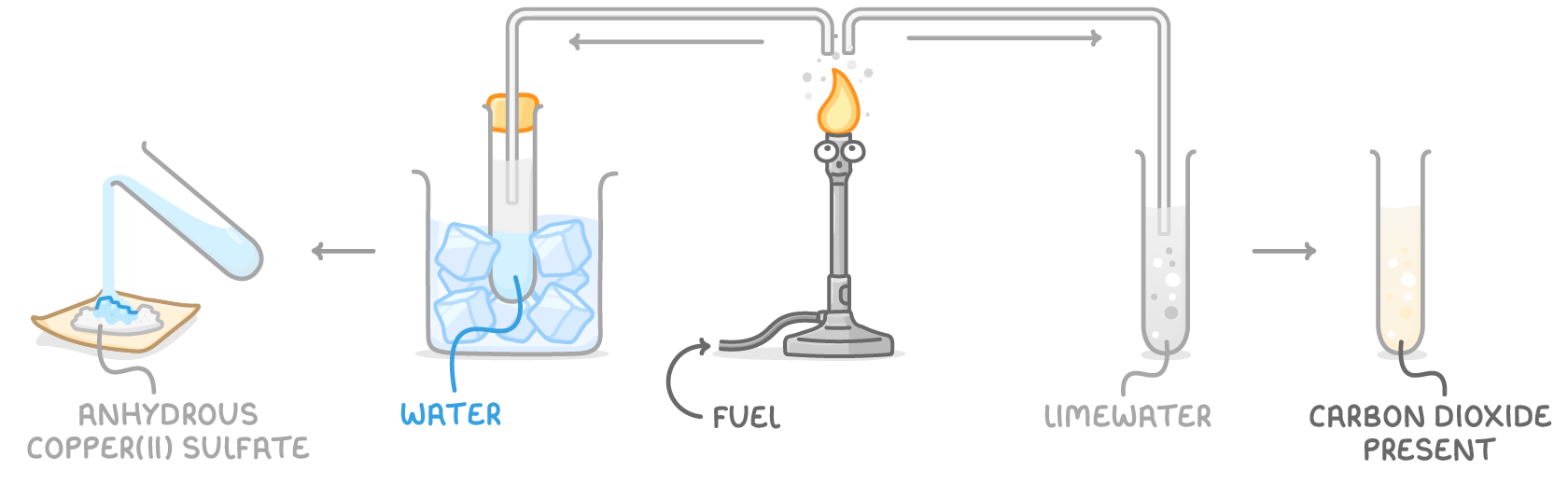
Both products can be identified if the gases leaving a burning fuel are collected:
- Carbon dioxide turns limewater from colourless to milky when the gases are bubbled through it.
- Water condenses to a colourless liquid when the gases are cooled, and turns white anhydrous copper(II) sulfate blue.
Incomplete combustion
- Burning a hydrocarbon in a limited supply of oxygen gives incomplete combustion.
- There's not enough oxygen to oxidise every carbon atom to carbon dioxide, so other products form:
- Carbon monoxide, CO - A toxic gas with one oxygen atom per carbon atom instead of two.
- Carbon - Released as fine solid particles (particulates), seen as soot.
- Carbon dioxide and water are still formed, so the products are usually a mixture of all four.
- Incomplete combustion produces a smoky yellow flame and releases less energy than complete combustion of the same amount of fuel.
Balancing an incomplete combustion equation
Balance it the same way as a complete combustion equation, with carbon monoxide written in place of carbon dioxide:
2C3H8 + 7O2 → 6CO + 8H2O
- Order: balance the carbon atoms first, then the hydrogen atoms, and the oxygen atoms last.
- Most fuels are compounds of carbon and hydrogen, but some contain sulfur, which oxidises to sulfur dioxide as it burns.
Writing a combustion equation
Burning a hydrocarbon fuel in plenty of oxygen always gives carbon dioxide and water:
fuel + O2 → CO2 + H2O
To balance the equation, put balancing numbers in front of the formulae. Never change the formulae themselves.
The method
- Write the unbalanced equation. Put the fuel and oxygen (O2) on the left, and carbon dioxide and water on the right.
- Balance the carbon atoms. Count the carbon atoms in one molecule of fuel and write that number in front of CO2.
- Balance the hydrogen atoms. Count the hydrogen atoms in one molecule of fuel and halve it (each H2O holds two). Write the result in front of H2O.
- Balance the oxygen atoms last. Count the oxygen atoms on the right: two in every CO2 plus one in every H2O. If the fuel contains oxygen, subtract it. Halve what's left (each O2 holds two) and write the result in front of O2.
- Clear any half. If the number in front of O2 ends in a half, double every balancing number so they are all whole numbers.
- Check. Count each element on both sides to confirm the totals match.
Worked example - Combustion equation for propane
Write the balanced symbol equation for the complete combustion of propane, C3H8.
Step 1 - Write the unbalanced equation
Fuel and oxygen on the left, carbon dioxide and water on the right:
C3H8 + O2 → CO2 + H2O
Step 2 - Balance the carbon atoms
One molecule of propane holds three carbon atoms, so three CO2 are needed:
C3H8 + O2 → 3CO2 + H2O
Step 3 - Balance the hydrogen atoms
Propane holds eight hydrogen atoms. Halving eight gives four, so four H2O are needed:
C3H8 + O2 → 3CO2 + 4H2O
Step 4 - Balance the oxygen atoms last
The right side holds 3 × 2 = 6 oxygen atoms in CO2 and 4 × 1 = 4 in H2O, so 10 in total. Propane contains no oxygen, so all 10 come from O2. Halving 10 gives five:
C3H8 + 5O2 → 3CO2 + 4H2O
Step 5 - Clear any half
Five is already a whole number, so nothing is doubled.
Step 6 - Check
- Carbon: 3 on the left, 3 on the right.
- Hydrogen: 8 on the left, 8 on the right.
- Oxygen: 10 on the left, 6 + 4 = 10 on the right.
The balanced equation for the complete combustion of propane is:
C3H8 + 5O2 → 3CO2 + 4H2O
Alkanes and chlorine
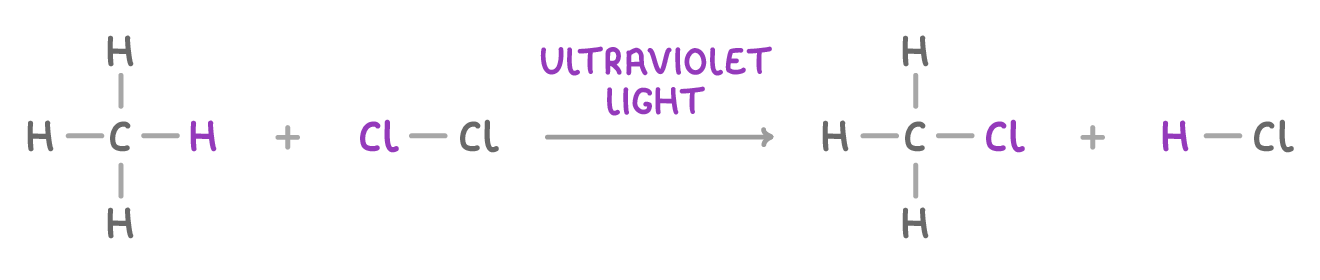
- Alkanes react with halogens in a substitution reaction.
- In a substitution reaction, one atom or group of atoms in a molecule is replaced by another atom or group of atoms.
- A hydrogen atom on the alkane is replaced by a halogen atom, and the displaced hydrogen atom joins the remaining halogen atom to form a hydrogen halide.
Two conditions on the reaction
- It needs ultraviolet light - A mixture of an alkane and a halogen doesn't react in the dark; ultraviolet light supplies the energy to start the reaction.
- It doesn't have to stop at one substitution - With excess chlorine, further hydrogen atoms can be replaced in turn.
Methane and chlorine
With chlorine, methane forms chloromethane and hydrogen chloride:
methane + chlorine → chloromethane + hydrogen chloride
CH4 + Cl2 → CH3Cl + HCl
The chloromethane molecule keeps the shape of methane: the carbon atom makes four single covalent bonds - three to hydrogen atoms and the fourth to the chlorine atom.