5.6 - Reversible Reactions & Equilibrium
Reversible reactions
- In a reversible reaction, the products can react together to re-form the original reactants, so the reaction can run in either direction.
- A reversible reaction is written with the ⇌ symbol in place of the usual arrow:
- A + B ⇌ C + D
The direction a reversible reaction runs in, and how far it goes, depends on the conditions (such as temperature, pressure, and concentration).
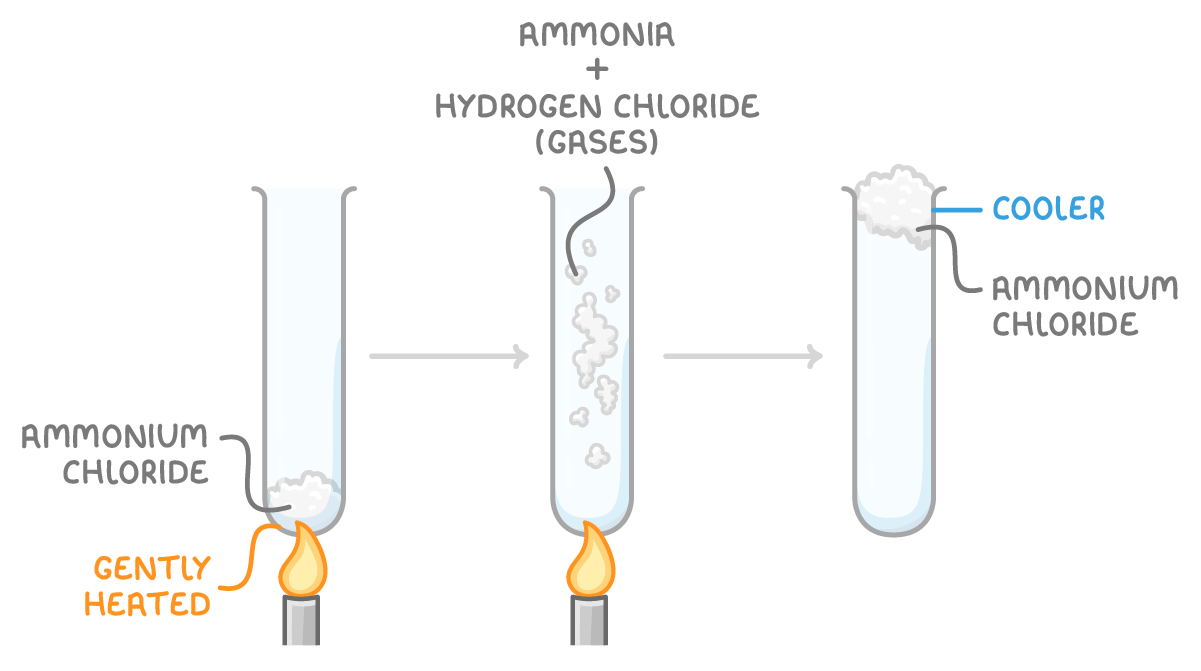
Example - Heating ammonium chloride
- Heating white solid ammonium chloride breaks it down into ammonia and hydrogen chloride (both colourless gases).
- Cooling the gases lets them recombine into solid ammonium chloride again.
- Ammonium chloride ⇌ ammonia + hydrogen chloride
Energy changes in reversible reactions
- If a reversible reaction is exothermic in one direction, it is endothermic in the other.
- The same amount of energy is transferred in each direction: the energy taken in by the endothermic reaction equals the energy released by the exothermic reaction.
Hydrated and anhydrous compounds
- Hydrated - A compound with water chemically combined within its crystals
- Anhydrous - A compound with that water removed
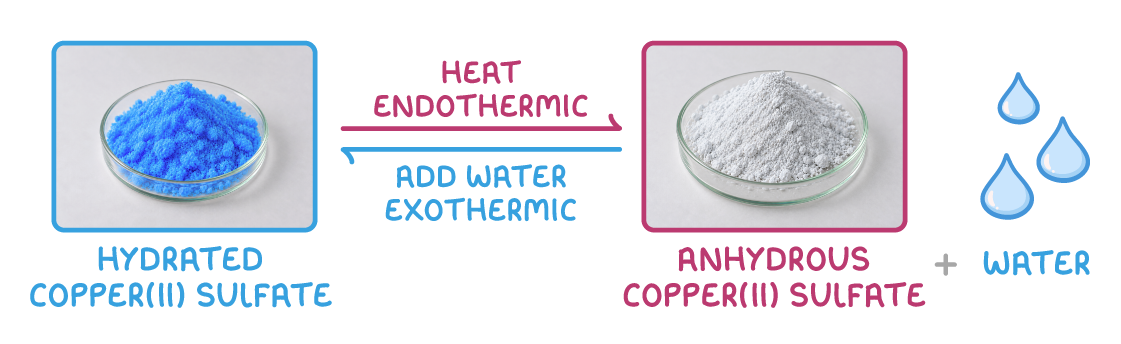
Example - Copper(II) sulfate
- Heating blue hydrated copper(II) sulfate crystals drives off water to leave white anhydrous copper(II) sulfate powder. This is endothermic.
- Adding water back to the white powder turns it blue again and releases heat. This is exothermic.
- Hydrated copper(II) sulfate (blue) ⇌ anhydrous copper(II) sulfate (white) + water
TermDefinition
Reversible reactionA chemical reaction where the products can react together to re-form the original reactants.
HydratedDescribes a substance that is chemically combined with water, such as a salt whose crystals contain water of crystallisation.
AnhydrousDescribes a substance that contains no water, such as a salt that has had its water of crystallisation removed.