10.8 - Rate of Reaction by Timing to an End Point
The experiment
Aim
To find out how the concentration of sodium thiosulfate solution affects the rate of its reaction with dilute hydrochloric acid, by timing how long a cross takes to disappear from view.
Background
- Reactions happen when particles collide with enough energy. The more often they collide, the faster the reaction.
- Sodium thiosulfate solution and hydrochloric acid are both colourless, but they react to form a yellow precipitate of sulfur, which makes the mixture cloudy.
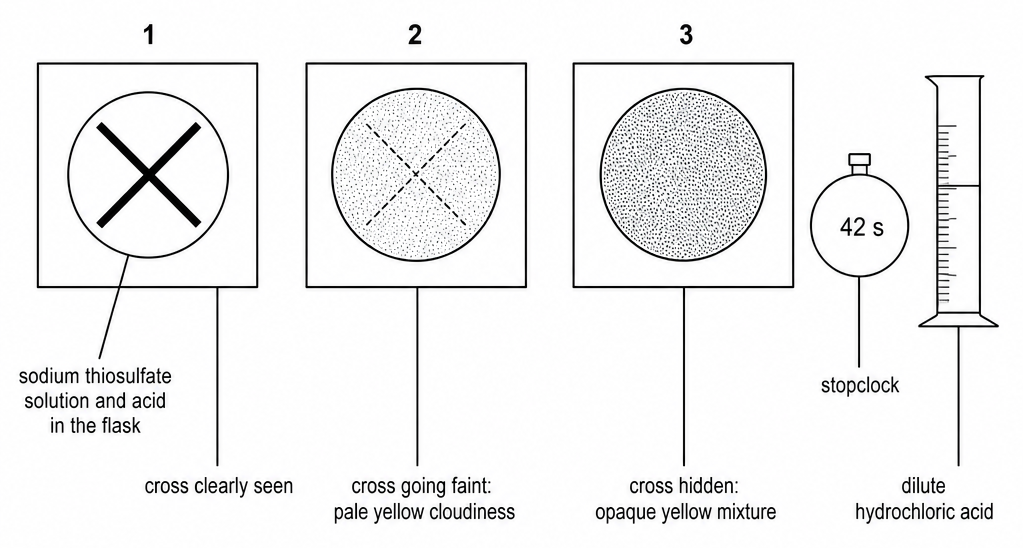
- You can't see the rate directly, but you can time how long the mixture takes to get cloudy enough to hide a cross under the flask.
- So in this practical you time how long the cross takes to disappear at different concentrations. The shorter the time, the faster the rate of reaction.
Variables
- Independent variable - The concentration of the sodium thiosulfate solution, or its temperature.
- Dependent variable - The time taken for the cross to disappear.
- Control variables - The volume and concentration of the acid, the total volume of thiosulfate solution and water, the temperature or the thiosulfate concentration (whichever isn't being changed), the cross, and the person watching it.
Method
- Draw a cross - Draw a thick black cross on paper and stand a conical flask on it.
- Make up the thiosulfate solution - Measure sodium thiosulfate solution and water into the flask, so the total volume is the same each time. Less thiosulfate and more water gives a lower concentration.
- Add the acid - Add a measured volume of dilute hydrochloric acid, swirl, and start the stopclock at the same moment.
- Stop the clock - Look down through the flask, and stop the clock as soon as you can't see the cross.
- Repeat at other concentrations - Keep the total volume the same, and do each concentration three times so you can find a mean.
- Or change the temperature - Keep the thiosulfate concentration the same, and change its temperature instead, by warming it in a water bath or mixing warm and cold solution. Record its temperature just before you add the acid, and time the cross in the same way.
Safety
- Eye protection - Dilute hydrochloric acid is an irritant.
- Ventilation - The reaction gives off sulfur dioxide, an irritant gas, so work in a well-ventilated room and don't breathe over the flask.
Worked example - Rate against concentration graph
A student reacted sodium thiosulfate solution with dilute hydrochloric acid at five concentrations, and timed how long a cross took to disappear. Each time, the thiosulfate solution was diluted with water to a total volume of 50 cm3.
| Concentration of thiosulfate in g/dm3 | 40 | 32 | 20 | 16 | 8 |
|---|---|---|---|---|---|
| Time taken in s | 20 | 25 | 40 | 50 | 100 |
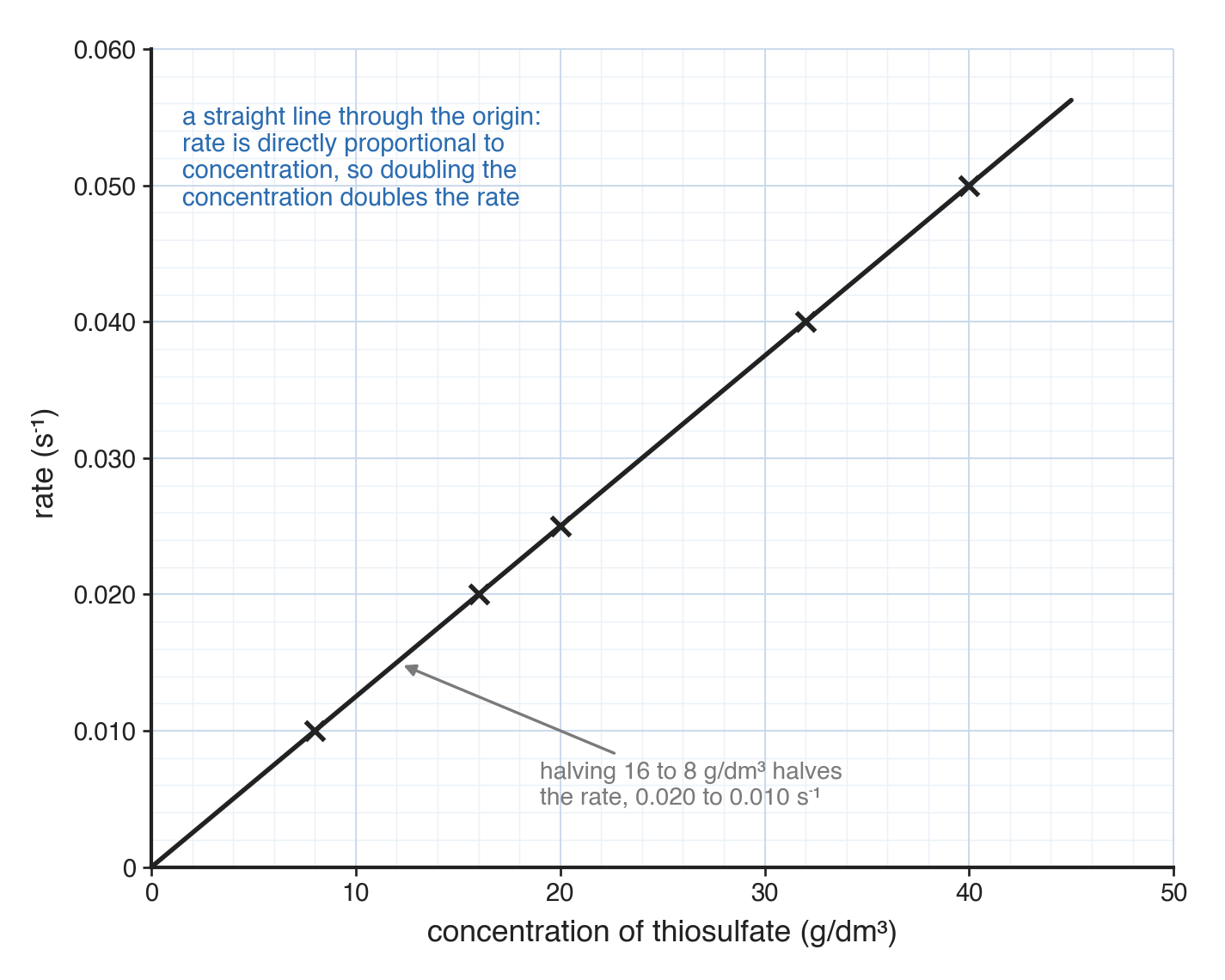
Find the rate at each concentration, plot a graph of rate against concentration, and explain what its shape shows.
Step 1 - Calculate the rate at each concentration
Rate = 1 ÷ time.
- At 40 g/dm3, the rate is 1 ÷ 20 = 0.050 s-1.
- At 32 g/dm3, the rate is 1 ÷ 25 = 0.040 s-1.
- At 20 g/dm3, the rate is 1 ÷ 40 = 0.025 s-1.
- At 16 g/dm3, the rate is 1 ÷ 50 = 0.020 s-1.
- At 8 g/dm3, the rate is 1 ÷ 100 = 0.010 s-1.
Step 2 - Plot the graph
Put concentration on the x-axis and rate on the y-axis. Draw a straight line of best fit through the points and through the origin.
Step 3 - Say what the line shows
A straight line through the origin shows the rate is directly proportional to the concentration. Doubling the concentration doubles the rate. Halving the concentration from 16 to 8 g/dm3 halves the rate, from 0.020 to 0.010 s-1.
Step 4 - Explain the trend
A more concentrated solution has more thiosulfate particles in the same volume, so they collide with the acid particles more often and the cross disappears sooner.
Common exam questions
Question 1
Why is 1 ÷ time used as a measure of rate, rather than the time itself?
A faster reaction takes less time, so the time goes down as the rate goes up. 1 ÷ time goes up as the reaction gets faster, as a rate should.
Question 2
Why should the same person judge when the cross disappears every time?
Different people judge the moment the cross disappears slightly differently. Using the same person keeps that the same, so only the concentration affects the time.
Question 3
Why is the total volume kept the same when the concentration is changed?
So only the concentration changes. With the cross, a different volume would also change the depth of liquid you look through, which changes the time on its own.
Question 4
A student repeats the experiment at a higher temperature, with the same concentration. What happens to the time taken, and why?
It gets shorter. The particles move faster, so they collide more often, and more of the collisions have enough energy to react.
Question 5
Why is the magnesium strip cut to the same length each time?
A longer strip has more magnesium to react, so it would take longer to disappear whatever the concentration.