10.3 - Determining the Formula of a Metal Oxide
The experiment
Aim
To find the empirical formula of a metal oxide, by measuring the mass of oxygen a metal gains when it burns, or the mass of oxygen a metal oxide loses when it is reduced.
Background
- An empirical formula gives the simplest whole-number ratio of atoms in a compound.
- The ratio can be found from the mass of each element in the compound, by turning each mass into moles.
- You can't weigh the oxygen in a metal oxide directly, but you can weigh the solid before and after it gains or loses oxygen.
- So in this practical you burn magnesium, or remove the oxygen from copper(II) oxide, and use the change in mass to work out the formula of the oxide.
Method - Burning magnesium
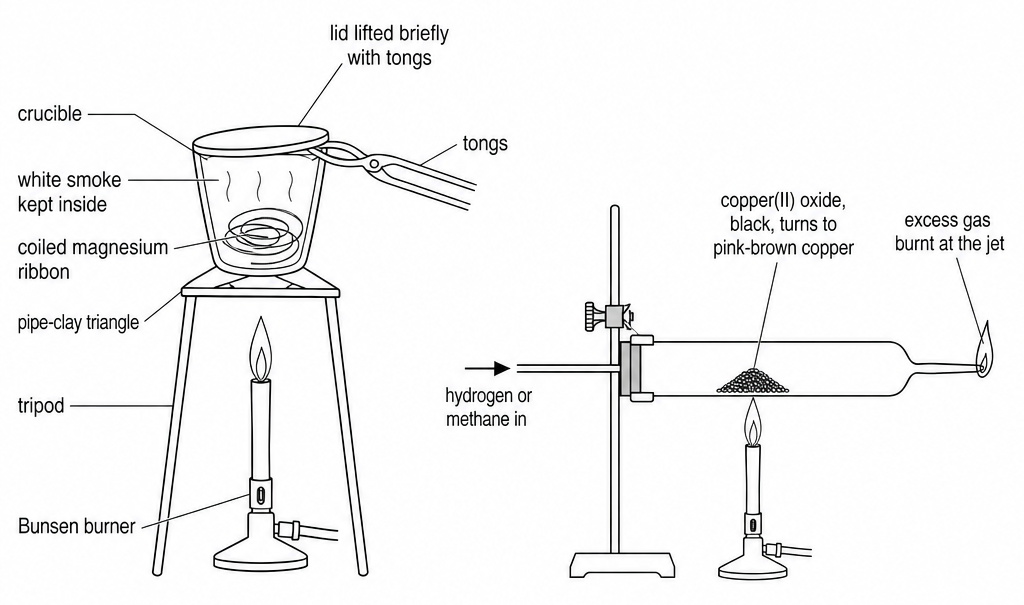
- Weigh the crucible - Heat the empty crucible and lid strongly until red hot, let them cool completely, and weigh them together.
- Add the magnesium - Clean the ribbon with emery paper if it looks dull, coil it loosely into the crucible, and weigh the crucible, lid, and magnesium.
- Heat with the lid on - Heat the crucible strongly on a pipe-clay triangle, lifting the lid briefly with tongs now and then, until the magnesium no longer glows when the lid is lifted.
- Heat to constant mass - Let the crucible cool and weigh it with its lid and contents. Heat, cool, and weigh it again until two readings in a row agree.
Method - Reducing copper(II) oxide
- Start the gas flowing - Weigh the empty tube, then weigh it again with the black copper(II) oxide in it, then pass hydrogen or methane through it before heating, burning the gas at the jet.
- Heat the oxide - Heat it strongly while the gas flows. It turns to pink-brown copper as its oxygen is carried away as water vapour or carbon dioxide.
- Heat to constant mass - Stop heating but keep the gas flowing until the tube has cooled, then weigh it. Heat, cool, and weigh it again until two readings in a row agree. The mass lost is the mass of oxygen, and the final mass minus the empty tube is the mass of copper.
Safety
- Eye protection - Wear it throughout, and never look directly at burning magnesium, since its bright light can damage your eyes.
- Hot crucible - Move it with tongs, and let it cool before touching it.
- Ventilation - Magnesium oxide smoke is an irritant.
- Burn off the gas - Light the hydrogen or methane at the jet, since either gas mixed with air is explosive.
Worked example - Empirical formula of a metal oxide
A student cleaned a strip of magnesium ribbon with emery paper, then heated it in a lidded crucible to constant mass, lifting the lid from time to time to let air in without letting any white smoke escape.
| Reading | Mass |
|---|---|
| Crucible and lid, empty | 15.00 g |
| Crucible, lid, and magnesium, before heating | 15.24 g |
| Crucible, lid, and contents, after heating to constant mass | 15.40 g |
The relative atomic masses are Mg = 24 and O = 16. Find the empirical formula of the oxide formed.
Step 1 - Find the mass of magnesium
15.24 - 15.00 = 0.24 g
Step 2 - Find the mass of magnesium oxide formed
15.40 - 15.00 = 0.40 g
Step 3 - Find the mass of oxygen gained
0.40 - 0.24 = 0.16 g
Step 4 - Divide each mass by its relative atomic mass
- Magnesium is 0.24 ÷ 24 = 0.0100 mol.
- Oxygen is 0.16 ÷ 16 = 0.0100 mol.
Step 5 - Divide each answer by the smaller of the two
Both amounts are already 0.0100 mol, so the ratio of magnesium to oxygen is 1 to 1.
Step 6 - Write the empirical formula
Magnesium and oxygen are in a 1 to 1 ratio, so the empirical formula is MgO.
Step 7 - Check the answer makes sense
The ratio came out as an exact whole number, which fits the formula of magnesium oxide. A ratio noticeably different from 1 to 1 would point to lost magnesium oxide smoke, or magnesium that hadn't fully reacted.
Common exam questions
Question 1
Why is the empty crucible heated strongly and cooled before the magnesium is weighed into it?
To burn off any oil or water left from a previous experiment. Otherwise the mass of the empty crucible would include it, and every mass worked out from that reading would be wrong.
Question 2
Why might the magnesium ribbon be cleaned with emery paper first?
Magnesium slowly reacts with oxygen in the air, forming a thin layer of magnesium oxide on its surface. Cleaning removes the layer, so the starting mass is all magnesium.
Question 3
Why is a lid kept on the crucible, but lifted briefly from time to time?
The lid stops the white magnesium oxide smoke escaping, which would make the mass of oxygen too low. Lifting it lets in enough air for all the magnesium to react.
Question 4
Why is the crucible heated to constant mass rather than for a fixed time?
To make sure the reaction has finished and no more oxygen is being gained, so the final mass is the true mass of the oxide.
Question 5
Why is hydrogen or methane passed through the tube before heating starts, and kept flowing while it cools?
Passing it through first flushes out the air, because heating either gas mixed with air could cause an explosion. Keeping it flowing while the tube cools stops the hot copper reacting with oxygen in the air and turning back into copper oxide.