4.4 - Extracting Metals from Their Ores
Ores, native metals, and extraction as reduction
- Most metals are found combined with other elements as metal compounds in rocks, usually as oxides.
- An ore is a rock containing enough metal compound to make extracting the metal worthwhile:
- Haematite (or hematite) - An iron oxide ore
- Bauxite - An aluminium oxide ore
Native metals
- Unreactive metals, such as gold, do not readily react with other elements and are found as pure metal.
- Metals found like this are described as uncombined, or in their native form.
Extraction is reduction
- Extracting a metal from its oxide requires removing the oxygen.
- Losing oxygen is reduction, so extracting a metal from its oxide is a reduction reaction.
Reactivity and extraction
- A reactive metal forms stable compounds and holds its oxygen tightly, making it harder and more expensive to extract.
- A less reactive metal forms less stable compounds and releases its oxygen more easily.
Choosing an extraction method
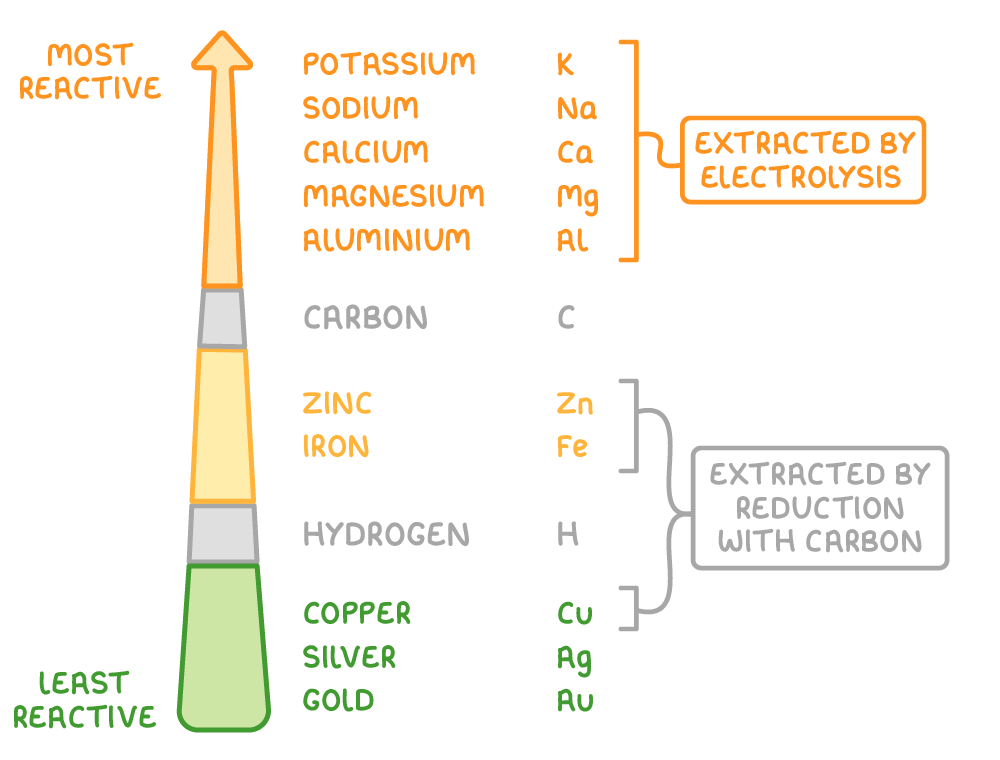
The method used to extract a metal from its ore depends on where the metal sits relative to carbon in the reactivity series.
Below carbon - Reduction with carbon
A metal below carbon is extracted by reduction with carbon. The ore is heated with carbon, which removes the oxygen from the metal oxide:
iron(III) oxide + carbon → iron + carbon dioxide
2Fe2O3(s) + 3C(s) → 4Fe(l) + 3CO2(g)
- The iron oxide loses oxygen, so it's reduced; the carbon gains oxygen, so it's oxidised.
- Zinc sits below carbon too and is extracted in the same way:
- zinc oxide + carbon → zinc + carbon dioxide
- 2ZnO(s) + C(s) → 2Zn(g) + CO2(g)
This only works for metals below carbon because carbon can only displace less reactive metals from their oxides.
Above carbon - Electrolysis
- A metal above carbon must be extracted by electrolysis. The compound is melted and an electric current is passed through it, splitting it into its elements.
- Aluminium sits above carbon, so it must be extracted from aluminium oxide using electrolysis.
- Electrolysis is also used if a metal reacts with carbon to form a carbide instead of the pure metal.
Cost
- Electrolysis is much more expensive than reduction with carbon because:
- Melting the compound requires large amounts of thermal energy
- Passing the electric current uses large amounts of electrical energy
- Reduction with carbon is cheaper because carbon is cheap and acts as both fuel and reducing agent.
Worked example - Choosing an extraction method
A company has a sample of magnesium oxide and a sample of zinc oxide, and wants to obtain the metal from each. Using this extract from the reactivity series, decide which extraction method to use for each, and why.
| More reactive |
|---|
| magnesium |
| carbon |
| zinc |
| Less reactive |
Step 1 - Find each metal in the series
Magnesium and zinc are both in the list, with carbon sitting between them.
Step 2 - See whether each is above or below carbon
- Magnesium is above carbon.
- Zinc is below carbon.
Step 3 - Read the method off each position
- Magnesium is above carbon, so carbon cannot displace it. Magnesium oxide must be melted and extracted by electrolysis.
- Zinc is below carbon, so carbon can displace it. Zinc oxide is extracted by reduction with carbon:
- zinc oxide + carbon → zinc + carbon dioxide
Step 4 - Interpretation
Electrolysis requires large amounts of energy to melt the compound and supply the electrical current, making magnesium much more expensive to extract than zinc.
Phytomining and bioleaching
- Traditional mining and smelting are expensive and damage the environment, especially when extracting copper from low-grade ores (ores containing only a small percentage of copper).
- Biological methods use living organisms to extract metals from low-grade ores.
Phytomining
Phytomining uses plants to absorb metal compounds:
- Plants are grown on soil containing low-grade ore.
- The plants absorb copper compounds through their roots and concentrate them in their leaves.
- The plants are harvested, dried, and burned.
- The resulting ash contains a high concentration of copper compounds.
- An acid (such as sulfuric acid) is added to the ash to produce a copper-rich solution called a leachate.

Bioleaching
Bioleaching uses bacteria to extract metals:
- Bacteria are mixed with low-grade ore.
- The bacteria break down the ore, producing a solution of dissolved copper ions called a leachate.
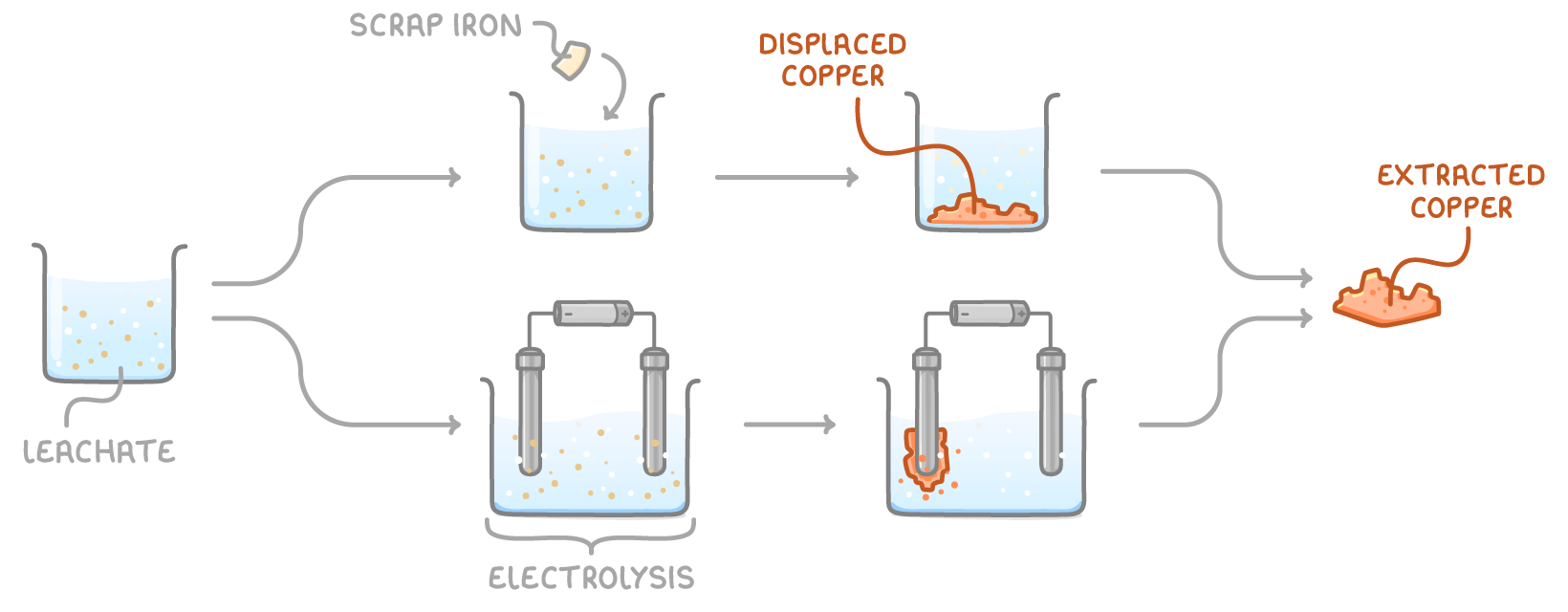
Extracting copper from the leachate
The copper in the leachate is extracted using one of two methods:
- Displacement using scrap iron - Iron is more reactive than copper, so it displaces copper ions from solution:
- Fe(s) + Cu2+(aq) → Fe2+(aq) + Cu(s)
- Electrolysis - Passing an electric current through the leachate deposits pure copper metal.