10.2 - Simple Distillation of a Mixture
The technique
Aim
To separate a liquid from a mixture, such as ink or salt water, by simple distillation, and to use the thermometer reading to show what is being collected.
Background
- Each pure substance boils at its own temperature, its boiling point.
- When a mixture is heated, the liquid with the lowest boiling point evaporates first. Substances with much higher boiling points, such as salt or the dyes in ink, stay behind in the flask.
- Cooling the vapour turns it back into a liquid, which can be collected somewhere else.
- You can't see which substance is evaporating, but a thermometer in the vapour reads its boiling point.
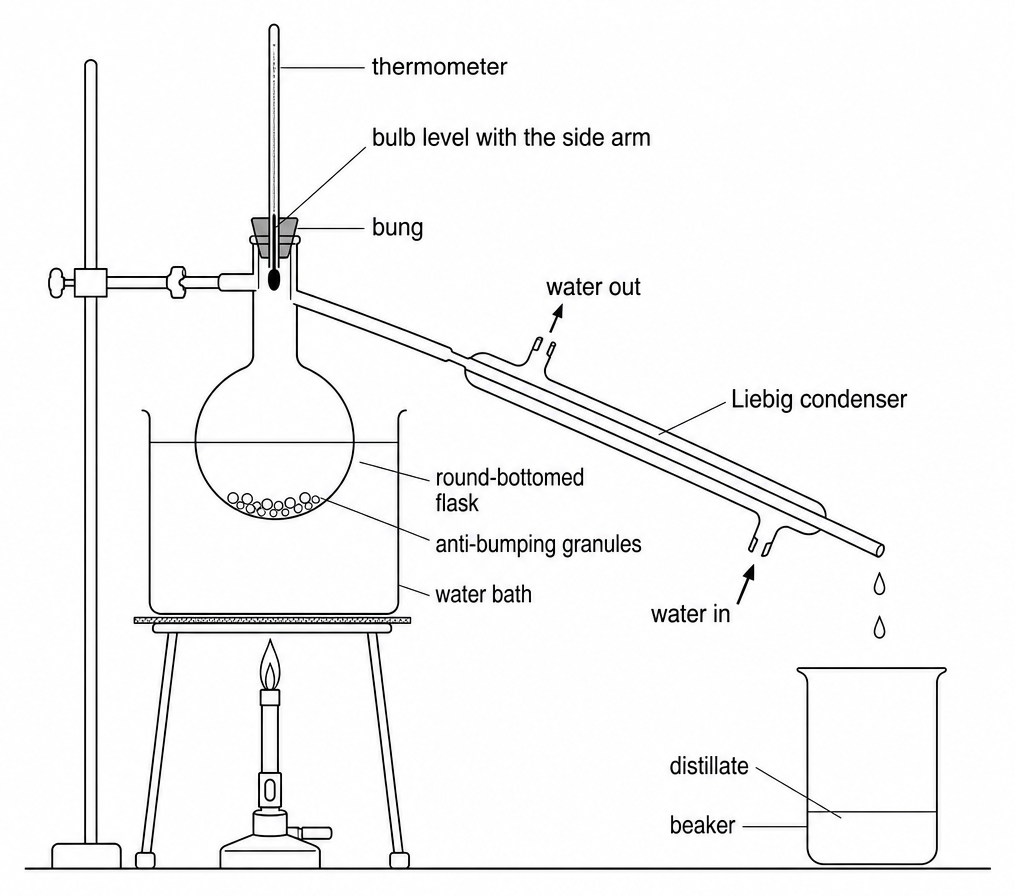
- So in this practical you boil the liquid off, turn it back into a liquid in a condenser, and collect it as the distillate, using the thermometer to check what you're collecting.
Method
- Add the mixture to the flask - Pour it into a round-bottomed flask with a few anti-bumping granules.
- Fit the thermometer - Put it through a bung in the neck of the flask, with the bulb level with the side arm.
- Connect the condenser - Join the side arm to a Liebig condenser, with the cooling water going in at the bottom and out at the top.
- Place a beaker under the condenser - To collect the distillate as it drips out.
- Heat the flask gently - Until the liquid boils steadily.
- Watch the thermometer - While the distillate collects, the reading stays steady at the boiling point of the substance coming over, such as 100 °C for water.
- Stop heating - Once you've collected enough, or when the temperature starts to rise, which shows a different substance is starting to come over.
Safety
- Eye protection - Wear it throughout.
- No naked flames with flammable liquids - Heat a mixture containing a flammable liquid, such as ethanol, with a water bath or an electric heater.
- Clamp the apparatus - Clamp the flask and condenser firmly and check every joint fits, so no vapour escapes.
- Keep the end of the tube clear - It mustn't dip into the liquid collecting below it.
Common exam questions
Question 1
Why does the cooling water enter the condenser at the bottom and leave at the top?
It keeps the condenser full of cold water along its whole length, so the vapour is cooled as soon as it enters.
Question 2
Why is the thermometer bulb level with the side arm, rather than in the liquid?
There it measures the temperature of the vapour leaving the flask, which is the boiling point of the substance being collected. In the liquid it would measure the temperature of the whole mixture.
Question 3
Why are anti-bumping granules added before heating?
They help bubbles of vapour form smoothly, so the liquid doesn't boil suddenly and violently and throw hot liquid into the apparatus.
Question 4
Why should a flammable liquid never be heated with a naked flame?
Heating it gives off flammable vapour, which a flame could set alight. A water bath or an electric heater heats it without a flame.
Question 5
Why must the end of the tube stay clear of the liquid collecting below it?
If the tube dips into the collected liquid and the flask cools, the pressure inside the flask drops and pulls the liquid back into the hot flask. This is called suck-back.