4.3 - Ionic Equations
Writing an ionic equation for a displacement
- When a more reactive metal reacts with a solution of a less reactive metal's compound, it displaces the less reactive metal.
- For example, an iron nail in copper(II) sulfate solution forms iron(II) sulfate solution and copper:
- Fe(s) + CuSO4(aq) → FeSO4(aq) + Cu(s)
An ionic equation shows only the particles that actually change during a reaction.
The method
-
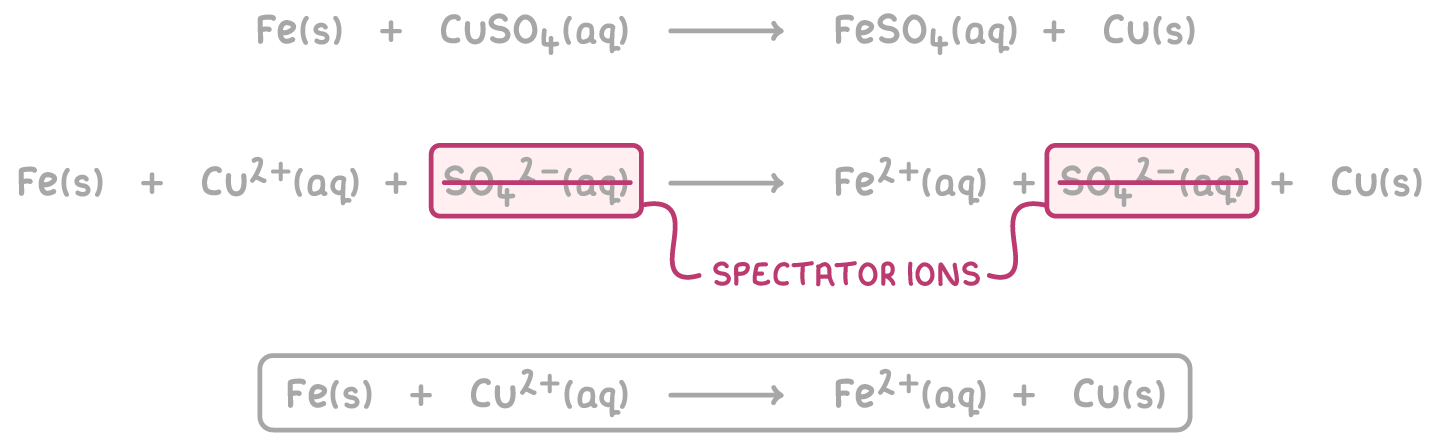
Start from the balanced symbol equation, with state symbols.
- Fe(s) + CuSO4(aq) → FeSO4(aq) + Cu(s)
-
Rewrite every dissolved (aq) ionic compound as its separate ions. Solids, liquids, and gases are left whole.
- Fe(s) + Cu2+(aq) + SO42-(aq) → Fe2+(aq) + SO42-(aq) + Cu(s)
-
Cross out spectator ions - Ions that appear unchanged on both sides and take no part in the reaction (here, SO42-(aq)).
-
Write what's left as the ionic equation.
- Fe(s) + Cu2+(aq) → Fe2+(aq) + Cu(s)
Check the atoms and the total charge (2+ on each side).
Reading the electron transfer
- Iron loses two electrons to form Fe2+, so it's oxidised.
- Copper ions (Cu2+) gain two electrons to form copper atoms, so they're reduced.
- Every displacement is a redox reaction: the metal atom is oxidised and the metal ion in solution is reduced.
Worked example - Zinc and copper(II) sulfate
Zinc is added to copper(II) sulfate solution. Write the ionic equation for the reaction.
Step 1 - Balanced symbol equation with state symbols
Zn(s) + CuSO4(aq) → ZnSO4(aq) + Cu(s)
One zinc, one copper and one sulfate on each side.
Step 2 - Split every dissolved ionic compound into its ions
CuSO4(aq) becomes Cu2+(aq) and SO42-(aq); ZnSO4(aq) becomes Zn2+(aq) and SO42-(aq). The zinc and copper metal are solids, so they stay whole.
Zn(s) + Cu2+(aq) + SO42-(aq) → Zn2+(aq) + SO42-(aq) + Cu(s)
Step 3 - Cross out spectator ions
SO42-(aq) is unchanged on both sides, so it's deleted.
Step 4 - Write the ionic equation
Zn(s) + Cu2+(aq) → Zn2+(aq) + Cu(s)
Check the atoms and the charge: one zinc and one copper on each side, and a total charge of 2+ on each side.