6.1 - Group 1 - The Alkali Metals
The alkali metals and their trends
- The Group 1 elements are the metals in the first column of the periodic table: lithium, sodium, potassium, rubidium, caesium and francium.
- They are known as the alkali metals.
- Every atom has a single electron in its outer shell, which is why the whole group behaves in a similar way.
Physical properties
- Soft - Can be cut with a knife, exposing a shiny surface.
- Low density - Lithium, sodium and potassium are less dense than water, so they float.
- Low melting points - Sodium melts at 98 °C, which is very low for a metal.
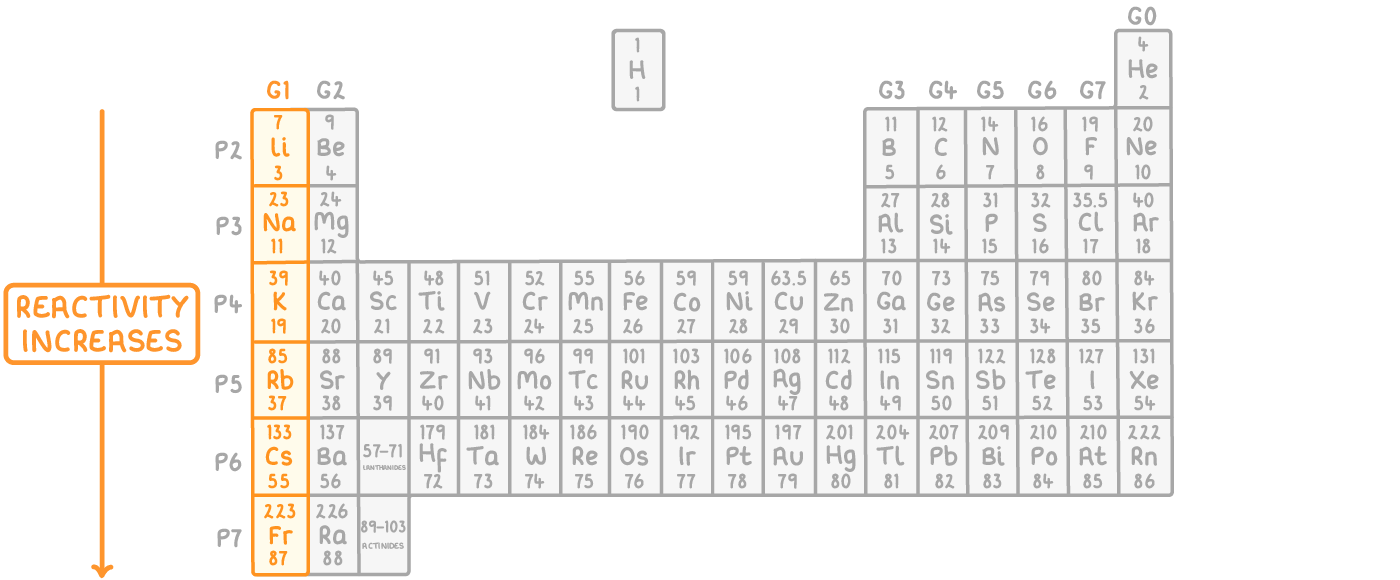
Reactivity increases down the group
- Lithium is the least reactive of the common alkali metals, and reactivity increases down the group to francium, the most reactive.
- The further down the group, the more vigorous the reaction.
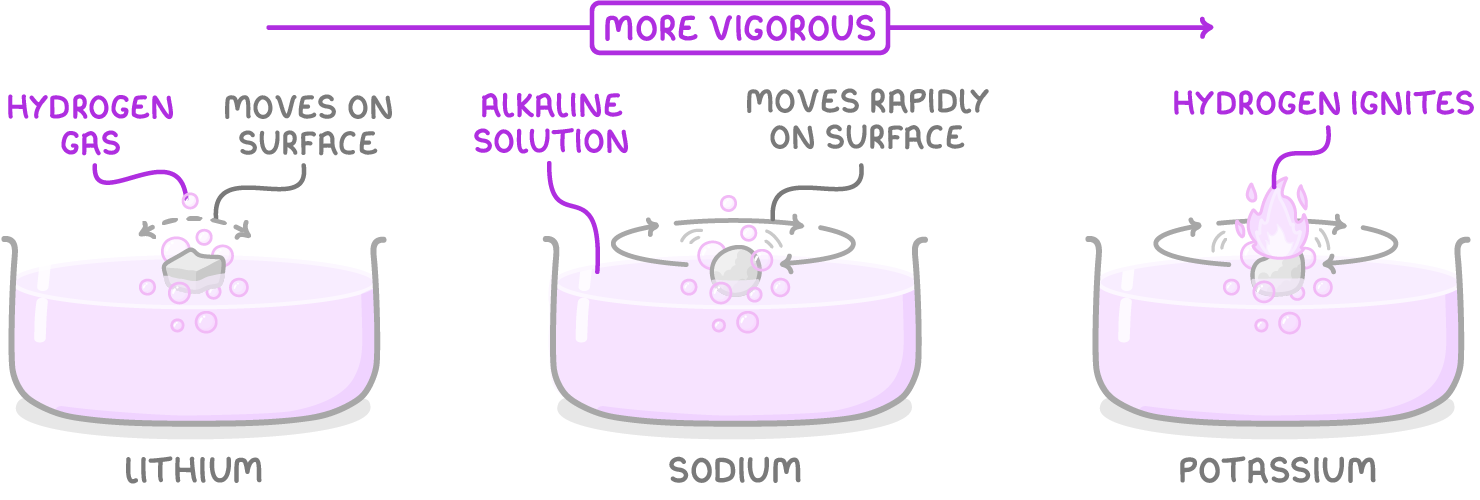
- Drop equal-sized pieces of lithium, sodium and potassium into water: lithium takes longest to react, sodium is quicker, and potassium is quickest.
Predicting behaviour
- An element's behaviour can be predicted from the elements above it.
- Rubidium and caesium sit below potassium, so their reactions are more violent: both react explosively with water, and caesium catches fire in air at room temperature.
Why reactivity increases down Group 1
- Every alkali metal atom has one electron in its outer shell.
- To gain a stable full outer shell, a Group 1 atom loses that single outer electron to form an ion with a 1+ charge.
- The more easily an atom loses its outer electron, the more reactive the metal is.
Why it gets easier down the group
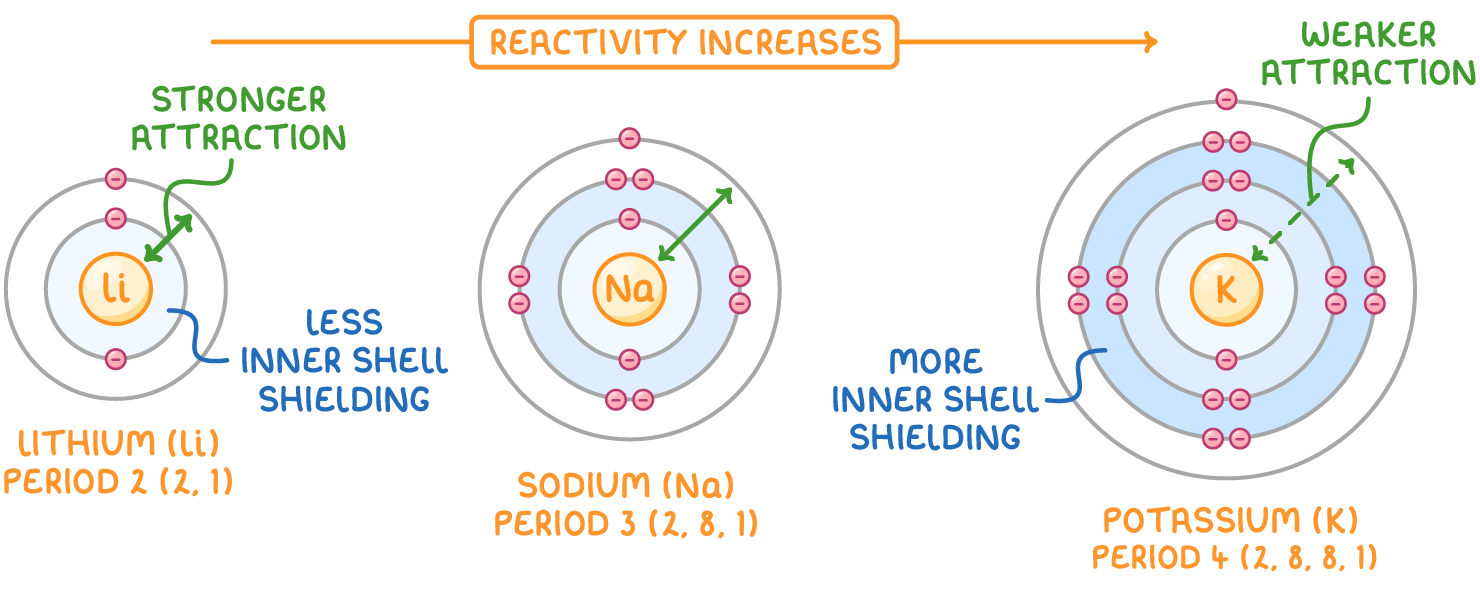
- Each element down the group has one more electron shell, so the atom is larger and the outer electron is further from the nucleus.
- The attraction between the positive nucleus and the negative outer electron weakens with distance.
- The extra inner electron shells shield the outer electron from the pull of the nucleus.
- Less energy is needed to remove the outer electron as you go down the group, so reactivity increases.
Forming ionic compounds
- Alkali metals react with non-metals by transferring their outer electron to form 1+ ions.
- The non-metal atoms gain electrons to form negative ions, producing an ionic compound (e.g. sodium + chlorine → sodium chloride).
- Group 1 ionic compounds are white solids that dissolve in water to give colourless solutions.
The reactions of the alkali metals
- Alkali metals react vigorously with cold water to produce:
- Hydrogen gas (seen as fizzing).
- A metal hydroxide, which dissolves to form an alkaline solution.
- Universal indicator added to the water turns from green to purple.
Word and balanced equations
alkali metal + water → metal hydroxide + hydrogen
For sodium:
2Na(s) + 2H2O(l) → 2NaOH(aq) + H2(g)
Lithium and potassium react in the same way, producing lithium hydroxide and potassium hydroxide.
Observations with cold water
| Metal | Observations |
|---|---|
| Lithium | Floats, fizzes steadily and moves on the surface until it disappears |
| Sodium | Floats, melts into a ball, fizzes and whizzes across the surface |
| Potassium | Floats, moves quickly, and ignites the hydrogen to burn with a lilac flame |
TermDefinition
Alkali metalsThe metals in Group 1 of the periodic table, which each have one electron in their outer shell.
ShieldingThe effect where inner electron shells weaken the attraction between the positive nucleus and the negative outer electron.
Key points to remember
How were these notes?