3.3 - Reactions of Acids
Acids with metals
Dilute acids react with many metals to produce a salt and hydrogen gas:
acid + metal → salt + hydrogen
Which salt forms depends on the acid
- Hydrochloric acid gives a chloride.
- Sulfuric acid gives a sulfate.
- Mg(s) + 2HCl(aq) → MgCl2(aq) + H2(g)
- Zn(s) + H2SO4(aq) → ZnSO4(aq) + H2(g)
- Fe(s) + 2HCl(aq) → FeCl2(aq) + H2(g)
What you see happening
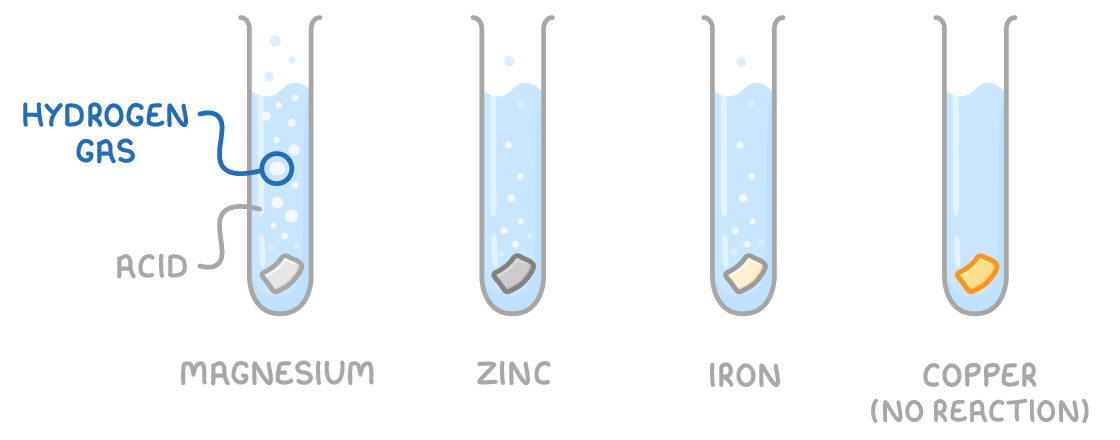
- Bubbles of hydrogen gas stream off the metal's surface.
- The piece of metal gets smaller and disappears completely if there is enough acid.
- The mixture warms up (the reaction is exothermic).
Reactivity sets the rate
The rate bubbles come off shows how reactive the metal is:
- Magnesium reacts vigorously with cold dilute acid, giving a fast stream of bubbles.
- Zinc and iron react slowly in the cold, but faster if warmed.
- Copper doesn't react with dilute acid at all.
Acids with bases and carbonates
Metal oxides and metal hydroxides are bases that neutralise acids to produce a salt and water:
acid + metal oxide (or hydroxide) → salt + water
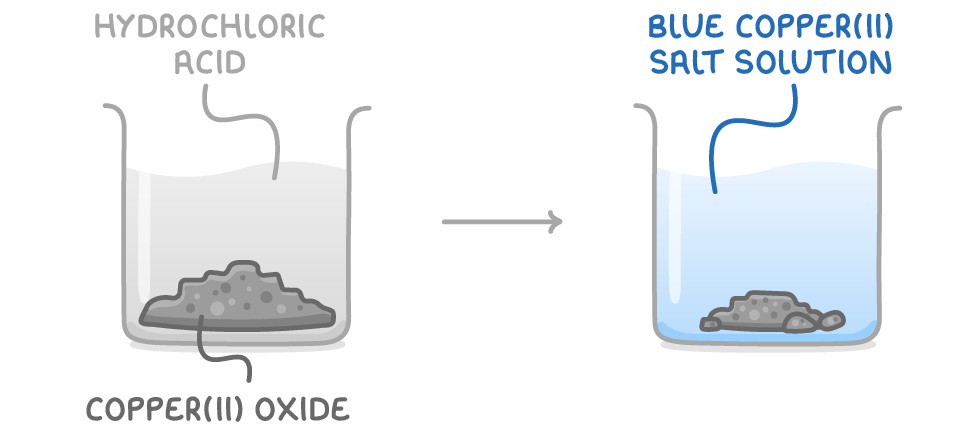
2HCl(aq) + CuO(s) → CuCl2(aq) + H2O(l)
H2SO4(aq) + 2KOH(aq) → K2SO4(aq) + 2H2O(l)
HNO3(aq) + NaOH(aq) → NaNO3(aq) + H2O(l)
Both soluble bases (alkalis, e.g. NaOH, KOH) and insoluble bases (e.g. CuO, MgO) neutralise acids this way.
Carbonates and hydrogencarbonates
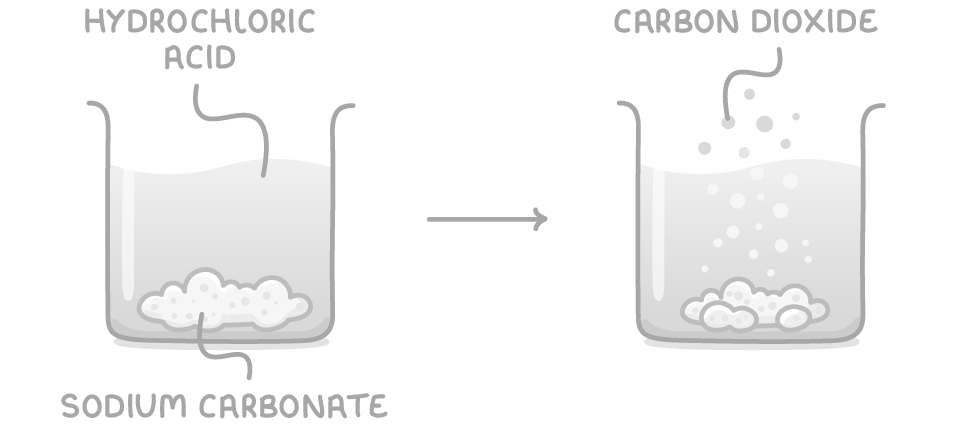
Metal carbonates and hydrogencarbonates react with acids to produce a salt, water, and carbon dioxide:
acid + metal carbonate (or hydrogencarbonate) → salt + water + carbon dioxide
2HCl(aq) + Na2CO3(aq) → 2NaCl(aq) + H2O(l) + CO2(g)
H2SO4(aq) + CaCO3(s) → CaSO4(s) + H2O(l) + CO2(g)
NaHCO3(aq) + HCl(aq) → NaCl(aq) + H2O(l) + CO2(g)
Ammonia
Ammonia reacts with an acid to form an ammonium salt only (no water forms because ammonia contains no oxygen):
acid + ammonia → ammonium salt
NH3(aq) + HCl(aq) → NH4Cl(aq)
Observations during neutralisation
- Effervescence (fizzing) occurs with carbonates and hydrogencarbonates as CO2 gas escapes; oxides and hydroxides produce no gas.
- Solid bases disappear as they react to form soluble salts.
- The reaction mixture warms up.
- If a transition metal base is used, a colour change occurs (e.g. black copper(II) oxide disappears, leaving a blue copper(II) salt solution).
Naming salts
- A salt is a compound formed when some or all of the hydrogen ions in an acid are replaced by metal ions or ammonium ions.
- A salt's name has two parts:
- First part - From the metal or ammonium in the base.
- Second part - From the acid.
| Acid | Formula | Salt formed |
|---|---|---|
| hydrochloric acid | HCl | chloride |
| sulfuric acid | H2SO4 | sulfate |
| nitric acid | HNO3 | nitrate |
- Most Group 1, Group 2, and aluminium or zinc salts form colourless solutions and white solids.
- Transition-metal salts are typically coloured (e.g. copper(II) salts are blue in solution).
Worked example - Salt from nitric acid and copper(II) oxide
Name the salt made when nitric acid reacts with copper(II) oxide, and write the word equation.
Step 1 - Name from the acid
The acid is nitric acid, so the salt is a nitrate.
Step 2 - Name from the metal
The base is copper(II) oxide, which supplies copper(II) ions.
Step 3 - Combine and write the equation
The salt is copper(II) nitrate.
nitric acid + copper(II) oxide → copper(II) nitrate + water
The neutralisation ionic equation
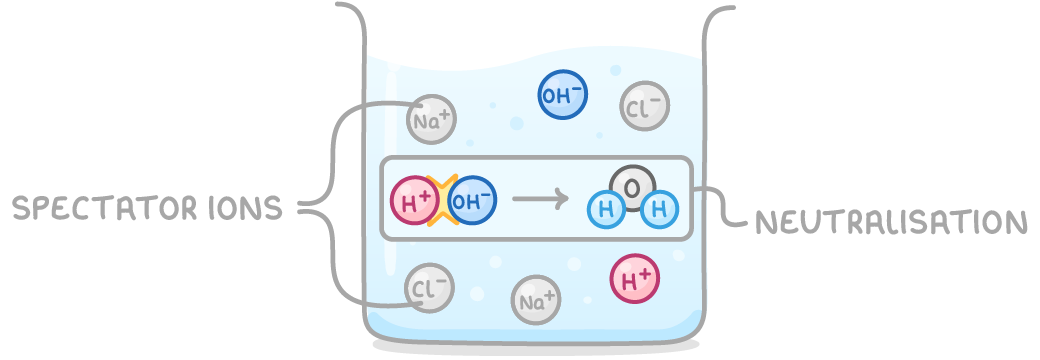
Neutralisation between an acid and an alkali involves hydrogen ions reacting with hydroxide ions to form water:
H+(aq) + OH-(aq) → H2O(l)
- An equation showing only the particles that react is an ionic equation.
- This single ionic equation describes every reaction between an acid and an alkali.
Spectator ions
- In the reaction between hydrochloric acid and sodium hydroxide:
- The acid supplies H+(aq) and Cl-(aq) ions.
- The alkali supplies Na+(aq) and OH-(aq) ions.
- H+ and OH- react to form H2O(l).
- Na+ and Cl- remain unchanged in solution.
- Ions that remain unchanged throughout a reaction are called spectator ions, and they're omitted from the ionic equation.
- If the water is evaporated, the spectator ions combine to form the solid salt (sodium chloride).