13.9 - Apparatus, Diagrams, Technique & Safety
What a Q1 apparatus question looks like
- Question 1 is built around an experiment shown as a diagram.
- Common contexts include gas preparation, separation or distillation, salt preparation, chromatography, electrolysis, and titration.
The four things Q1 tests
- Naming or completing apparatus - Give the correct name for a labelled item, or draw and label a missing part.
- Experimental technique - How a piece of apparatus is used correctly, such as adjusting a Bunsen burner or reading a burette.
- Explaining why a step is done - Suggesting or explaining the reason for a practical step.
- Safety and hazard reasoning - Naming a precaution or explaining the hazard behind one.
A typical question
A student prepares a gas by heating a solid mixture, using the apparatus shown in Fig. 1.1.
(a) Name the item of apparatus labelled A. [1]
(b) Explain why this experiment should be carried out in a fume cupboard. [1]
(c) Describe how a Bunsen burner is adjusted to make the flame as hot as possible. [1]
Naming and drawing apparatus
Apparatus you should recognise:
- Measuring instruments - Stopwatches, thermometers, balances, burettes, pipettes, measuring cylinders, gas syringes (for measuring time, temperature, mass, and volume)
- General equipment - Delivery tubes, filter funnels, boiling tubes, conical flasks, test-tubes, retort stands, spatulas, stirring rods, stoppers, tripods, white tiles
Naming apparatus
- Give the specific name - "Measuring cylinder" scores where "container" does not.
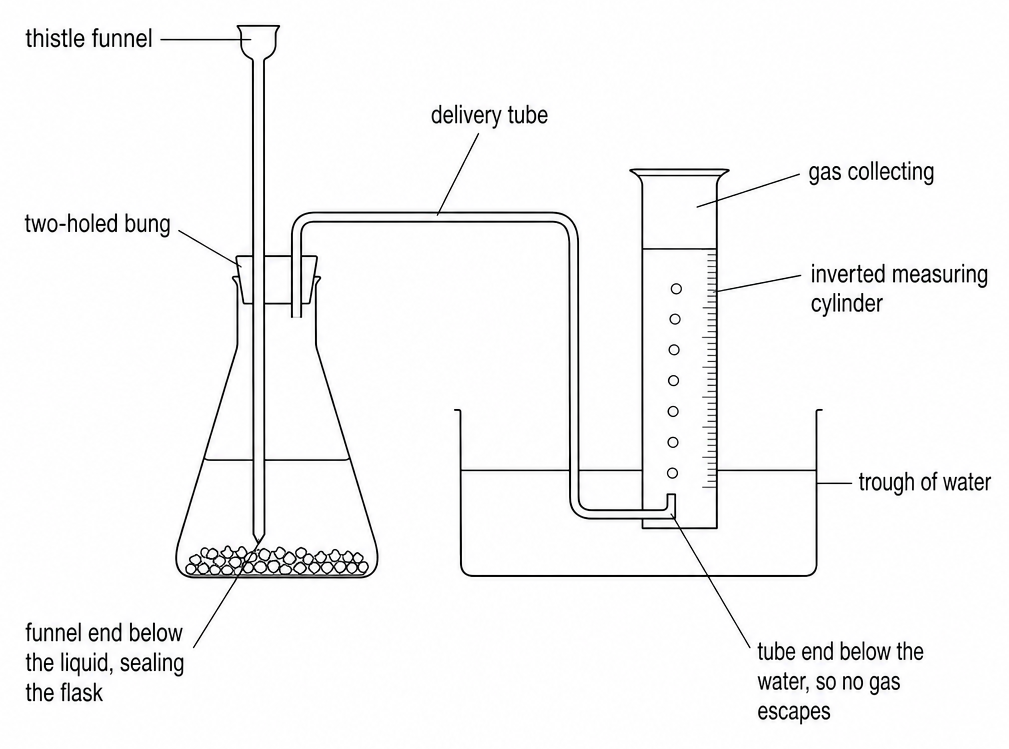
- Match the name to the job shown - Glassware collecting gas over water is a measuring cylinder or test-tube, not a beaker.
Completing a diagram
- Draw a single clear line, not a sketchy one, and ensure the added part connects to the existing apparatus - a delivery tube that stops short of the bung loses marks.
- Show the apparatus working - Draw heating symbols directly under the vessel, and lead gas-collection tubes all the way into the collecting vessel.
- Diagrams are drawn in cross-section: show liquid levels and make sure tubes dip below or stay above the liquid surface as required.
Burette and pipette technique
Reading the burette
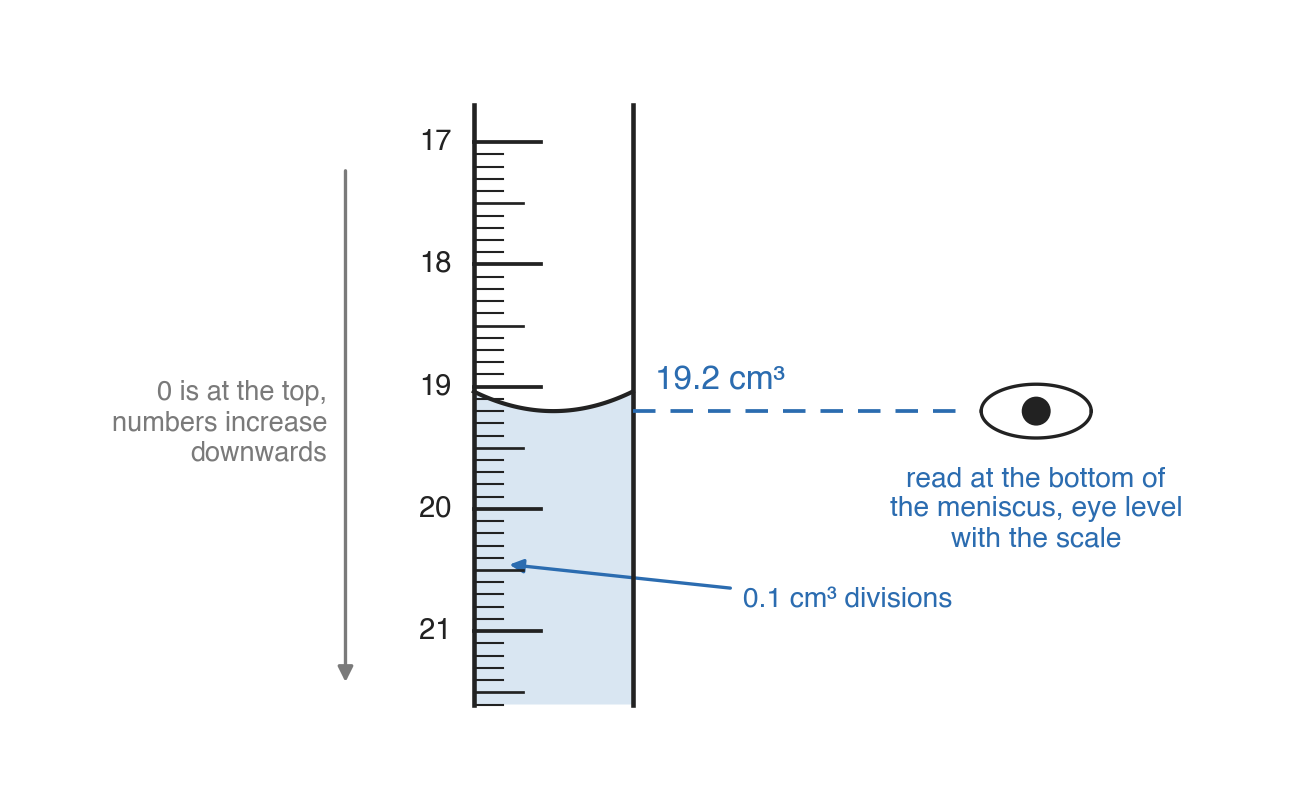
- Burette readings are recorded to one decimal place (e.g. 0.0 cm3, 19.2 cm3) or consistently to the nearest 0.05 cm3.
- A volumetric pipette delivers one fixed volume (e.g. 25.0 cm3).
Titration technique
- Rinse the burette with the solution it will hold - Residual water would dilute the solution.
- Rinse the conical flask with water only - Residual solution would add extra unmeasured reactant; water changes the volume but not the amount of reactant.
- Place the flask on a white tile - Makes the indicator colour change at the end point clearer to see.
- Add titrant drop by drop near the end point while swirling - Prevents overshooting the end point.
Comparing a burette and a measuring cylinder
- A burette is more accurate than a measuring cylinder because it can be read to one decimal place rather than whole units.
- A volumetric pipette is also more accurate, but it only measures one fixed volume.
Suggest a change to the apparatus that would measure the sodium hydroxide more accurately, and explain why.
Answer: Use a burette (or pipette). It is more accurate than a measuring cylinder because it can be read to one decimal place.
Safety and hazard reasoning
Stating a precaution
When given a hazard and asked for a precaution:
State one safety precaution that should be taken when using zinc chloride. [1]
Give the practical action: wear gloves, wear goggles, or use a fume cupboard (or work in a well-ventilated area).
Explaining a hazard
When given the precaution and asked why it is needed:
Hydrogen chloride gas is toxic. Explain why this experiment should be carried out in a fume cupboard.
- Name the specific property of the substance: hydrogen chloride is toxic (or poisonous).
- Avoid vague answers like "it is not safe" or "to avoid danger".
Choosing and justifying apparatus
When asked why a piece of apparatus is chosen, link what it does to a specific property of the substance or measurement rather than giving a generic statement.
| Apparatus chosen | Justification |
|---|---|
| Gas syringe (instead of collecting over water) | The gas is soluble in water or reacts with water, so displacement would lose gas |
| Burette or pipette (instead of a measuring cylinder) | The volume must be measured accurately to one decimal place |
| Thermometer with fine graduations | A small temperature change needs to be detected |
| Fume cupboard (instead of the open bench) | The gas produced is toxic or poisonous |
Common exam questions
Question 1
A diagram shows a piece of glassware with a bulb in the middle of a long tube, used to measure out exactly 25.0 cm3 of a solution. Name it.
A (volumetric) pipette.
Question 2
A student is asked to complete a diagram showing a gas being collected. What two things does the mark scheme want drawn and labelled?
A delivery tube leading from the reaction vessel, and a measuring cylinder inverted in a trough of water, its open end below the water's surface so the gas bubbles up into it.
Question 3
Why must a burette be rinsed with the solution it is going to hold, and not just with water?
So that any water left inside does not dilute the solution as it runs through the burette during the titration.
Question 4
Why does a conical flask only need rinsing with water, and not with the solution it is about to hold?
Because any solution left clinging to the flask's sides would add extra reagent to the mixture, whereas water left in the flask only adds water, which does not change the amount of anything reacting.
Question 5
Give one safety precaution when using concentrated hydrochloric acid.
Wear gloves and goggles (or work in a fume cupboard, since it releases a toxic gas).
Question 6
Explain why a reaction producing sulfur dioxide should be carried out in a fume cupboard.
Sulfur dioxide is toxic, so working in a fume cupboard prevents it from being breathed in.
Question 7
Suggest why a burette is used to add the acid, rather than a measuring cylinder.
A burette is more accurate than a measuring cylinder, because it can be read to one decimal place.
Question 8
A student collects a gas over water. Suggest a reason why this method would not work for ammonia.
Ammonia is very soluble in water, so most of the gas would dissolve rather than collect in the measuring cylinder; a gas syringe would be used instead.
Question 9
Describe how a Bunsen burner is adjusted to give the hottest flame.
Open the air hole fully, so that the flame burns with a blue colour rather than a yellow, sooty one.
Question 10
A student is told to add a reagent drop by drop rather than all at once. Suggest why.
Adding it drop by drop lets the exact point at which the reaction is complete, such as a colour change, be seen and not overshot; adding it all at once risks adding far more than is needed before the change can be spotted.