11.9 - Condensation Polymers
Condensation polymerisation
- A condensation polymer is a polymer formed when monomers join together with the loss of a small molecule, usually water.
- Each monomer carries two functional groups - One at each end - so it can react at both ends to continue the polymer chain.
- A functional group is the atom or group of atoms that decides how a molecule reacts.
How the monomers are arranged
- Two different monomers, each carrying two of the same functional group. The two monomers alternate along the chain.
- A single monomer carrying two different functional groups (one at each end) polymerising head to tail.
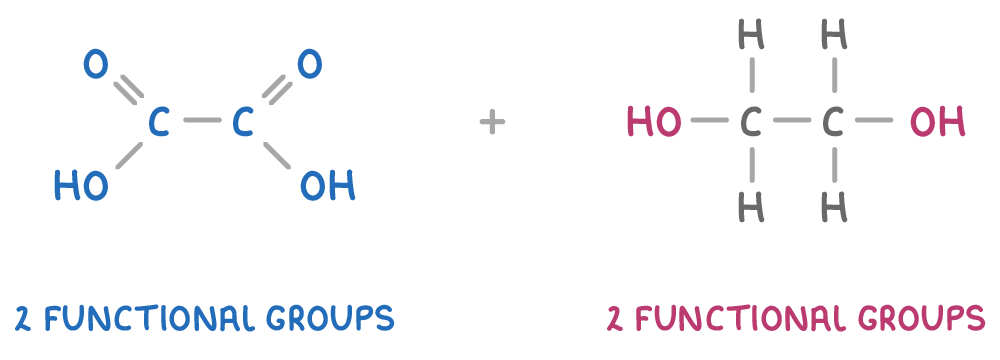
Water is formed as a product
- Every time two monomer ends join, a molecule of water is lost.
- Condensation polymerisation produces two products: the polymer and water.
- The repeat unit contains fewer atoms than the monomers, because atoms leave to form water.
Addition and condensation polymerisation compared
| Addition polymerisation | Condensation polymerisation | |
|---|---|---|
| Monomers | One kind, with a carbon-carbon double bond (C=C) | Usually two kinds, each with two of the same functional group; or one kind with two different groups |
| What reacts | The C=C double bond opens | A functional group at one end reacts with a functional group on the next monomer |
| Products | One product: the polymer | Two products: the polymer and water |
| Repeat unit | Contains all the atoms of the monomer | Contains fewer atoms than the monomers, because water is lost |
Nylon, a polyamide
Nylon is a polyamide: a condensation polymer formed by joining monomers with amide links.
The amide link
An amide link is -CO-NH-, formed between a carboxylic acid group and an amine group.
Monomers for nylon
Nylon is made from two monomers, each with two functional groups:
- A dicarboxylic acid (carrying two -COOH groups).
- A diamine (carrying two -NH2 groups).
Each time an acid group reacts with an amine group, an amide link forms and a molecule of water is lost.
Nylon's structure
Using block diagrams for the monomer carbon chains, the repeat unit is:
[-CO-▭-CO-NH-▭-NH-]n
Each repeat unit has one amide link in the middle, and a second forms where it bonds to the next unit, at the brackets.
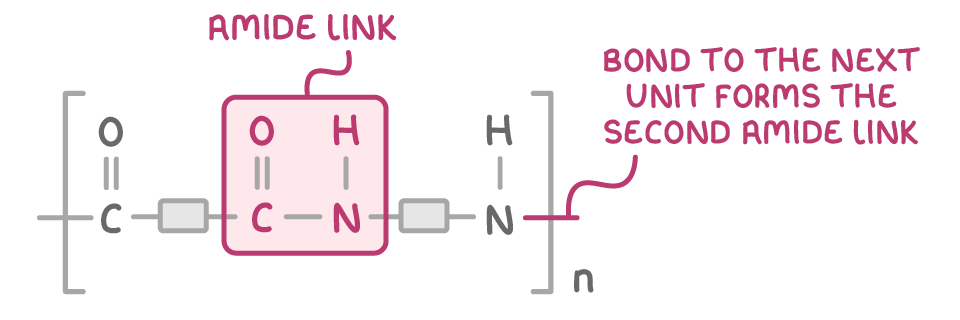
Making a polyamide in the laboratory
- Dissolve the diamine in water and a more reactive form of the dicarboxylic acid monomer in an organic solvent.
- Pour one solution carefully on top of the other to form two separate layers.
- The polyamide forms only at the boundary between the layers, where the two solutions meet.
- The polymer can be pulled out from the interface with tweezers as a continuous thread.
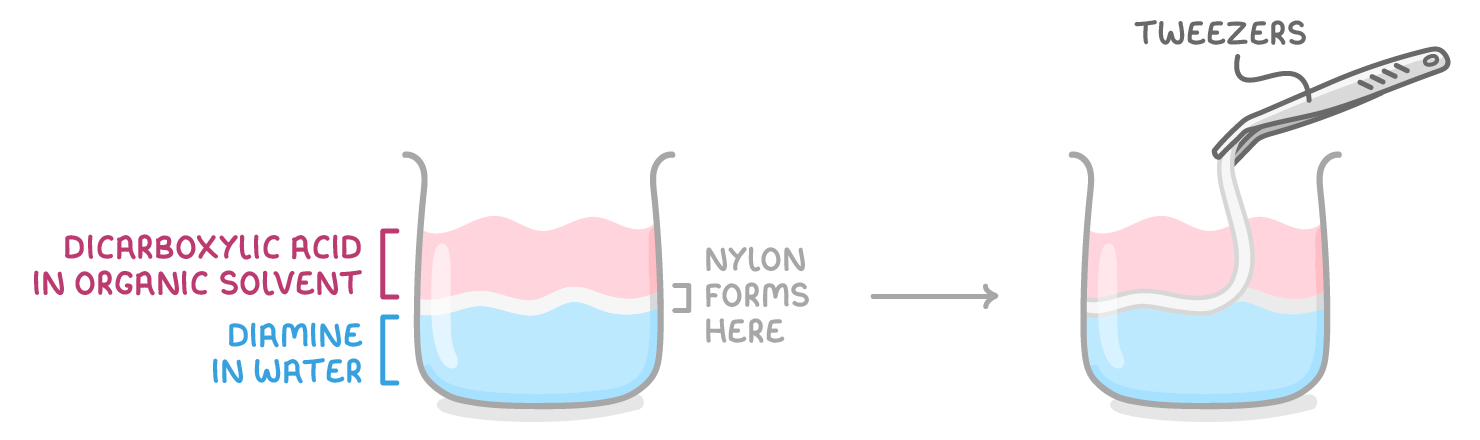
TermDefinition
Condensation polymerA polymer formed when monomers join together with the loss of a small molecule, usually water.
Functional groupAn atom or group of atoms in a molecule that determines how the molecule reacts.
PolyamideA condensation polymer whose monomers are joined by amide links. Nylon and proteins are both polyamides.
Amide linkThe -CO-NH- group joining monomers in a polyamide.