12.7 - Tests for Anions
The test for carbonate ions
- A carbonate contains the carbonate ion, CO32-, a negatively charged ion (an anion).
- Carbonates react with dilute acids to produce a salt, water, and carbon dioxide gas.
Carrying out the test
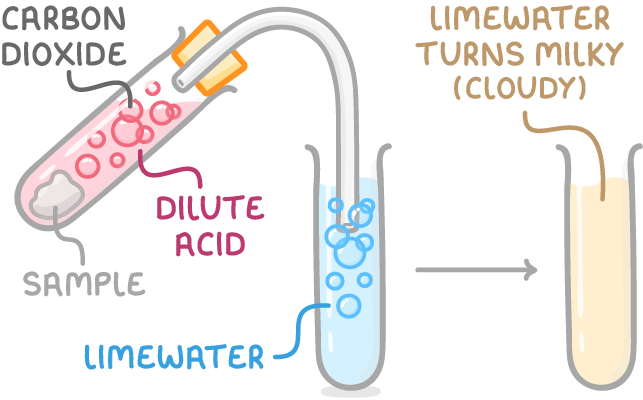
- Add dilute acid (usually dilute hydrochloric acid) to the sample.
- If carbonate ions are present, the mixture fizzes (effervesces) as carbon dioxide gas bubbles off.
- Bubble the gas through limewater (calcium hydroxide solution).
Reading the result
- Carbon dioxide reacts with calcium hydroxide to form insoluble calcium carbonate, turning the limewater cloudy (milky).
- Fizzing and the limewater turning cloudy white is the positive result: the sample contains carbonate ions.
The test for halide ions
Chloride (Cl-), bromide (Br-), and iodide (I-) are the halide ions - the negatively charged ions (anions) of Group 7.
Carrying out the test
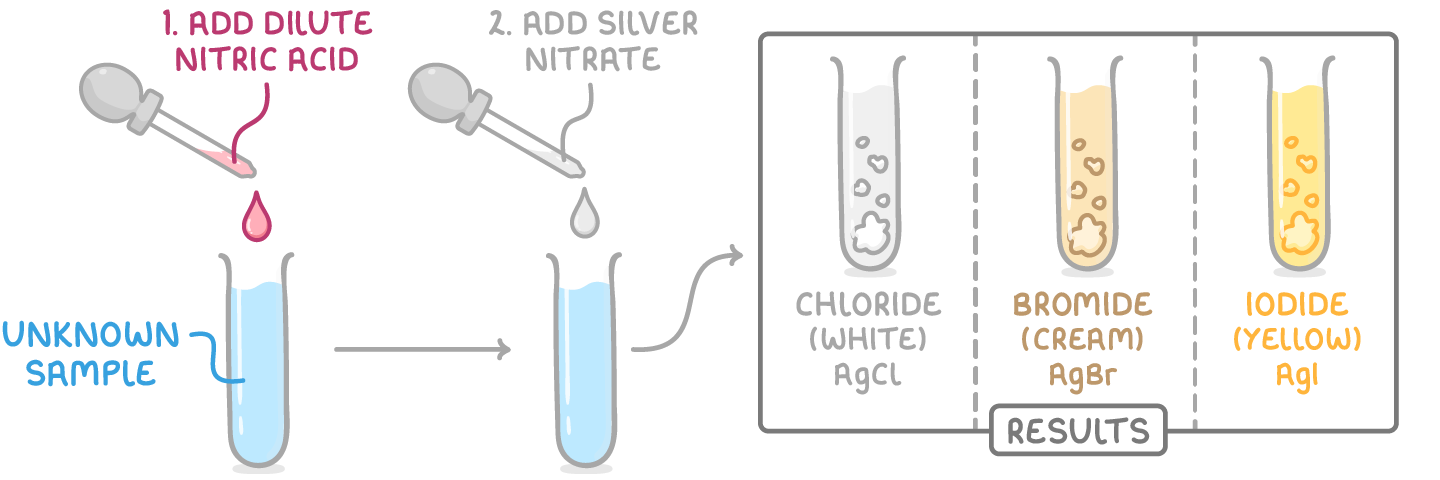
- Add dilute nitric acid - This reacts away any carbonate ions in the sample that would otherwise form a pale precipitate and give a false positive.
- Hydrochloric acid must not be used, as it contains chloride ions that would react with the silver nitrate.
- Add silver nitrate solution - Silver ions react with halide ions to form insoluble silver halides.
Results
- Chloride (Cl-) - Forms a white precipitate (silver chloride, AgCl).
- Bromide (Br-) - Forms a cream precipitate (silver bromide, AgBr).
- Iodide (I-) - Forms a yellow precipitate (silver iodide, AgI).
The test for sulfate ions
The sulfate ion, SO42-, is the negatively charged ion (the anion) in a sulfate.
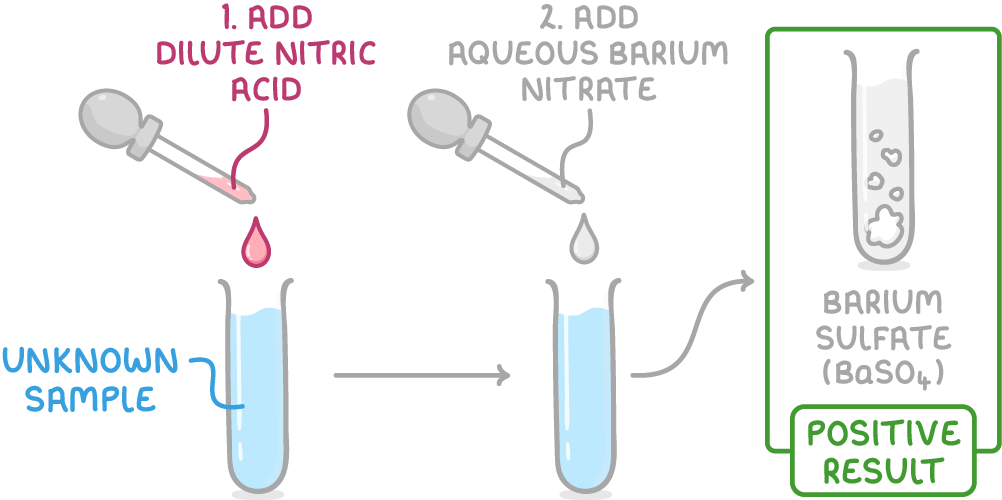
Step 1 - Acidify with dilute nitric acid
- Carbonate ions also form an insoluble white solid with barium ions; the acid reacts them away first to prevent a false positive.
- Sulfuric acid must not be used, as it adds sulfate ions and guarantees a false positive.
Step 2 - Add aqueous barium nitrate
Barium ions react with sulfate ions to form a white precipitate of insoluble barium sulfate.
A white precipitate is the positive result: the sample contains sulfate ions.
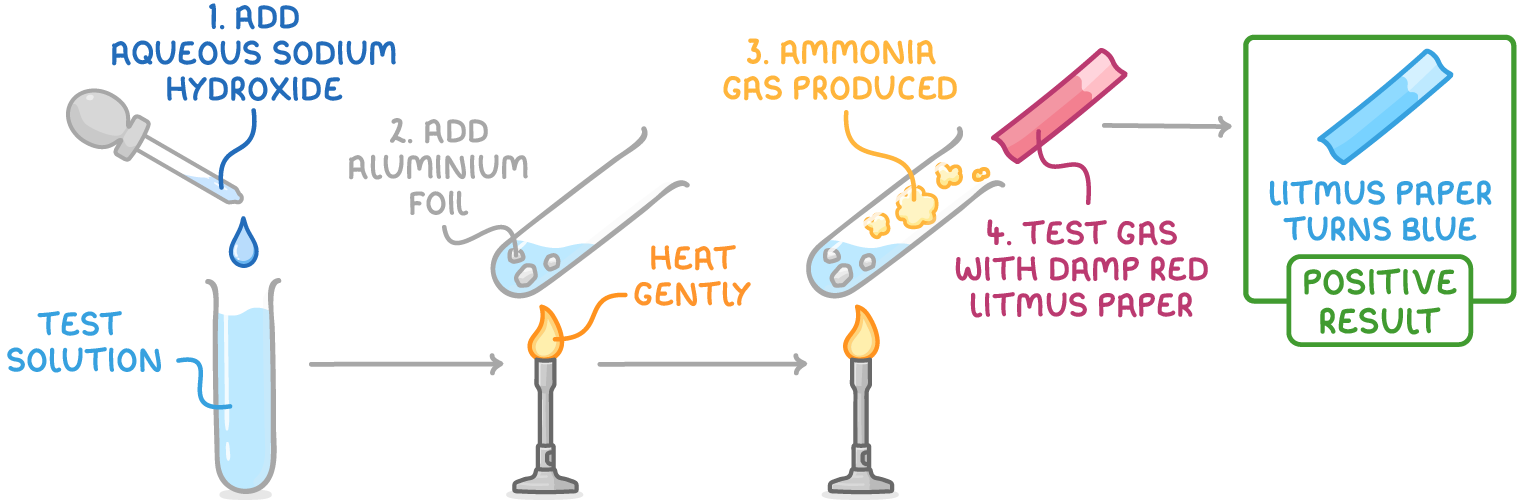
The test for nitrate ions
- The nitrate ion, NO3-, is a negatively charged ion (an anion).
- Because nitrate salts are soluble, nitrate ions are identified by reducing them to a gas rather than by precipitation.
Carrying out the test
- Add aqueous sodium hydroxide to the test solution.
- Add aluminium foil and warm the mixture gently.
- The aluminium reduces the nitrate ion, producing ammonia gas (NH3).
- Test the gas with damp red litmus paper.
Reading the result
- Ammonia dissolves in the water on the damp paper to form an alkaline solution, turning the red litmus blue.
- The paper must be damp - dry paper won't change colour because the gas needs moisture to form hydroxide ions.