8.2 - Group 1 - The Alkali Metals
The alkali metals and their trends
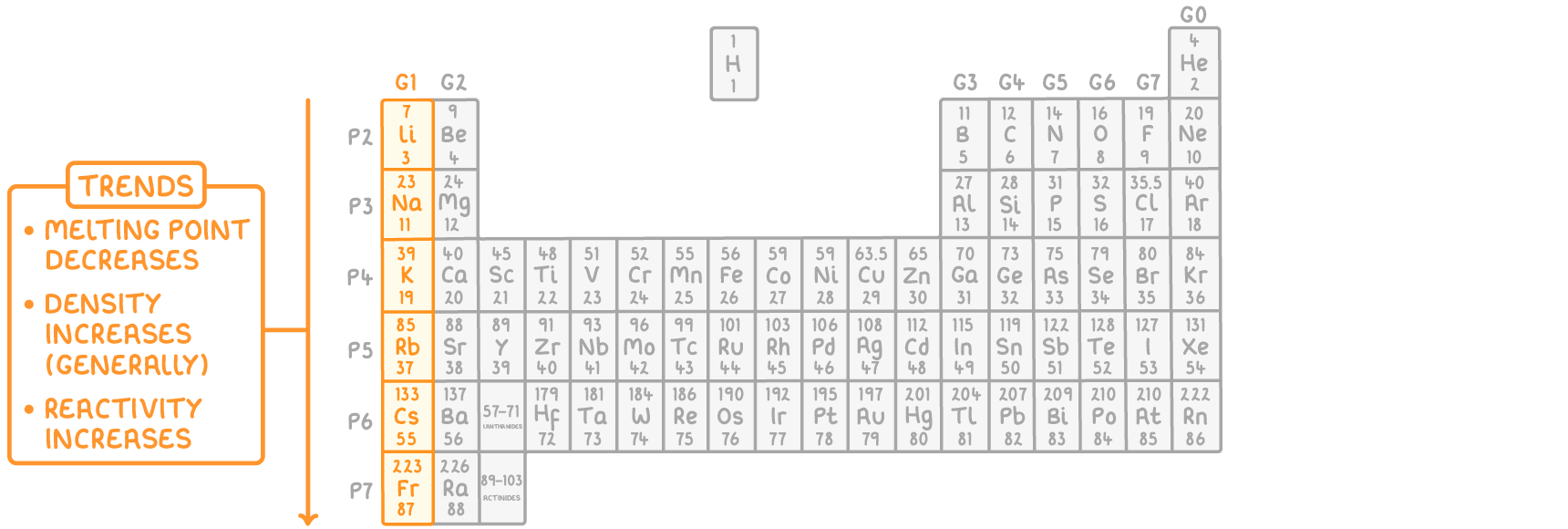
- The Group 1 elements are the metals in the first column of the periodic table: lithium, sodium, potassium, rubidium, caesium and francium.
- They are known as the alkali metals.
- Every atom has a single electron in its outer shell, which is why the whole group behaves in a similar way.
Physical properties
- Soft - Can be cut with a knife, exposing a shiny surface.
- Low density - Lithium, sodium and potassium are less dense than water, so they float.
Trends down the group
- Melting point decreases - Lithium melts at 180 °C, sodium at 98 °C and potassium at 63 °C.
- Density generally increases - The metals get denser going down the group (although potassium is slightly less dense than sodium).
- Reactivity increases - Lithium is the least reactive of the common alkali metals, and reactivity increases down the group to francium, the most reactive.
Predicting behaviour
- An element's properties can be predicted from the trends in the group.
- Given the melting points of lithium, sodium and potassium, rubidium can be predicted to have a melting point lower than potassium's (it melts at 39 °C).
- Rubidium and caesium sit below potassium, so their reactions are more violent: both react explosively with water, and caesium catches fire in air at room temperature.
TermDefinition
Alkali metalsThe metals in Group 1 of the periodic table, which each have one electron in their outer shell.