Acids & Bases - exam practice
Acids & Bases
Question 1 of 9
A scientist works in a lab that tests samples of vinegar.
Vinegar is mainly a mixture of ethanoic acid and water.
Vinegar needs to have a minimum of 5% acidity in order to be used to preserve food.
Calculate how much ethanoic acid needs to be in 25 cm3 of vinegar in order for it to be used to preserve food.
Use the equation:
Note that the mass of 1 cm3 of vinegar is 1.01 g.
The scientist uses a titration to find out how much 1 mol/dm3 sodium hydroxide she needs to add to exactly react with 25.0 cm3 of vinegar.
The equation below shows ethanoic acid behaving as an acid.
CH3COOH ⇌ CH3COO– + H+
Calculate the minimum volume of sodium hydroxide the scientist uses in her titration.
The relative formula mass of CH3COOH is 60.0.
A student tests three different pH meters to find out which pH meter gives the most accurate pH readings.
She prepares five solutions, A to E, with different concentrations of hydrogen ions, H+.
She dips the pH meters into each solution and takes a reading.
The table below shows the student's results.
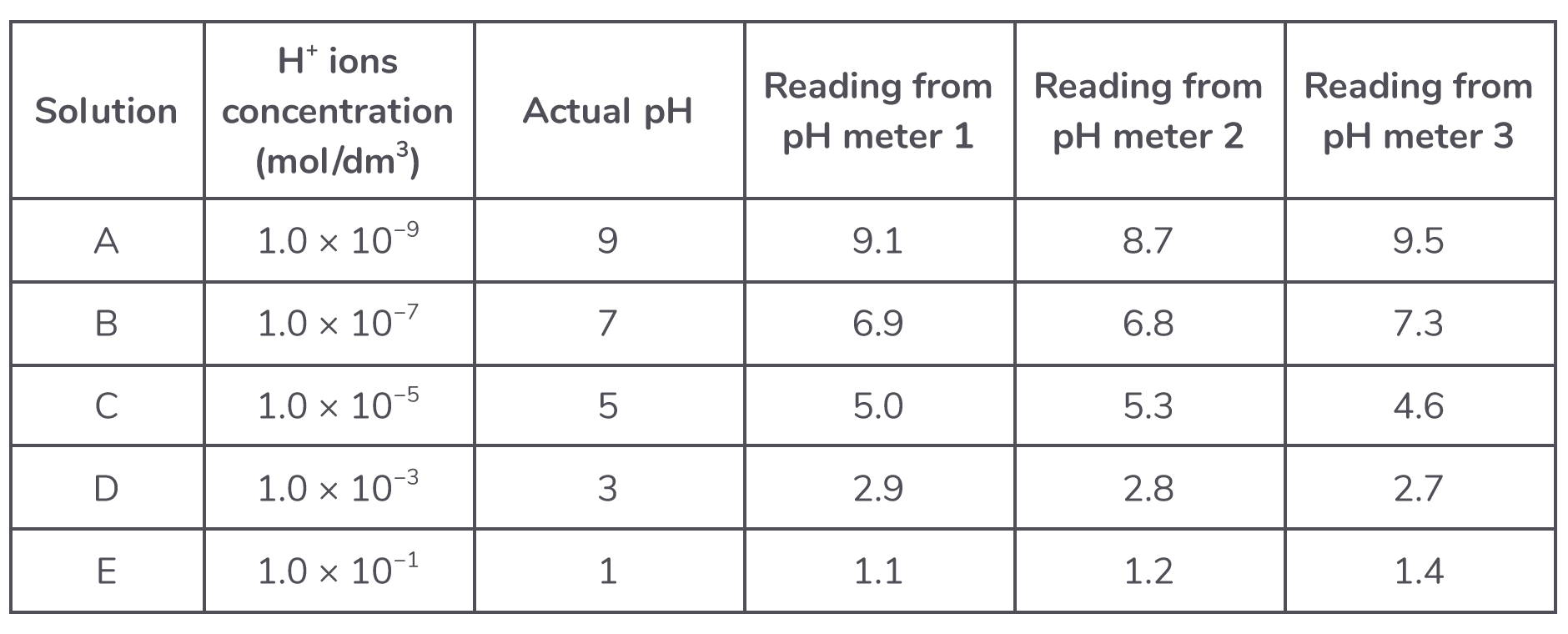
Give one letter, A to E, that corresponds to:
- an acidic solution
- a neutral solution
- an alkaline solution
Predict the pH of a solution with a concentration of 1.0 × 10⁻⁴ mol/dm3 of hydrogen ions.
What is the trend in the relationship between concentration of hydrogen ions and pH?
Which of the statements below best describes a concentrated acid?
Which of the statements below best describes a strong alkali?
What conclusions can you make about the relative accuracy of each pH meter?
Explain each conclusion.
A student does a titration to find the volume of sulfuric acid that reacts with 25 cm3 of potassium hydroxide solution.
The image below shows the equipment used.

25 cm3 of potassium hydroxide solution is measured with the measuring cylinder.
Which piece of equipment could the student use to measure the 25 cm3 more accurately?
Which of the following ions does sulfuric acid produce in aqueous solution?
Universal indicator turns purple in potassium hydroxide solution.
What is the pH of the solution?
Describe how the student would use the equipment in the image to complete the titration.
The higher the concentration of a sample of dilute acid, the greater the volume of alkali needed to neutralise the acid.
The student tested two samples of the same dilute acid, A and B.
Describe how the student could use titrations to find which sample, A or B, is more concentrated.
Lead nitrate is a salt.
A student produces lead nitrate using an acid and a base.
Which acid should the student use to produce lead nitrate?
Which of the the following is a base the student could use to produce lead nitrate?
Lead nitrate solution mixed with sodium sulfate solution forms lead sulfate as a precipitate.
Pb(NO3)2 + Na2SO4 ➔ PbSO4 + 2NaNO3
The method used to make the lead sulfate is:
- Pour 100 cm3 lead nitrate solution into a beaker.
- Add drops of sodium sulfate solution until a precipitate is seen.
- Allow the precipitate to settle to the bottom of the beaker.
- Pour off the liquid.
- Use a spatula to transfer the solid lead sulfate onto a filter paper.
State and explain two ways of improving this experimental method in order to increase the amount and quality of lead sulfate that could be obtained from 100 cm3 of lead nitrate solution.
Ammonium nitrate and potassium chloride are both salts.
They can be made by neutralisation reactions.
Complete the word equations below.
ammonia + ➔ ammonium nitrate + water
potassium hydroxide + hydrochloric acid → potassium chloride +
A student dissolved some crystals of an unknown salt in water.
The student added sodium hydroxide solution to the salt solution until it was in excess.
Describe what the student would see if the salt contained calcium ions.
Would the result predicted in part a) prove that the salt contains calcium ions?
Explain your answer.
Describe an additional test the student could do that would prove the salt contains calcium ions.
A student investigates the solubility and pH of metal oxides and non-metal oxides in water.
The table shows the student’s results.
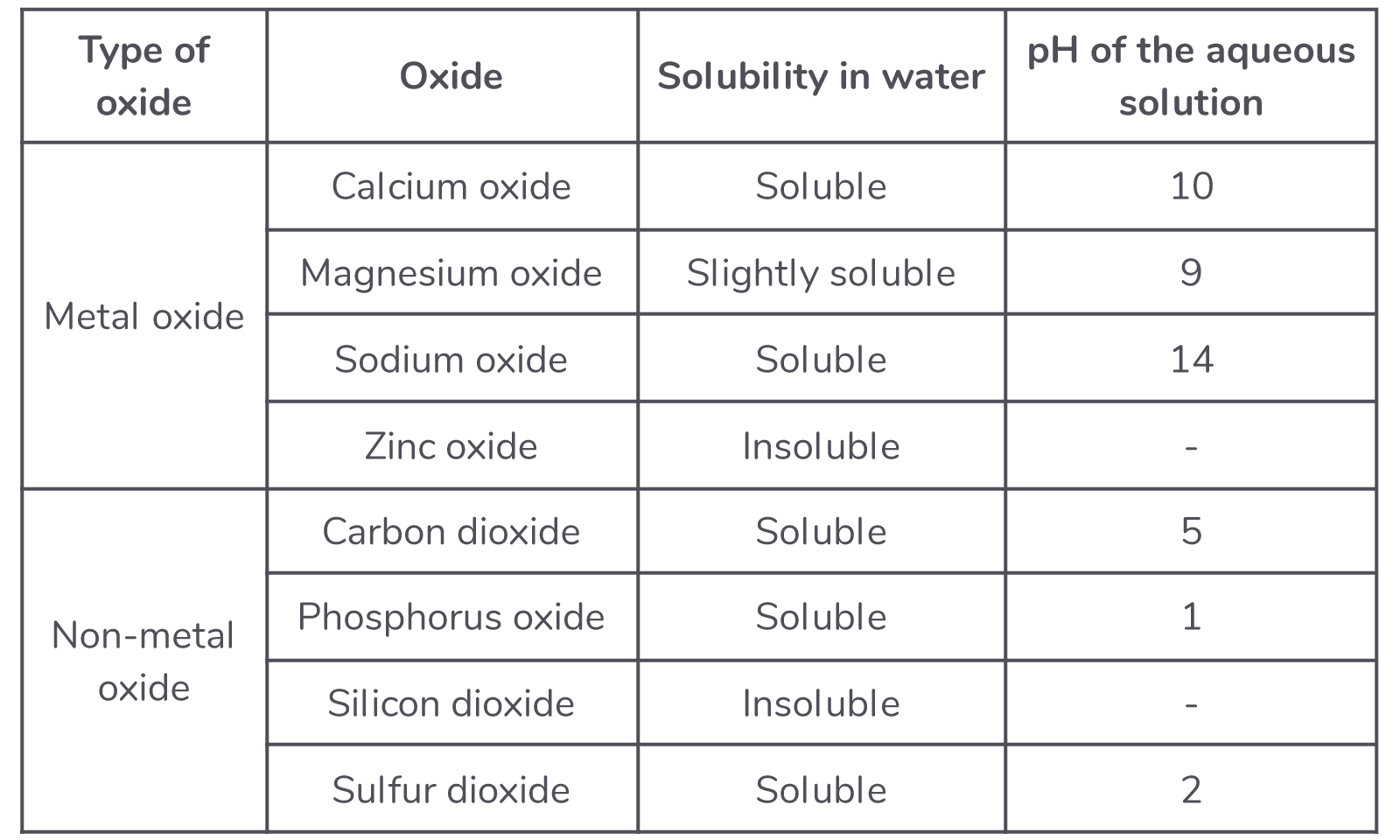
The student concluded that:
- metal oxides produce alkaline solutions
- non-metal oxides produce acidic solutions
Use information from the table above to explain why the student’s conclusions are only partly correct.
Give an improved conclusion for metal oxides.
A student makes crystals of magnesium sulfate using the method below:
- Add sulfuric acid to a beaker.
- Warm the sulfuric acid.
- Add a spatula of magnesium oxide to the beaker.
- Stir the mixture.
- Repeat steps 3 and 4 until there is magnesium oxide remaining in the beaker.
- Filter the mixture.
- Evaporate the filtrate gently until crystals start to form.
- Leave the solution to finish crystallising.
Give one reason for each of the following steps:
- step 2
- step 5
- step 6
Which method should the student use to evaporate the filtrate gently in step 7?
A student carries out a titration to find out the concentration of a phosphoric acid solution.
She reacts sodium hydroxide with the phosphoric acid solution.
The student states that ‘the titration uses a neutralisation reaction’.
Define a neutralisation reaction.
Which equation represents neutralisation?
This is the student’s incomplete method for the titration:
- Put the sodium hydroxide in a burette.
- Put the phosphoric acid solution in a flask.
- Add the sodium hydroxide to the phosphoric acid solution.
- Stop adding the sodium hydroxide when the phosphoric acid solution is neutralised.
The student needs to add another substance to the flask so that she knows when to stop adding the sodium hydroxide.
Which substance does the student need to add, and what will she observe?
The student wants to make sure her final burette reading is as accurate as possible.
Describe one way in which the student can make her reading as accurate as possible.
The student’s repeat readings for her titrations are shown in the table below.
The student calculates that the mean titration volume is 20.05 cm3.
Explain why the student is correct.
Use the information in the table and a calculation in your answer.

Phosphoric acid contains phosphate ions, PO43−.
Phosphoric acid is completely neutralised by sodium hydroxide.
What is the formula of the salt that is made?
The apparatus in the image below can be used in a method to find the volume of hydrochloric acid required to neutralise a solution of sodium hydroxide.

What is the name given to the method shown in the image above?
Give the symbol equation for the reaction.
A student carries out the experiment.
His burette readings are shown in the diagram.
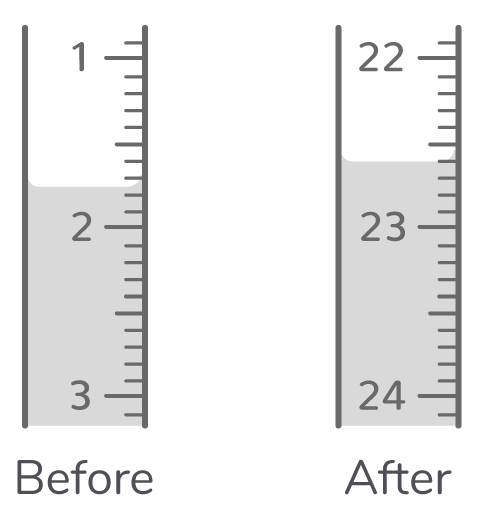
Use the diagram to give the burette readings to the nearest 0.05 cm3.
Give the:
- burette reading before adding the acid
- burette reading after adding the acid
- volume of acid added, in cm3
Calculate the concentration of the hydrochloric acid used.
Give your answer to 2 significant figures.