Groups 1, 7 & 0 - exam practice
Groups 1, 7 & 0
Question 1 of 5
Potassium (K) is an element in group 1 of the periodic table.
Why do group 1 elements have similar chemical properties?
The atomic number of potassium is 19.
Give the electronic structure of a potassium atom.
Write down the balanced symbol equation for the reaction of potassium with water.
State the trend in reactivity of the group 1 elements.
Halogens are elements in group 7 of the periodic table.
Chlorine, bromine and iodine are halogens.
A student investigated the reactivity of halogens by carrying out displacement reactions.
Explain how you would carry out displacement reactions to investigate the relative reactivity of chlorine, bromine and iodine.
The student recorded his results in the table below.
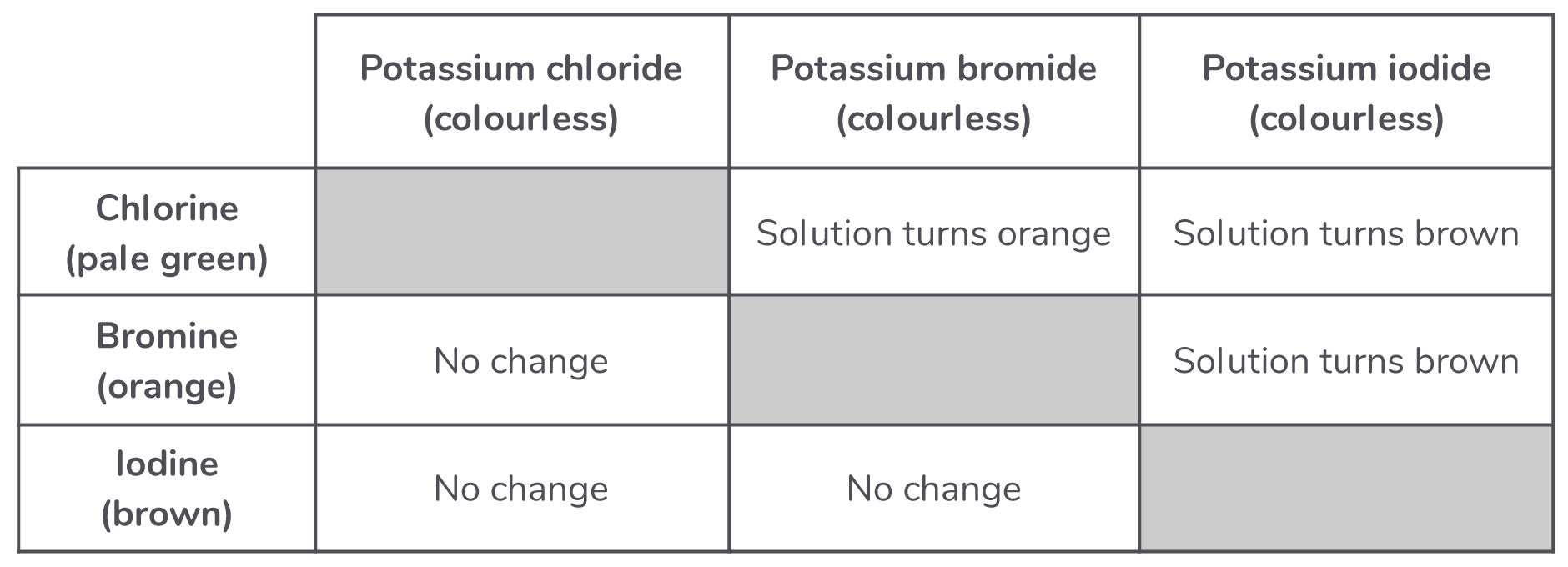
Balance the symbol equation for the reaction of aqueous chlorine and potassium iodide solution.
Cl2(aq) + KI(aq) → I2(aq) + KCl(aq)
Explain how the reactivity of halogens changes going down group 7.
Use the results in the table above in your answer.
A scientist recorded the observations she made when she reacted lithium, potassium and rubidium with water.
The scientist's observations are shown in the table below.
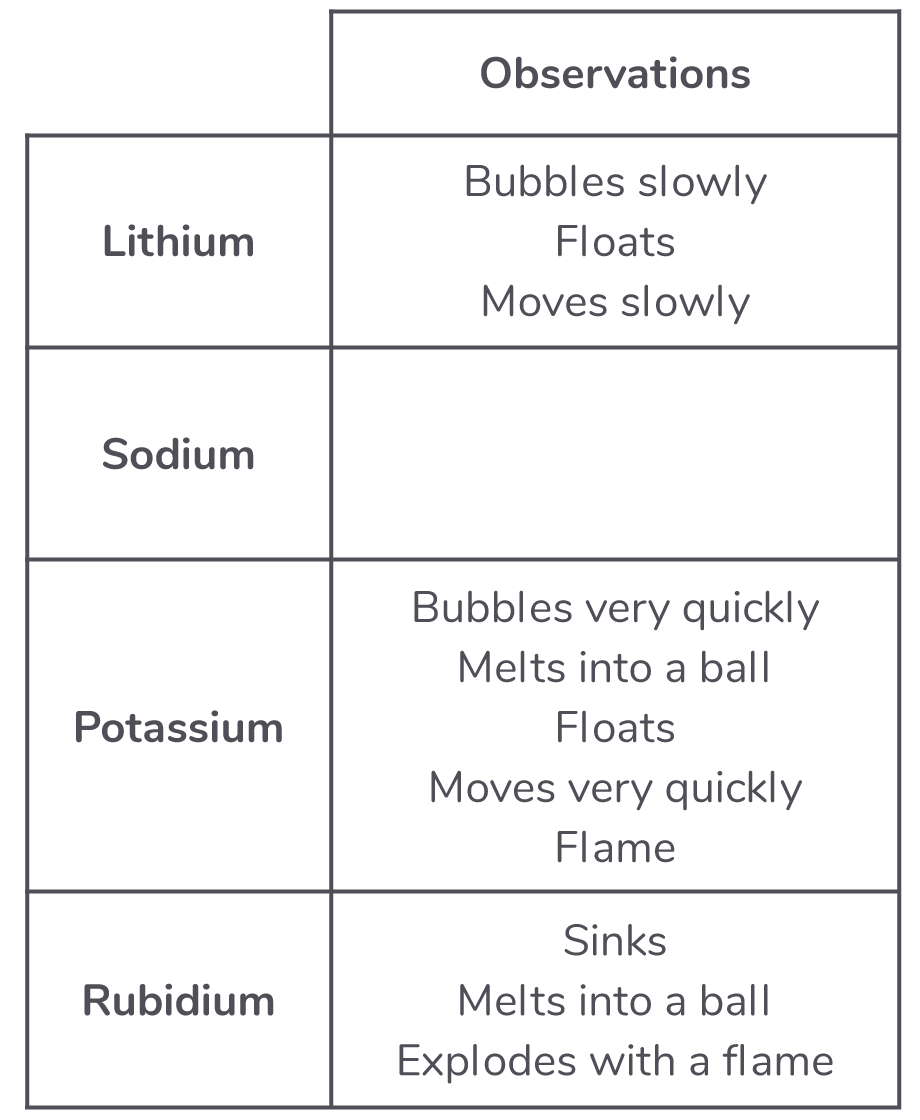
Give two observations you could make when sodium reacts with water.
The scientist concluded that, for group 1 elements, reactivity increases down the group.
Give two ways in which the scientist's observations support her conclusion.
Write and balance the equation for the reaction of rubidium with water.
Explain why rubidium is more reactive than potassium.
The image below shows some of the elements in the periodic table.
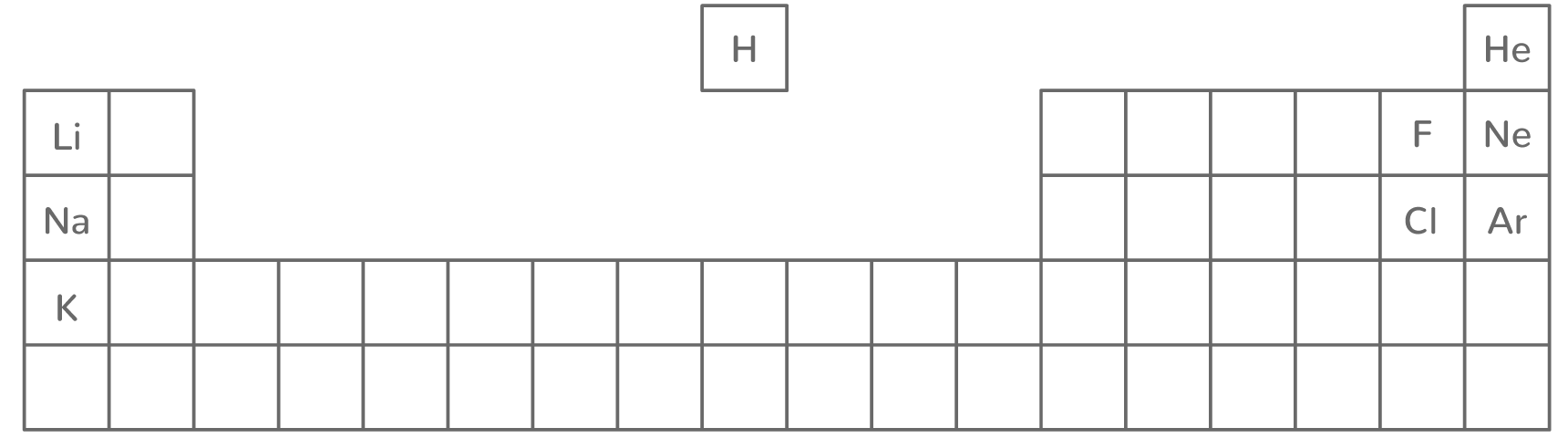
Give the chemical symbol for one of the noble gases.
Which of these statements about the noble gases is correct?
Explain why noble gases are monatomic.
Group 1 metals burn vigorously when heated and placed in a gas jar of oxygen.
Give the word equation for the reaction of sodium with oxygen.
What is the name of the type of chemical reaction that occurs when group 1 metals react with oxygen?
A scientist dissolves the product of the reaction above in water.
The solution contains a substance with the formula NaOH.
What is the name of the substance with the formula NaOH?
Predict the pH value of the solution.