
Chemistry
Free one-page printable revision notes covering IGCSE Chemistry. Each sheet brings the key ideas from one topic together on a single page. View any sheet online, or download and print it for your wall.
Bonding and structure
Ionic, Covalent & Metallic Bonding
Ionic, covalent and metallic bonding, dot-and-cross diagrams, properties and how bonding type affects melting point and conductivity.
States of Matter & the Particle Model
The three states of matter, particle arrangements and forces, changing state, energy changes during melting and boiling, and state symbols in equations.


Atomic structure
Atomic Structure & Electron Shells
Atoms, elements, compounds, isotopes, relative atomic mass and electron shell rules for GCSE Chemistry.
The Periodic Table
Groups, periods, trends in reactivity, noble gases and how the periodic table is organised.


Chemical changes
Acids, Bases & Titration
pH scale, acid-alkali neutralisation, strong vs weak acids, acid reactions and salt naming, and the titration method with concordant titres.
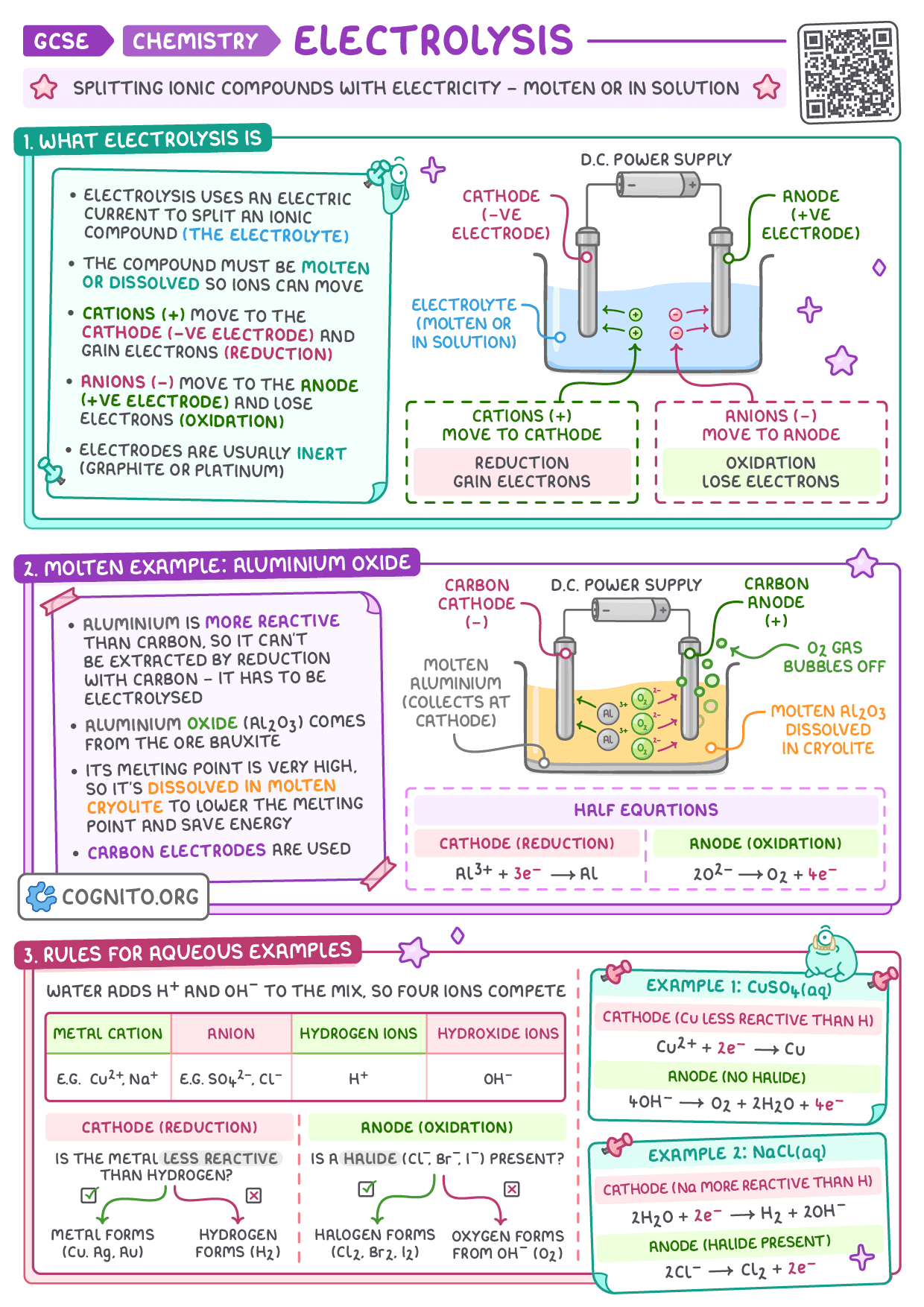
Electrolysis
Splitting ionic compounds using electricity - what electrolysis is, the molten aluminium oxide example, and rules for aqueous solutions.

Energy changes
Energy Changes
Exothermic vs endothermic reactions, reaction profiles with activation energy, and bond energy calculations including worked examples.

Organic chemistry
Alkanes, Alkenes & Alcohols
Naming rules, alkane and alkene structures, alcohols, carboxylic acids and esters - functional groups, reactions, general formulae and the first four members of each family.
Addition & Condensation Polymers
Addition and condensation polymerisation, polyesters and polypeptides with worked equations, examples of common polymers, and disposal issues.
Crude Oil, Fractions & Combustion
Hydrocarbons and alkanes, fractional distillation column, cracking long-chain alkanes, complete and incomplete combustion, and atmospheric pollutants.


Rate and extent of chemical change
Rate of Reaction
What rate of reaction means, how to measure and calculate it, collision theory, the four factors that affect rate, and how catalysts work.
Reversible Reactions & Equilibrium
Reversible reactions, dynamic equilibrium, Le Chatelier's principle and how temperature, pressure and concentration shift equilibrium.


Chemical analysis
Chemical Tests
Gas tests, flame tests, cation tests with NaOH, and anion tests for halides, sulfates, nitrates and carbonates.
Separation Techniques
Filtration, crystallisation, simple and fractional distillation, and paper chromatography - methods, apparatus, and when to use each technique.

