11.1 - Hydrocarbons & Homologous Series
Hydrocarbons and homologous series
- Organic chemistry is the chemistry of compounds that contain carbon.
- A hydrocarbon is a compound made up of hydrogen and carbon only.
- Methane (CH4) is a hydrocarbon. Ethanol is not, because it contains oxygen.
Why there are so many carbon compounds
- A carbon atom forms four covalent bonds, and it bonds readily to other carbon atoms.
- Carbon atoms join end to end into chains (short or long) and into rings.
- Each carbon uses its remaining bonds to join to hydrogen atoms or atoms of other elements.
Homologous series
- A homologous series is a family of similar compounds.
- Members of the same homologous series share:
- The same general formula.
- Each member differs from the next by a CH2 unit.
- A gradual change in physical properties (melting and boiling points rise as molecules get bigger, because larger molecules have stronger intermolecular forces).
- Similar chemical properties (they react in similar ways).
The alkanes
- Alkanes are the simplest homologous series of hydrocarbons.
- Every carbon-carbon bond is a single bond, and all other bonds are to hydrogen atoms.
- An alkane holds as many hydrogen atoms as its carbon framework can, making it saturated.
The first four alkanes
| Name | Number of carbon atoms | Molecular formula |
|---|---|---|
| Methane | 1 | CH4 |
| Ethane | 2 | C2H6 |
| Propane | 3 | C3H8 |
| Butane | 4 | C4H10 |
Each alkane has one more carbon atom and two more hydrogen atoms than the one before it (the CH2 step).
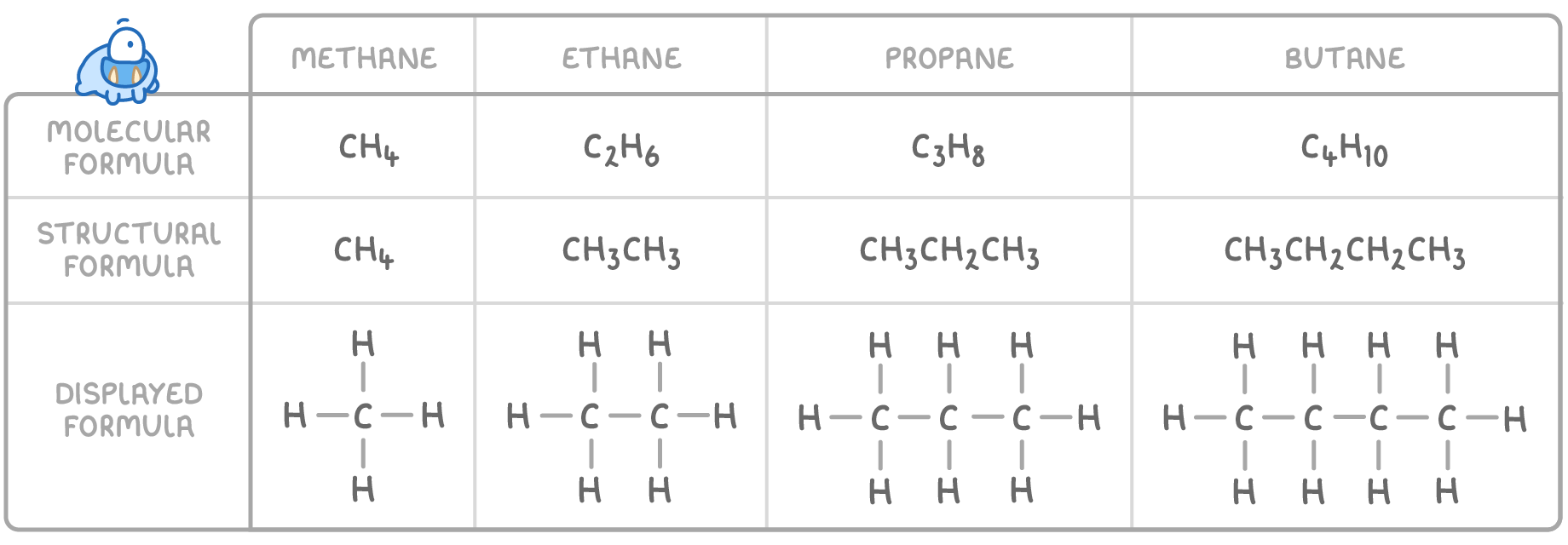
Ways to write an alkane
- Molecular formula - Shows the actual number of atoms of each element in a molecule (e.g. propane is C3H8).
- Structural formula - Shows the arrangement of atoms along the chain without drawing every bond (e.g. propane is CH3CH2CH3).
- Displayed formula - Shows every atom and every covalent bond as a line.
When drawing a displayed formula, check that every carbon atom has four bonds and every hydrogen atom has one.
Recognising an alkane
- A name ending in -ane.
- A structure containing only carbon and hydrogen with single C-C bonds only.
The alkenes
- Alkenes are hydrocarbons that contain a carbon-carbon double bond (C=C).
- Every other bond in the molecule is a single bond.
- The double bond is the alkenes' functional group.
Why alkenes are unsaturated
- Because two bonds are shared between two carbons in the C=C double bond, each of those carbons has one fewer bond available for hydrogen.
- An alkene therefore has two fewer hydrogen atoms than the alkane with the same number of carbons (e.g. ethane is C2H6; ethene is C2H4).
- Compounds containing double bonds that could hold more hydrogen atoms are unsaturated.
The first three alkenes
| Name | Number of carbon atoms | Molecular formula |
|---|---|---|
| Ethene | 2 | C2H4 |
| Propene | 3 | C3H6 |
| Butene | 4 | C4H8 |
There is no alkene with one carbon atom, because a C=C double bond requires at least two carbons.
Two forms of butene
- With an unbranched chain of four carbon atoms, butene (C4H8) exists in two structural forms:
- In but-1-ene, the double bond is between the first and second carbons.
- In but-2-ene, the double bond is between the second and third carbons.
- The number indicates the position of the double bond, counting from the end that gives the lowest number.

Recognising an alkene
- A name ending in -ene.
- A structure containing a carbon-carbon double bond (C=C).
TermDefinition
Hydrocarbon
Homologous series
Saturated
Functional group
Unsaturated