6.4 - Redox
Oxidation and reduction as oxygen transfer
- Oxidation is the gain of oxygen by a substance.
- Reduction is the loss of oxygen from a substance.
Examples
- When magnesium burns in oxygen to form magnesium oxide, the magnesium gains oxygen, so it has been oxidised:
- 2Mg + O2 → 2MgO
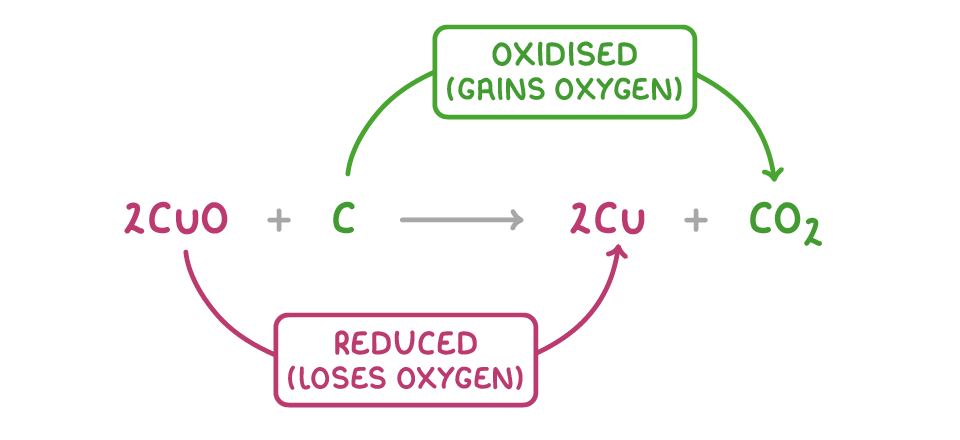
- When copper(II) oxide reacts with carbon, the copper(II) oxide loses oxygen and is reduced, while the carbon gains oxygen and is oxidised:
- 2CuO + C → 2Cu + CO2
- A reaction where oxidation and reduction happen together is a redox reaction.
Following hydrogen instead
- Losing hydrogen is oxidation, gaining hydrogen is reduction.
- When hydrogen and chlorine react, the chlorine gains hydrogen, so it has been reduced:
- H2 + Cl2 → 2HCl
Oxidising and reducing agents
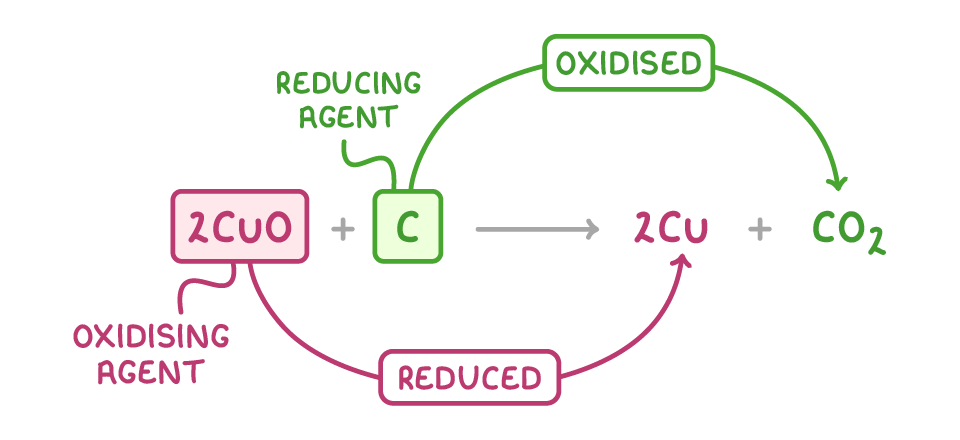
- Oxidising agent - A substance that oxidises another substance, and is itself reduced.
- Reducing agent - A substance that reduces another substance, and is itself oxidised.
- In summary:
- The substance that is reduced is the oxidising agent.
- The substance that is oxidised is the reducing agent.
Worked example - Copper(II) oxide and carbon
2CuO + C → 2Cu + CO2
- Copper(II) oxide loses oxygen, so it is reduced; the carbon took its oxygen away, so carbon is the reducing agent.
- Carbon gains oxygen, so it is oxidised; the copper(II) oxide supplied that oxygen, so copper(II) oxide is the oxidising agent.
Testing for oxidising and reducing agents
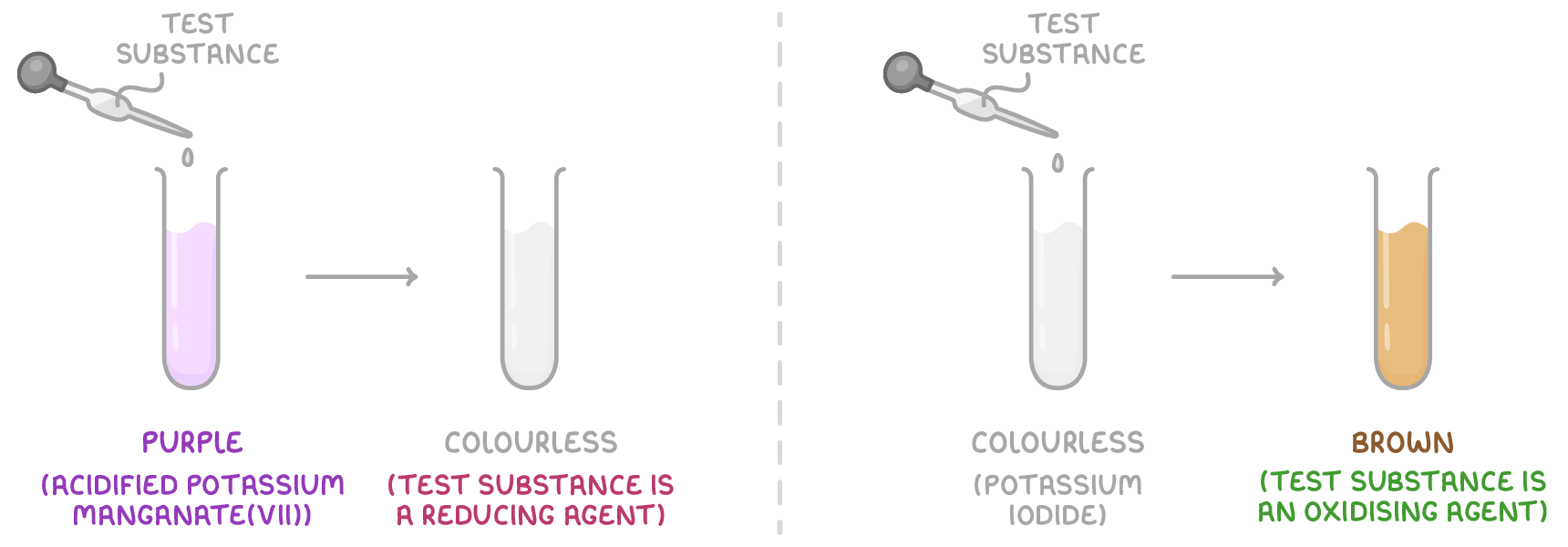
- Acidified aqueous potassium manganate(VII) is an oxidising agent (starts purple). If it turns colourless, it has been reduced, showing that the tested substance is a reducing agent.
- Aqueous potassium iodide is a reducing agent (starts colourless). If it turns brown, iodine has formed and the iodide has been oxidised, showing that the tested substance is an oxidising agent.
- A colour change in either test confirms that a redox reaction has occurred.
The Roman numeral in a name
- A Roman numeral in a compound's name gives the oxidation number of the element it follows. For a simple metal ion this is the same as the charge on the ion, so iron is +3 in iron(III) oxide and +2 in iron(II) oxide.
- Oxidation is an increase in oxidation number, and reduction is a decrease in it. An iron atom (0) that becomes an Fe2+ ion (+2) has been oxidised, and an Fe3+ ion that becomes an Fe2+ ion has been reduced.
TermDefinition
Oxidation
Redox reaction
Reduction
Oxidising agent
Reducing agent
Oxidation number