3.3 - Conservation of Mass
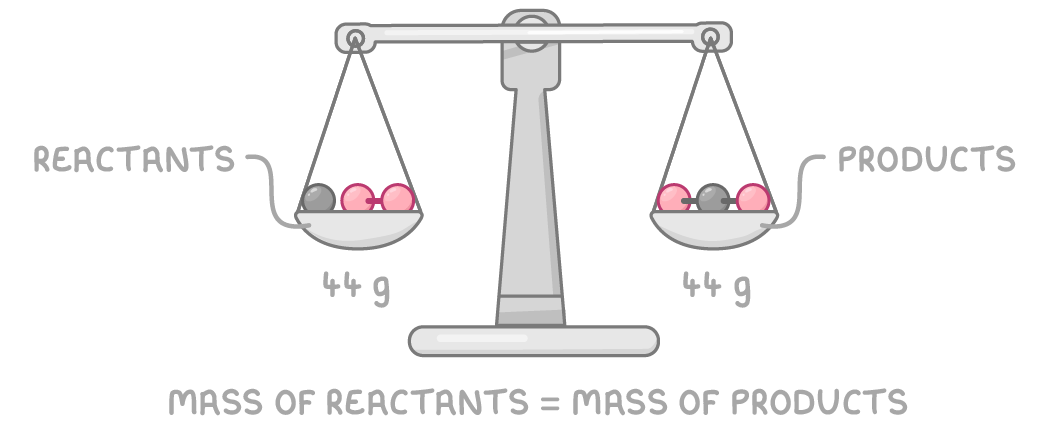
The law of conservation of mass
- In any chemical reaction, the total mass of the products equals the total mass of the reactants.
- This is the law of conservation of mass, and it holds for every reaction.
- No atoms are created or destroyed; they're only rearranged into new substances. Because every starting atom is present in the products, total mass cannot change.
Calculating an unknown mass
- Conservation of mass lets you calculate a missing mass by arithmetic.
- If 12 g of carbon reacts completely with 32 g of oxygen, the mass of carbon dioxide produced must be 12 + 32 = 44 g.
Demonstrating conservation in a closed system
- A closed system is a sealed container that no substances can enter or leave.
- When a precipitation reaction is carried out in a closed flask on a balance, an insoluble solid (precipitate) forms, but the mass reading on the balance does not change:
- CuSO4(aq) + 2NaOH(aq) → Cu(OH)2(s) + Na2SO4(aq)
TermDefinition
Law of conservation of mass
Closed system
Precipitate